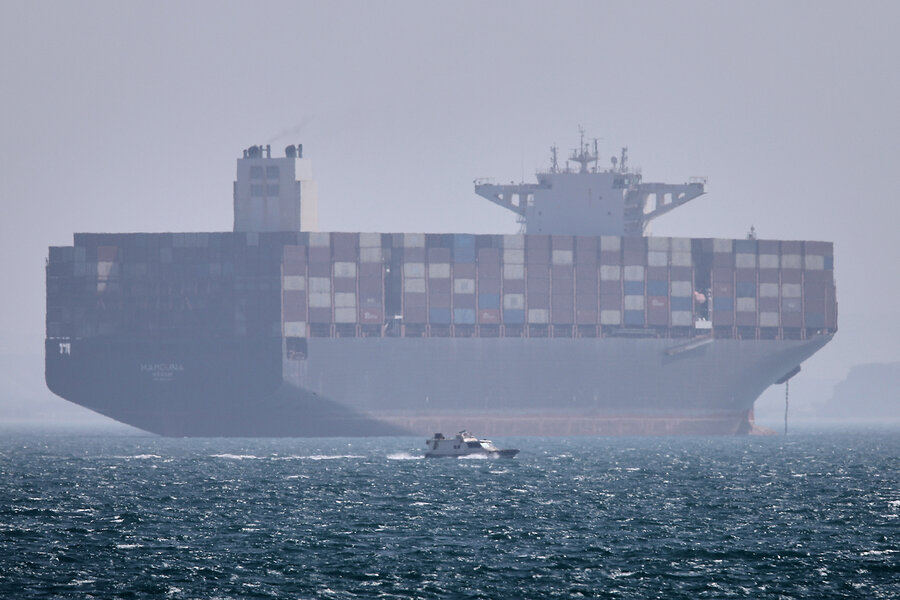
The U.S. military is attempting to guide commercial ships through the Strait of Hormuz.
The vital shipping lane has been almost entirely closed to cargo ships since Iran imposed a blockade in early March, shortly after the United States and Israel began attacking Iran. The closure has left more than 1,500 commercial ships – and at least 20,000 sailors – stranded near the narrow waterway of the Persian Gulf.
On Sunday, President Donald Trump said the U.S. would “restore freedom of navigation for commercial shipping.” He posted on social media that the mission would take effect Monday and would help “guide” ships safely out of the strait.
Why We Wrote This
As the global economy feels the impact from a disruption of shipping in the Strait of Hormuz, both the United States and Iran claim they control the waterway. America’s efforts to open the lanes, coming amid the Iran war, are meeting steep challenges.
“The goal here is pretty simple: establish a zone of transit that is protected by a bubble of the United States, both naval and air assets,” Secretary of State Marco Rubio told reporters on Tuesday.
But by Tuesday afternoon, only a few vessels had managed to move through the strait.
U.S. officials say Iran has launched several attacks against American ships, but that all of them were unsuccessful. Defense Secretary Pete Hegseth said at a briefing on Tuesday that a ceasefire between the countries was still in place, though Iran has accused the U.S. of breaching the truce.
This is not the first U.S. military operation aimed at protecting international shipping. The current effort differs from previous interventions, however, because it originates from Mr. Trump’s decision to go to war.
“The U.S. is trying to get back to the situation that existed before we launched this escapade,” says Eugene Gholz, a professor of political science at the University of Notre Dame. “We’re not trying to gain. We’re trying to undo a loss.”
What is the U.S. attempting to do with Project Freedom?
Mr. Trump has described U.S. military operations in the Persian Gulf as “a Humanitarian gesture.” He has talked also about imposing a “blockade” against Iranian shipping, and said any interference would be dealt with “forcefully.”
The president did not provide details in his Sunday announcement about what it would look like practically for the U.S. to guide ships through the Strait of Hormuz. U.S. Central Command said in a statement that U.S. military forces involved would include more than 100 land- and sea-based aircraft, 15,000 service members, and U.S. missile-guided destroyers.
On Monday, Central Command said U.S. protection helped a total of two commercial ships to successfully pass through the strait.
It is unclear how long the ceasefire with Iran reached on April 8 can hold. U.S. officials say the military shot down several Iranian missiles and drones on Monday and sank seven Iranian speedboats that were “threatening commercial shipping.”
Mr. Hegseth added on Tuesday that the current U.S. operations in the strait would be temporary, and that other nations would soon need to take over the responsibility of maritime security. However, Mr. Rubio said later that “the primary responsibility for this Project Freedom is on the United States,” and that the U.S. would “systematically” continue efforts to clear the passageway.
What’s the Iranian response so far?
Iran says the Strait of Hormuz remains fully under its control.
“Project Freedom is Project Deadlock,” Iranian Foreign Minister Abbas Araghchi wrote in a social media post. “The U.S. should be wary of being dragged back into [a] quagmire by ill-wishers.”
On Monday, Iranian officials accused the U.S. military of jeopardizing shipping security in the strait. Throughout the war, Iran has maintained that all vessels need permission from Iran before crossing through those waters. And it reiterated that warning on Monday, as the U.S. Navy began carrying out new orders from the president.
“Iranians interpreted this as a threat, as a U.S. escalation, and they responded,” says Dr. Gholz.
How unprecedented is the latest U.S. intervention in the Strait of Hormuz?
The U.S. military has been operating in the Strait of Hormuz for many years, but its current operations are a departure from the recent past.
The Iran-Iraq War began in 1980 and went on for nearly a decade. Both countries carried out a series of attacks against merchant vessels traveling through the Strait of Hormuz and other parts of the Persian Gulf, in an effort to inflict economic harm on each other.
This aspect of the conflict came to be known as the Tanker War, and it led to a 25% drop in commercial shipping in the region, according to the U.S. Naval Institute.
U.S. involvement grew in 1986, after the Kuwaiti government sought international protection for its oil tankers in Gulf waters. Kuwait approached both Washington and Moscow. After the Soviets showed interest in getting involved, U.S. President Ronald Reagan answered the call from Kuwait. And after negotiations, it was agreed that 11 Kuwaiti ships would sail under the American flag.
Over the next two years, the U.S. military expanded its operations in the Gulf, which included the destruction of two Iranian oil platforms, along with some of Iran’s crucial warships.
The U.S. also announced at the time that it would provide an escort upon request to all neutral vessels wanting to transit through the Strait of Hormuz. That is different from the current situation, with the U.S. offering protection to all commercial shipping, apart from Iran and its trading partners.
What’s at stake for the U.S.?
Before the start of the Iran war at the end of February, at least 130 cargo ships were safely passing through the strait each day, accounting for about 20% of the world’s oil and natural gas. That status quo was upended when U.S. and Israeli strikes began.
“If the U.S. succeeds, we will get what we already had,” says Dr. Gholz. “We could have had safe shipping in the Strait of Hormuz; we had it for a long time, and we decided we would put that at risk.”
The American public, and people worldwide, are already paying more at the pump for gas and diesel, meaning the Trump administration might feel the urgency to lower prices by opening the strait to oil and gas shipping. But the current U.S. military mission in the Strait of Hormuz also puts thousands of U.S. military personnel in harm’s way.
“The risk is not zero for U.S. military assets,” says Dr. Gholz.
Even if the current ceasefire holds, maintaining a military force of this size in the Middle East for any length of time does not come cheap. Operating costs such as fuel, maintenance, and combat pay for some 15,000 military personnel add up quickly.
On Monday, a fire broke out on a South Korea-owned ship in the region. President Trump urged the government in Seoul to respond by joining the U.S. military’s security mission in the Gulf. But the incident might have been a reminder to other commercial ships about the level of uncertainty that remains.
“Why sail today? You can just wait till next week. As long as there’s hope that it’s going to end next week, no one is willing to take much risk,” says Dr. Gholz.