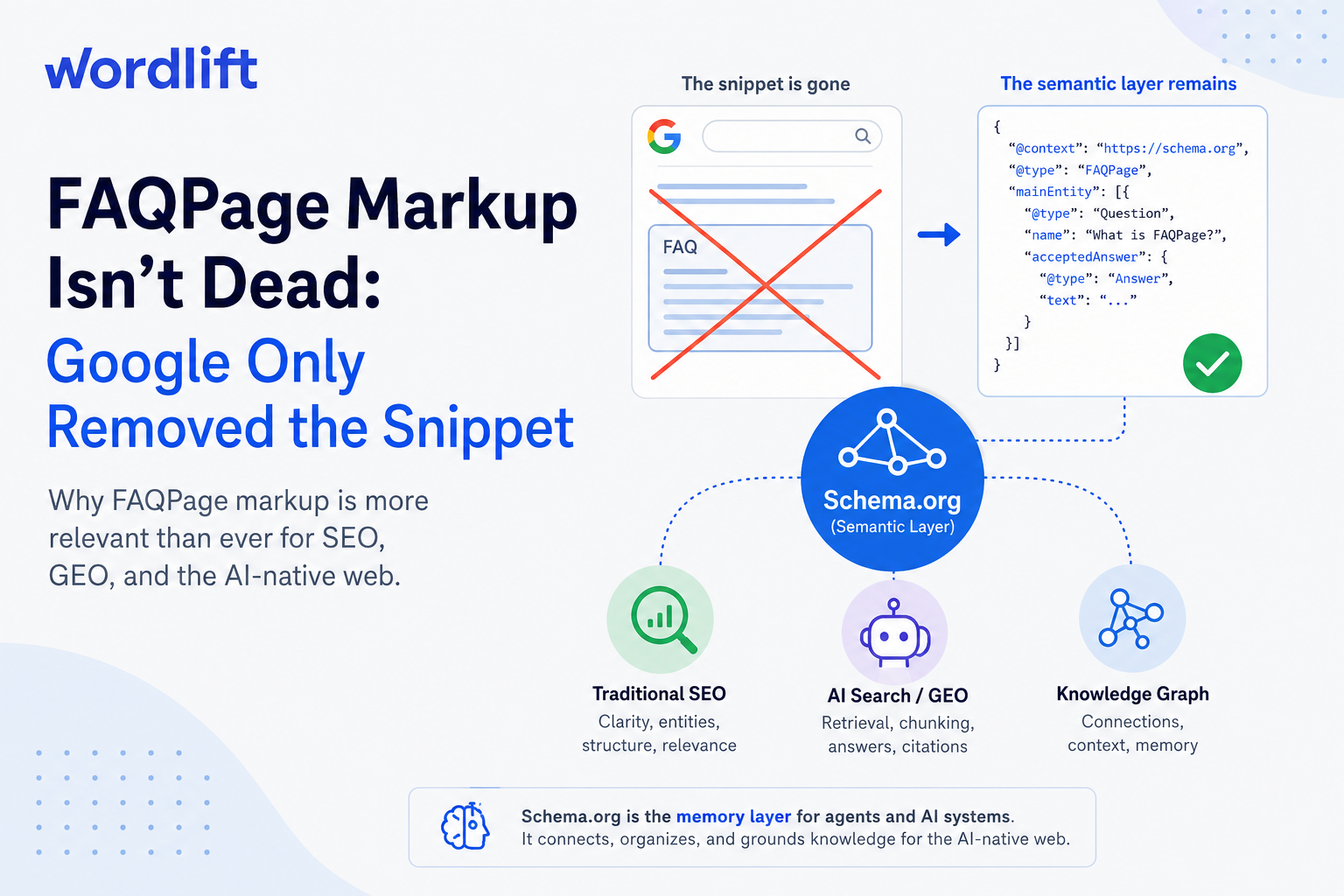
Since Google officially removed FAQ rich results in May 2026, many SEOs concluded that FAQPage markup no longer matters.
That interpretation misses the bigger picture.
FAQ rich snippets were only one application layer built on top of a broader semantic infrastructure. What disappeared was a visual SERP feature. What remains is the semantic layer underneath it.
This distinction matters even more now that search is evolving toward AI systems, retrieval pipelines, and machine-readable publishing.
The web is becoming increasingly agent-consumable, and structured meaning is more important than ever.
A Brief History of FAQPage Markup
When Google introduced FAQ rich results, the idea made perfect sense.
Web pages already contained question-and-answer sections. FAQPage markup allowed publishers to explicitly structure those relationships so search engines could:
- better understand the content,
- extract concise answers,
- improve SERP presentation,
- and potentially help users resolve questions faster.
At first, the results were impressive.
Pages expanded dramatically in the search results. CTRs improved. SEO plugins added one-click FAQ generators. Entire industries adopted FAQ markup almost overnight.
But something else happened too.
FAQPage quickly became one of the most overused forms of structured data on the web.
Publishers started adding bloated FAQ sections to almost every page imaginable:
- product pages,
- category pages,
- blog posts,
- landing pages,
- affiliate content,
- thin SEO pages.
Many FAQs were not written for users at all. They were written for SERP expansion.
The pattern became familiar:
a useful Google feature gets exploited at scale until the signal quality degrades.
The “Abuse It, Lose It” Warning
Long before the final shutdown, Lily Ray and other experienced SEOs warned that FAQ rich results were heading toward abuse saturation.
The unofficial rule of modern search features became:
abuse it, lose it.
Importantly, this was never an argument against Schema.org or structured data itself.
It was an argument against manipulative deployment patterns.
Google’s problem was not semantic markup.
Google’s problem was low-quality implementation at internet scale.
This distinction is essential because much of today’s discourse still conflates the two.
Google’s Progressive Wind Down of FAQ Rich Results
The removal of FAQ snippets did not happen overnight.
Google progressively reduced their visibility over several years.
First came eligibility tightening.
Then FAQ rich results became increasingly restricted to authoritative domains, especially:
- government sites,
- health websites,
- highly trusted publishers.
Over time, many SEOs noticed FAQ snippets appearing less frequently even when markup remained technically valid.
Eventually, Google announced the final shutdown.
The important thing to understand is this:
Google reduced the rendering layer, not the Schema.org vocabulary itself.
The visual feature disappeared.
The semantic model did not.
May 7, 2025: The End of FAQ Rich Results
On May 7, 2025, Google officially removed FAQ rich results from Search.
For many people, this became shorthand for:
“FAQ schema is dead.”
But that statement confuses presentation with meaning.
Schema.org is not a SERP feature.
Schema.org is a shared vocabulary for expressing machine-readable meaning.
FAQ rich results were simply one user interface built on top of that semantic layer.
Removing the UI does not invalidate the semantics.
Why FAQPage Markup Still Matters
The disappearance of FAQ rich snippets does not mean FAQPage markup lost all value.
In many ways, the opposite is happening.
The web is transitioning from a human-first retrieval layer toward a hybrid ecosystem where machines increasingly consume, interpret, summarize, and recombine content.
That changes the role of structured data completely.
FAQPage Markup for Traditional SEO
Even without visible rich snippets, FAQPage markup still helps search engines:
- understand explicit question-answer relationships,
- disambiguate topics,
- structure information consistently,
- reinforce entity associations,
- and extract machine-readable meaning.
This does not mean FAQPage markup automatically improves rankings.
There is no reliable evidence for a direct ranking boost.
But semantic clarity still matters.
Structured Q&A content creates cleaner information architecture and stronger topical organization.
Search engines continue to rely heavily on structured extraction pipelines internally, even when no visible SERP enhancement is shown.
The disappearance of a rich result does not imply the disappearance of machine understanding.
FAQPage Markup for GEO and AI Search
This is where the conversation becomes much more interesting.
Large Language Models and AI retrieval systems prefer content that is:
- explicit,
- compressed,
- structured,
- machine-readable,
- and easy to chunk into retrievable units.
FAQ structures naturally satisfy those requirements.
Question-answer formatting is inherently aligned with:
- retrieval pipelines,
- answer extraction,
- semantic chunking,
- and conversational interfaces.
In that sense, FAQPage markup has shifted from being primarily a SERP enhancement mechanism to becoming part of an AI-readable publishing layer.
This is a major transition.
For years, many SEOs optimized FAQPage for visual expansion in Google Search.
Now the opportunity is different:
optimizing for machine comprehension.
The FAQSection Proposal by Joost de Valk
One of the limitations of the original FAQPage model is that it assumes the entire page is fundamentally an FAQ.
But modern content rarely works that way.
Most high-quality documents contain:
- narrative sections,
- editorial sections,
- product information,
- references,
- and embedded FAQs.
This is part of the motivation behind discussions around more granular semantic structures such as FAQSection.
The idea is important because it reflects a broader evolution happening across the web:
moving from page-level semantics toward composable semantic sections.
The future of semantic publishing is likely not:
Instead, it is:
- one document containing multiple semantically meaningful components.
That is much closer to how humans and AI systems actually consume information.
From Rich Results to Knowledge Graphs: My Own Usage Pattern
Personally, I increasingly use FAQPage markup not as an isolated SEO widget, but as part of a broader entity-centric semantic graph.
The most interesting patterns emerge when connecting:
FAQPage.about- entity relationships through
Thing - and reverse references using
subjectOf.
In this model, FAQs stop being standalone snippets and become semantic statements about entities.
For example:
- a Product can be the
abouttarget of an FAQPage, - while the Product itself references the FAQPage through
subjectOf.
This creates explicit bidirectional semantic relationships.
The result is not merely “markup.”
It becomes graph enrichment.
This is particularly important in an AI-native web where systems increasingly rely on:
- entity grounding,
- contextual relationships,
- semantic disambiguation,
- and retrieval-aware content structures.
The future of structured data is not isolated rich results.
It is connected meaning.
Schema.org as the Memory Layer for AI Systems
One of the biggest misconceptions around Schema.org is reducing it to “structured data for Google rich results.”
That was always the narrowest possible interpretation.
What is emerging now is something much larger:
Schema.org is increasingly becoming part of the memory layer for AI systems, agents, retrieval pipelines, and machine-readable applications.
The value is not limited to publishing markup on a web page.
The real value lies in creating interoperable semantic structures that:
- connect entities,
- organize knowledge,
- enrich retrieval,
- and provide machine-readable grounding for AI systems.
This becomes particularly powerful when semantic relationships are combined with vector search and retrieval systems.
For example, one of the patterns I use is combining:
- Schema.org entity relationships,
- semantic chunking,
- vector similarity search,
- and GraphQL retrieval.
Instead of retrieving isolated text embeddings, the system can retrieve semantically connected information:
- Answers,
- their parent Questions,
- the FAQPage,
- and the entity the page is actually about.
That transforms retrieval from “similar text lookup” into contextual semantic navigation.
Here is a simplified example of that pattern:
{
  entitySearch(
    query: {
      typeConstraint: { in: ["http://schema.org/Answer"] }
      search: { chunkset: "answer-1", string: "What is translated" }
    }
  ) {
    iri
    score: float(name: "_:score")
    entity: resource(name: "seovoc:isChunkOf") {
      type: string(name: "rdf:type")
      text: string(name: "schema:text")
      question: resource(name: "schema:parentItem") {
        iri
        type: string(name: "rdf:type")
        name: string(name: "schema:name")
        faq_page: resource(name: "schema:parentItem") {
          iri
          type: string(name: "rdf:type")
          name: string(name: "schema:name")
          text: string(name: "schema:text")
          about: resource(name: "schema:about") {
            iri
            type: string(name: "rdf:type")
            name: string(name: "schema:name")
            markdown_text: string(name: "seovoc:markdownText")
            url: string(name: "schema:url")
          }
        }
      }
    }
  }
}
What matters here is not the syntax itself.
What matters is that semantic relationships become traversable memory structures.
The embedding helps retrieve relevant chunks.
The graph provides context, grounding, explainability, and semantic continuity.
This is where structured data stops being “SEO markup” and starts becoming infrastructure for AI-native applications.
Final Thoughts
FAQ rich snippets disappeared because the industry optimized aggressively for visual SERP expansion.
But the broader trajectory of the web points in the opposite direction:
toward more machine-readable meaning, not less.
As AI systems become increasingly involved in retrieval, synthesis, and answer generation, semantic publishing becomes foundational infrastructure.
That means the real value of FAQPage markup was probably misunderstood from the beginning.
The snippet was temporary.
The semantics are long term.
And in an AI-native web, shared vocabularies like Schema.org may become more important than ever.