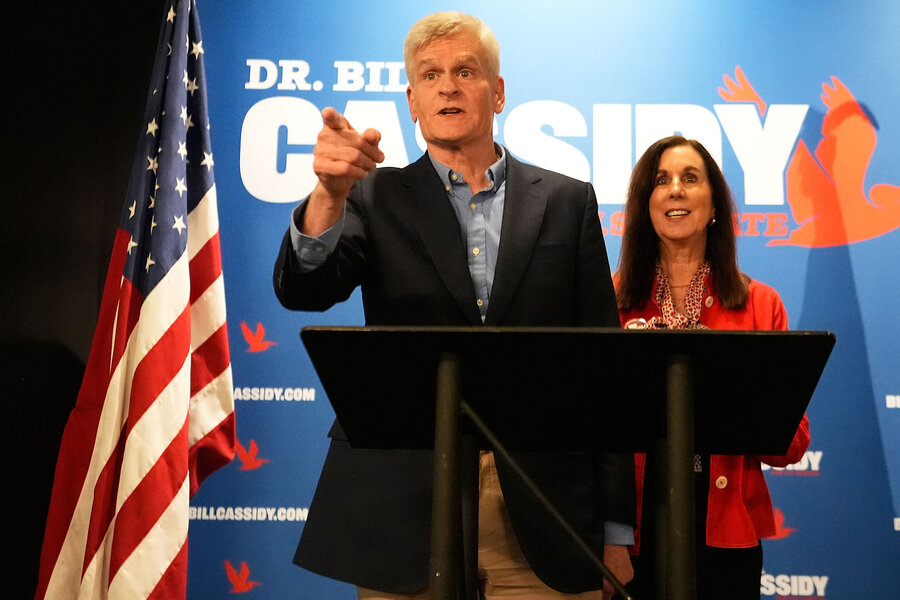
Sen. Bill Cassidy doesn’t think about Jan. 6, 2021, the day supporters of President Donald Trump stormed the U.S. Capitol. The Louisiana Republican says he doesn’t “sit around constantly mulling over the past like Lady Macbeth.” Or rewatch the selfie video from inside the Capitol, where he called on the “hooligans” to “Stop, period” and allow the peaceful transfer of power.
And he certainly doesn’t sit around thinking about the impeachment vote he cast a little over a month later, in which he, along with six other Republicans and all Democrats, found President Trump guilty of “incitement of insurrection.” (The Senate ultimately did not convict Mr. Trump.)
“You make a decision based on facts, and you move on,” says Senator Cassidy, as he works a room full of blazer- and kitten-heel-wearing supporters at a seafood restaurant outside New Orleans. He shakes hands, cracks dad jokes, and talks about the things he says actually do keep him up at night, such as flood management and healthcare reform.
Why We Wrote This
GOP Sen. Bill Cassidy voted to convict Donald Trump in the 2021 impeachment trial and has pushed back on public health matters. His fate on Saturday will signal the clout of the Make America Healthy Again movement, as well as the president’s hold on his party.
Mr. Trump hasn’t moved on in the same way. The president, who demands total loyalty from Republicans in Congress, has made unseating the two-term senator in Saturday’s Louisiana primary a priority.
It’s not just the impeachment vote that has drawn Mr. Trump’s ire. There have been other dustups between the senator and the White House in the president’s second term – particularly over public health. During Robert F. Kennedy Jr.’s hearing to become secretary of Health and Human Services, Dr. Cassidy, a physician, challenged the vaccine skeptic on a number of fronts. And in the year since, he has continued to question many of Mr. Kennedy’s decisions and opinions.
As far as Trump pushback goes, Dr. Cassidy’s was hardly the most forceful: He eventually cast the tiebreaking committee vote that cleared the way for Mr. Kennedy’s confirmation. Still, he dragged his feet long enough to “make both sides mad,” says Louisiana Treasurer John Fleming, who is running to replace the senator. Mr. Trump has endorsed a third Republican in the race, Louisiana Rep. Julia Letlow, who has the support of Mr. Kennedy’s MAHA (Make America Healthy Again) movement.
All of which could make Saturday’s primary even more telling. Even as Mr. Trump’s own poll numbers hit new lows amid rising prices and an unpopular war in Iran, his hold on his party has shown little sign of abating. His ability to punish errant Republicans was brought home just last week in Indiana, where state lawmakers who had resisted his redistricting demands lost seats to primary opponents. Dr. Cassidy is a much bigger, and potentially riskier, target – a two-term senator with a track record of delivering for his state. His fate will signal the clout of the still-young MAHA movement within the GOP as well as the president’s power as Mr. Trump heads into the lame-duck years of his final term.
“In such a frustrated and polarized society that we live in today, sometimes what we’re against is what stands out,” says Denham Springs City Council member Jim Gilbert before introducing Dr. Cassidy at a Baton Rouge campaign event. “And not what we’re for.”
A three-way split
Recent polls suggest Dr. Cassidy is in the race of his political life. A late April Emerson College poll has the senator trailing both Dr. Fleming, a physician like Dr. Cassidy, and Ms. Letlow, with 21% of the vote to their 28% and 27%, respectively. It’s possible the sitting senator won’t even make it to the all-but-guaranteed June runoff if no candidate passes the 50% threshold this Saturday.
Likely hurting Dr. Cassidy are changes to Louisiana’s elections. The state used to hold a “jungle” primary, where all candidates for an office appear on the ballot together, regardless of party. This year, Louisiana moved to a more typical party primary, which often favors candidates on the far ends of the ideological spectrum. Some speculate that GOP Gov. Jeff Landry, an ally of the president, pushed through this change deliberately to help Dr. Cassidy’s opponents.
Things took another turn last month when the U.S. Supreme Court struck down Louisiana’s congressional map. In response, Governor Landry postponed the state’s House primary vote until this summer, but left the Senate primary on May 16. Both Dr. Cassidy and Dr. Fleming worry that the changes will cause confusion for voters.
Dr. Cassidy tells the Monitor he believes the race will ultimately be decided on “who delivered” for the state. For voters concerned about “how well I work with President Trump,” Dr. Cassidy points to bills he worked on that the president signed into law, like the HALT Fentanyl Act, or the “no tax on tips” part of Mr. Trump’s One Big Beautiful Bill. He also frequently references the $13.5 billion he brought to Louisiana as a lead negotiator for former President Joe Biden’s Infrastructure Investment and Jobs Act, which is a frequent source of criticism from his opponents.
Mr. Gilbert, the Denham Springs council member, talks about how quickly the senator secured federal funds for his city when it flooded in 2016. Grant Parish Sheriff Steven McCain says after his parish flooded, the senator helped them get boats to navigate the water-covered, hilly terrain. Supporters across the state emphasize how Louisianans benefit from the senator’s position as chair of the powerful Health, Education, Labor, and Pensions Committee.
To which Dr. Cassidy’s opponents have a ready response.
“None of that matters,” Ms. Letlow tells the Monitor bluntly, “if you don’t have access to the president.”
“I like Trump”
Mr. Trump called Ms. Letlow personally to ask her to get into the race against Dr. Cassidy. He followed that up with an endorsement on Truth Social (“RUN JULIA RUN!!!”) days before she made her campaign official in January. The president’s support for Ms. Letlow goes back to her first campaign in 2021, when she ran in a special election to fill the seat of her late husband, Luke Letlow, who died of COVID-19 shortly after being elected in 2020. She was reelected in Louisiana’s 5th Congressional District, the rural northeastern corner of the state, again in 2022 and 2024.
In an interview after speaking to two dozen members of a Rotary club in rural Crowley, nicknamed “the Rice Capital of the World,” Ms. Letlow attributes the president’s endorsement to loyalty. “He knows he can count on me,” she says.
Leaning on the hood of his car across the parking lot, GOP voter James Webb gives a similar reason for jumping ship from Dr. Cassidy to Ms. Letlow: “I like Trump,” he says, throwing up his hands both literally and figuratively.
“President Trump is very well liked in Grant Parish,” says Sheriff McCain, a Cassidy supporter, adding that the president’s endorsement “carries a lot of weight.” i
Mr. Trump won the state by roughly 20 points in each of his three presidential elections. But the Bayou State has also shown strong support over the years for Dr. Cassidy, a former state senator who defeated a Democratic incumbent to win Louisiana’s 6th Congressional District in 2008 and defeated a Democratic incumbent again in 2014 when he first ran for Senate. The first Republican to hold the seat since the 19th century, Dr. Cassidy won reelection in 2020 (with Mr. Trump’s endorsement) with more than 50% of the vote against 14 opponents.

Jabin Botsford/The Washington Post/AP/File
A Cassidy campaign flyer shows the senator standing behind Mr. Trump in the Oval Office. And attendees at his events, many wearing “Geaux Bill” buttons, downplay any conflict between the senator and the president. The impeachment vote “was a little blip,” says Bernard Pentes in Metairie.
For a blip, though, it has had a big ripple effect. Of the seven Republican senators who voted to convict Mr. Trump following the Capitol attack in 2021, only one, Alaska Sen. Lisa Murkowski, has been reelected despite facing a Trump-backed challenger. Three others retired, one resigned, and Maine Sen. Susan Collins will have her own existential race this year, although she did not face a serious primary challenge.
After the impeachment vote, “it really seemed obvious that [Cassidy] was going to have real trouble running for reelection,” Dr. Fleming tells the Monitor in a Baton Rouge coffee shop.
The four-term congressman and House Freedom Caucus co-founder had opted out of a Senate run in 2014 after Dr. Cassidy announced his own campaign, not wanting to “risk a contest” between two Republicans that could benefit the Democratic incumbent. This year, Dr. Fleming decided Dr. Cassidy was “beatable.”
“The Republicans in this state are some of the most conservative voters in the country,” says Woody Jenkins, a Republican who served in the Louisiana House of Representatives for almost 30 years and ran several of his own close campaigns for Senate. He calls the impeachment vote a “nail in the coffin” for Dr. Cassidy, saying: “He showed his true colors at that moment.”
Mr. Jenkins adds: “Then we had the pandemic.”
MAHA and vaccines
One big frustration for the Cassidy campaign is that many voters wrongly accuse the senator of having supported COVID-19 vaccine mandates.
“People should get vaccinated for COVID-19, but the government should not mandate it,” Dr. Cassidy said in 2021.
And despite the MAHA wedge in this primary race, his opponents shared a similar position. In 2021, Ms. Letlow said she “would have given everything” for the COVID-19 vaccine to have been available for her husband. When asked if her support for the vaccine puts her at odds with her MAHA supporters, the congresswoman responds that she “never said that vaccines should be mandated.”
Dr. Fleming says he is “not an anti-vaxxer at all,” and tells all his patients, children, and grandchildren to get vaccinated, but is opposed to vaccine mandates. He says he does not agree with “everything” that Mr. Kennedy says or believes, and that some of his “ideas about vaccines” are “really out of the mainstream.” But he also says he supports all of the president’s Cabinet choices and “can’t think of anything” that Mr. Trump has done that he would push back on.

Story Hinckley/The Christian Science Monitor
When Dr. Cassidy announced his vote to confirm Mr. Kennedy, he said he had been given assurances of a “close collaborative working relationship,” with input on HHS hiring decisions. Other commitments, he said, included keeping the Centers for Disease Control and Prevention’s advisory committee on vaccines intact.
But the HHS secretary went on to handpick new members for the vaccine panel, which then voted to withdraw a recommendation for the Hepatitis B vaccine – a move Dr. Cassidy called a “mistake.” During his medical career, Dr. Cassidy, a liver specialist, had created a program to provide the Hepatitis B vaccine to 36,000 children in Baton Rouge.
On the CDC’s vaccine safety web page today, an asterisk on the headline “Vaccines do not cause autism” clarifies that it “has not been removed due to an agreement with the chair of the U.S. Senate Health, Education, Labor, and Pensions Committee that it would remain on the CDC website.”
In recent months, Dr. Cassidy has continued to challenge Mr. Kennedy’s moves at HHS in Senate hearings. At the end of April, Mr. Trump blamed Dr. Cassidy directly (“a very disloyal person”) in a Truth Social post for the stalled nomination of the president’s original pick for U.S. surgeon general, MAHA influencer Casey Means.
Taking the stage in Baton Rouge, Dr. Cassidy talks about the need for courage in politics. When he’s finished, reporters ask if he was referencing his impeachment vote. Or perhaps his pushback to Mr. Kennedy? Actually, Dr. Cassidy says, he was thinking about his vote for Mr. Biden’s infrastructure bill. But, sure, he adds, the same point could apply to all those things.
“Do I get criticized? Yes,” he says. “If you don’t want to get criticized, don’t run for Senate.”