The release of nearly 3.5 million files linked to late financier and convicted sex offender Jeffrey Epstein has given the public extensive new material to examine regarding his alleged crimes, the people connected to his alleged criminal network, and the circumstances surrounding his death.
The documents, the way the case keeps surfacing in news reports, and the information gaps that remain, have given rise to multiple conspiracy theories, none of which have been proved. The examples include, prominently, that Mr. Epstein operated and led an elite child-trafficking network that spanned multiple countries and involved powerful figures; that he was a spy connected to Israel’s intelligence agency, Mossad; and that his death, ruled a suicide, was actually a homicide committed to protect powerful people.
Public access to these files is meant to ensure transparency regarding criminal networks, false statements by public figures, and justice-system failure. But the case also challenges people to distinguish between factual evidence and unproven conspiracy theories. As the public shows declining trust in institutions and navigates a sea of information – some of it wrong, some of it supercharged by social media platforms – those theories and others can gain traction.
Why We Wrote This
Public information about Jeffrey Epstein has provided people insight into the convicted sex offender’s life and crimes, but it has also elevated conspiracy theories about him and his clientele. Those kinds of theories – hard to prove or definitively disprove – can be difficult to dislodge.
More details could come out Monday, when Tova Noel, a guard on duty at the Metropolitan Correctional Center in New York when Mr. Epstein’s death occurred, is expected to testify before the House Committee on Oversight and Government Reform.
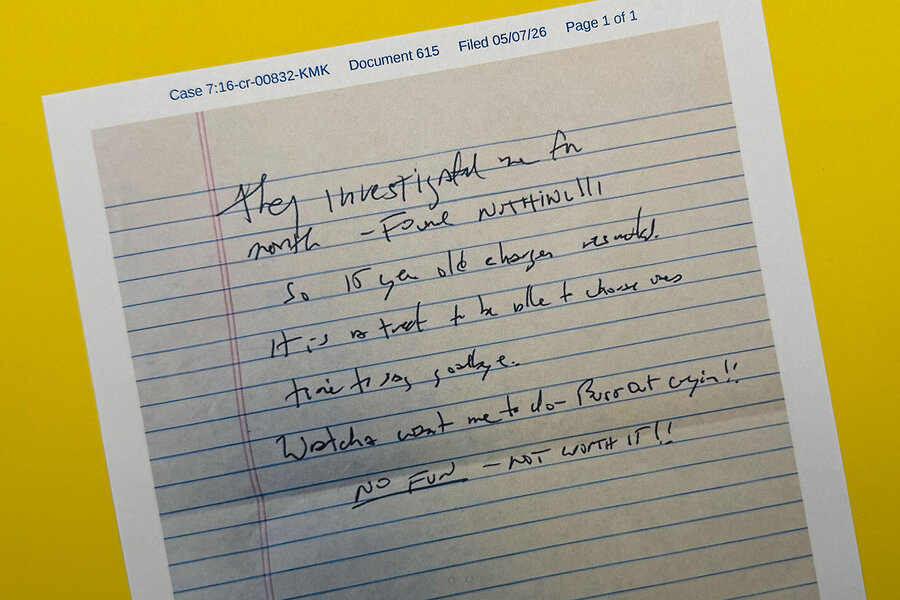
A federal judge on May 6 unsealed an apparent suicide note that had been found by Mr. Epstein’s former cellmate. The late financier is believed to have written, “It is a treat to be able to choose one’s time to say goodbye.” But neither Ms. Noel’s testimony nor the note, experts say, is likely to put conspiracy theories to rest.
“Information doesn’t always drive beliefs,” says Joseph Uscinski, a professor at the University of Miami who has studied public opinion and mass media through the lens of conspiracy theories. “This is a human way of thinking. People come to conclusions first, evidence will come later, if at all.”
In fact, a recent Ipsos poll found that nearly 65% of Americans believe the government is most likely hiding information about the death of Mr. Epstein, and nearly 75% believe the government is withholding information about his operation’s clientele.
Such beliefs often endure because they pull at threads of truth, says Mark Fenster, a professor at the University of Florida who studies conspiracy theories. He says Mr. Epstein fits a common narrative about prominent people who abuse their influence. Reports about others involved with Mr. Epstein could fit that narrative as well, he says. “Conspiracy theories are a sort of storytelling device. It’s a way of making sense of things that seem random and seem difficult to tie together.”
In a case such as that of Mr. Epstein, theories can be both unproven and difficult to disprove. For one thing, members of Congress believe many files haven’t yet been released by the Justice Department. Regarding allegations of a trafficking ring for many elite clients, the evidence so far doesn’t include a “client list” or equivalent.
A prison note, online searches, and bank deposits
The House Oversight Committee believes a prison guard could help fill in parts of the story. Ms. Noel is believed to be the last person to see Mr. Epstein alive.
Theories are circulating online that claim Ms. Noel and another guard helped orchestrate a cover-up, alleging the guards slept on duty, and permitted an unidentified person into the area, seen on surveillance footage, the night of Mr. Epstein’s death. The theories also incorporate Justice Department allegations that the guards falsified their security logs. The DOJ charged Ms. Noel and her colleague with falsifying records, though the charges were later dropped as a result of a deferred prosecution agreement. No evidence has surfaced to support the other accusations.
The House committee sent a letter to Ms. Noel on March 13 stating that, based on “public reporting, documents released by the Department of Justice, and documents obtained by the Committee, the committee believes you have information that will assist in its investigation.”
The committee is trying to piece together Mr. Epstein’s last moments. Ms. Noel and another guard discovered Mr. Epstein unresponsive, hanging from a piece of a bedsheet in his cell. Committee members, including Chairman James Comer, a Republican from Kentucky, want to ask Ms. Noel about items revealed in Justice Department files and unanswered in past investigations.
Mr. Comer told Fox News in March that the committee would ask Ms. Noel about 12 cash deposits, between November 2018 and July 2019, flagged by JPMorgan Chase. One was $5,000 deposited to Ms. Noel’s account 10 days before Mr. Epstein’s death. Those 12 deposits were not investigated by the Justice Department.
The committee also hopes to examine Ms. Noel’s internet search history. Hours before Mr. Epstein’s death on Aug. 10, 2019, records show, Ms. Noel searched for information on Mr. Epstein’s case status. During a DOJ investigation in 2021, Ms. Noel said she did not remember making the searches.
“We have a lot of questions,” Mr. Comer said to Fox.
Ms. Noel has yet to comment publicly on either her upcoming testimony or on other aspects of the Epstein investigation.
At the time of his death, Mr. Epstein was awaiting trial after being federally indicted for one count of sex trafficking minors and one count of sex trafficking conspiracy.
The night before his death, a federal judge unsealed documents in a lawsuit against Epstein associate Ghislaine Maxwell. They revealed accounts from victims, including the late Virginia Giuffre, who had previously said they were abused or forced to engage in sexual acts with public figures, including politicians and royals.
Records about Mr. Epstein’s time at the Metropolitan Correctional Center became a hunting ground for internet sleuths. As people pored over jail surveillance footage released by the FBI last year, some discovered a “missing minute” – a gap in the video. That fueled a conspiracy theory that the video was altered, removing evidence that someone interacted with Mr. Epstein before his death.
Pam Bondi, then the U.S. attorney general, said that the missing footage was due to a nightly system reset. Congress later released a full video that included the missing minute. It revealed nothing unusual.
Yet conspiracy theories persist, including one sparked by something that does, in fact, appear in the video.
Camera footage from the night of Mr. Epstein’s death shows a figure that appears to be in an orange jumpsuit walking up the stairs toward the prison tier where Mr. Epstein’s cell was, according to an FBI memo, released by the Justice Department at the end of January. In the memo, the bureau speculates that the shape “could possibly be an inmate.” The DOJ said it was “possible someone was carrying inmate linen or bedding up the stairs,” but that inmates would have been on lockdown at the time.
Whether Ms. Noel is able to shed light on that incident, or whether other pertinent information is revealed during Monday’s hearing, might not matter to people who believe Mr. Epstein’s death was something other than a suicide.
“Whatever they believe at the beginning of the testimony, they will probably double down on by the end of the testimony,” says Professor Uscinski from the University of Miami.
A complicated story
It can be difficult for public figures, such as those named in the Epstein files, to separate themselves from speculation about their connections to Mr. Epstein.
Appearing in the files is not proof of wrongdoing. But since Mr. Epstein’s arrest in July 2019, conspiracy theories have been circulating about high-profile people who knew or had relationships with him. For example, former President Bill Clinton, who appeared in multiple photos with Mr. Epstein, is known to have flown to Mr. Epstein’s private island, Little Saint James. Other noted island visitors included physicist Stephen Hawking, supermodel Naomi Campbell, and lawyer Alan Dershowitz. Mr. Clinton gave a deposition to the Oversight Committee in February. Britain’s Andrew Mountbatten-Windsor – formerly known as Prince Andrew, and brother of King Charles III – was stripped of his title and is under investigation because of the Epstein documents and photos.
Speculation has also followed President Donald Trump over his association with Mr. Epstein.
Mr. Trump and Mr. Epstein were reportedly friends until, according to Mr. Trump, a falling out sometime during the early 2000s. Their connection is documented in the Epstein files, in which Mr. Trump is mentioned on more than 38,000 occasions. The files include accusations that Mr. Trump assaulted a woman in the 1980s and that he knew about Mr. Epstein’s sex trafficking. Mr. Trump has denied both accusations.
More recent speculation involves both Mr. Trump and first lady Melania Trump and their connection to Mr. Epstein.
Mrs. Trump’s name appears in several emails in the Epstein files, indicating that she communicated with Ms. Maxwell, Mr. Epstein’s partner. On April 9, Mrs. Trump held an unexpected press event to deny any relationship with either Mr. Epstein or Ms. Maxwell, and to refute a theory that Mr. Epstein introduced her to Mr. Trump.
“Numerous fake images and statements about Epstein and me have been circulating on social media for years now,” Mrs. Trump said in a prepared statement. “Be cautious about what you believe.”
Mrs. Trump’s denials regarding her connection to Mr. Epstein and Ms. Maxwell have not been substantiated. But her attempt to push back on those who link her to the couple underscores the power and reach ideas – whether based on facts or speculation – can have when they take hold with a section of the public, Professor Uscinski says.
“Too often, we focus on the theories, not on the people. Conspiracy theories are just ideas,” he adds. Instead, focus on facts and actual actions taken, he says. “People do things.”