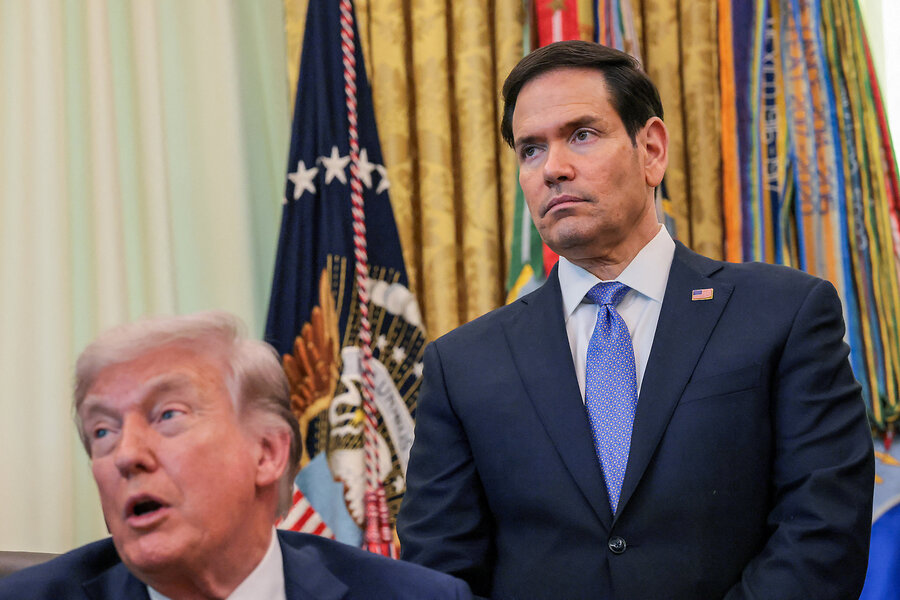
As a United States senator from Florida, Marco Rubio was a high-profile “neocon” – a hawk on China and Russia, a strong supporter of Taiwan, Ukraine, and NATO, and an advocate for free trade and human rights.
Today, not so much – at least on those issues. As both secretary of State and acting national security adviser, Secretary Rubio is fully on board with President Donald Trump’s approach to foreign policy: more “Art of the Deal” use of American leverage, including tariffs, less hard-line absolutism with other major powers.
Mr. Rubio’s evolution shouldn’t come as a shock. After all, he is no longer his own boss; he works for President Trump – in two key capacities, the first to hold both titles since Henry Kissinger in the 1970s. That comes with perks, including (as national security adviser) an office steps away from the Oval Office and, last week, a ringside seat at the high-stakes presidential summit in China.
Why We Wrote This
Marco Rubio has found ways to execute a Trump foreign policy that shows an evolution in his own positions. It has made him stand out among the president’s close advisers.
But the job of being Mr. Trump’s front man on foreign policy also brings profound responsibility, starting with a need to display the emotional intelligence required in dealing with a mercurial president, offer sage advice, and defend Mr. Trump’s actions in public.
Mr. Rubio has risen to the challenge, foreign policy analysts say, in how he blended his own core Reaganite neoconservative, pro-interventionist views and the “America First” nationalism of the Trumpist “Make America Great Again,” or MAGA, movement.
“I have been genuinely surprised that he has not only survived but thrived in this administration,” says Daniel Drezner, a professor at Tufts University’s Fletcher School of Law and Diplomacy. “There were a lot of reasons to think he was going to be the first one out.”
For starters, Professor Drezner adds, “MAGA didn’t trust him, obviously, as a former neocon.”
To critics, Mr. Rubio is a sellout, a politician with an eye on the 2028 presidential contest over any sense of principle, kowtowing to Mr. Trump in the name of winning over the president’s base of support.
With little fanfare, Mr. Rubio instituted major personnel cuts early on at the State Department – and continues to do so. As national security adviser, he implemented a dramatic reduction in the National Security Council staff in an effort to combat the “deep state.”
Within the Trump orbit, Mr. Rubio’s reinvention is noteworthy in other ways. Treated with derision as “Little Marco” by candidate Trump when they competed in the 2016 GOP presidential primary, he is now lauded as an articulate explainer and defender of policy, charismatic when Vice President JD Vance can appear stilted, and a devout Catholic family man in a cabinet known for some controversial characters.
Mr. Rubio’s star turn earlier this month in the White House briefing room, relaxed and charming for 50 minutes as a fill-in press secretary, garnered international attention. His early May deployment to Rome, for meetings with Pope Leo XIV and the Italian prime minister to smooth over online clashes with Mr. Trump, also burnished his image as an effective envoy for the administration.
In addition, it turns out, the president’s definition of “America First” does not necessarily equate with isolationism. This means he and Mr. Rubio were never as far apart in their worldview, and the U.S.’s place in the world, as some may have thought. In his 2023 book, “Decades of Decadence,” well before Mr. Trump’s reelection, Mr. Rubio laid out the case for continued engagement in the world – and a need to both honor the Reagan legacy and move on from his 1980s worldview.
The U.S. is a “nation in desperate need of a leader” who understands that the threats to Mr. Trump’s vision of America “are different from the threats Reagan confronted and overcame,” Mr. Rubio writes.
In Cuba, for example, that has meant both working toward regime change and showing humanity toward its citizens. Last week, the U.S. State Department repeated a willingness to provide $100 million in humanitarian aid to the Cuban people.
Mr. Rubio’s Cuban heritage, as the son of immigrants, and fluent Spanish are a plus in GOP outreach to crucial Latino voters – and in his diplomacy. The ultimate prize for Mr. Rubio is an end to communist rule on the island nation that sits just 90 miles off the southernmost point of his native Florida. Earlier this year, the U.S. intensified its decadeslong embargo against Cuba, including an energy blockade that has caused widespread power outages.
CIA Director John Ratcliffe’s surprise visit to Cuba on Thursday, to discuss intelligence cooperation, economic stability, and security, is in line with Mr. Rubio’s strategic goals. It was the first high-level official U.S. visit to the nation in 10 years. Since joining the second Trump administration, Mr. Rubio has held secret meetings with former President Raúl Castro’s grandson, part of the effort to move Cuba to a post-communist future.

On Friday, multiple news outlets reported that the U.S. Justice Department is preparing to indict former President Castro over his alleged role in the 1996 shoot-down of planes operated by Miami-based Cuban exiles. The alleged plan raises expectations that the U.S. might try a military operation in Cuba similar to the January capture of Venezuela’s president, who was brought to the U.S. to face narcoterrorism charges.
In other key ways, Mr. Rubio’s positions remain much as they always were – and in line with Mr. Trump’s. He opposed the Obama-era Iran nuclear deal from the start, and applauded when the president ditched it during his first term. Today, he vigorously defends the U.S.-Israel war in Iran.
In Venezuela, Mr. Rubio is widely seen as the mastermind of U.S. policy, including the capture of President Nicolás Maduro. Mr. Rubio remains involved in the details of Venezuela’s governance, as evidenced in an interview last week with Sean Hannity of Fox News on Air Force One en route to China.
“I think we’ve made some steady progress on improving Venezuela,” Mr. Rubio said, laying out how its oil money now goes into a New York bank account to pay salaries of teachers, firefighters, police, and professors.
Mr. Rubio is hardly a “viceroy” – a proxy ruler on behalf of a sovereign – but that suggestion soon after Mr. Maduro’s capture added to the Rubio meme as “Secretary of Everything.” In addition to his two main titles, he is also still technically acting administrator of the U.S. Agency for International Development, which he has effectively dismantled, and for a time, acting archivist of the United States.
Mr. Rubio’s dual role today as both secretary of State and the president’s national security adviser seems less intentional than when Mr. Kissinger did it. Mr. Rubio took over as national security adviser in May 2025, when Mike Waltz was ousted after the “Signalgate” scandal. (Mr. Waltz had accidentally included a journalist in a group chat on a major military operation.)
Ever since, Mr. Rubio has been acting national security adviser, which may be the more important of his two primary roles. That’s the job that gives him daily proximity to Mr. Trump, and the ability to influence his decisionmaking.
“In any administration, being close to the president is where the power is,” says Matthew Kroenig, vice president of the Atlantic Council and a former foreign policy adviser to the Rubio 2016 presidential campaign.
“That’s even more the case given the way [Mr. Trump] makes decisions,” Dr. Kroenig adds. “It seems like there’s not a big interagency process. It’s a handful of people around the president who are really shaping his thinking.”
Also unusual in the current administration is the fact that the president’s main envoys dealing with the biggest global conflicts – Iran, Ukraine/Russia, and Israel/Gaza – are his son-in-law Jared Kushner and friend Steve Witkoff, not his secretary of State. Neither Mr. Kushner or Mr. Witkoff are government employees.
Mr. Rubio is in the White House more than he’s traveling, notes Dr. Drezner of the Fletcher School. “To the extent that he does travel – and I think this is politically savvy – it’s often as cleanup,” he adds, citing the secretary’s trip to Europe after Mr. Trump’s summit in Alaska with Russian President Vladimir Putin last August.
In the end, Mr. Rubio’s biggest impact on Trump administration policy may be in its focus on the Western Hemisphere, as seen in the November 2025 National Security Strategy. Call it “Americas First,” versus the singular America First, as it introduced a 21st century version of the 1823 Monroe Doctrine – or “Donroe Doctrine” – i.e., asserting the Western Hemisphere as the U.S.’s “neighborhood.”
Venezuela and Cuba are important in today’s Trumpian narrative, as are Mexico, Canada, Panama, and Greenland. For Mr. Rubio, a post-communist Cuba has always been the holy grail. But in other ways, his posture has evolved, blending aspects of his old neocon ways (e.g., foreign interventionism) with the MAGA values of America First, including trade protectionism.
In his book “Decades of Decadence,” Mr. Rubio made clear he had moved on from his support for economic globalization – including once-vocal support for the Trans-Pacific Partnership.
In short, the Rubio transformation didn’t happen just because he joined the Trump administration, says Dr. Kroenig of the Atlantic Council. Like many Republicans in the Trump era, Mr. Rubio has shifted over time as his party and its voters have shifted.
“It’s been a more gradual evolution after 2016,” says Dr. Kroenig.