The Trump administration is on the defensive as it seeks to justify the creation of a nearly $2 billion legal fund designed to pay alleged victims of politicized law enforcement.
President Donald Trump and other administration officials describe the “anti-weaponization fund” as necessary for preventing politicized investigations of individuals the way they believe Mr. Trump was targeted after his first term in office.
Critics, ranging from Democrats in Congress to the editorial board of The Wall Street Journal, see the fund as its own form of politicizing American government. Some are calling it a corrupt and opaque mechanism for using taxpayer funds to reward the president’s most loyal supporters, including individuals charged for participating in storming the U.S. Capitol on Jan. 6, 2021. (Those individuals, known colloquially as J6ers, also received sweeping pardons from Mr. Trump last year.)
Why We Wrote This
The Trump administration has reached an unusual settlement in a case of the president suing his own government. Critics worry that a resulting “anti-weaponization fund” will be ripe for abuse benefiting President Donald Trump, his family, and his allies.
The unusual arrangement – which Department of Justice officials say has precedent from the Obama administration – stems from a lawsuit that President Trump filed in his personal capacity against his own government, and that he settled days before a judge had been scheduled to begin scrutinizing it.
In addition to creating the fund, the settlement includes a provision posted on the DOJ website Tuesday that appears to offer sweeping protection to Mr. Trump and his family from any existing tax investigations.
Two police officers who clashed with protesters during the Jan. 6 attack filed a lawsuit on Wednesday to block the fund, arguing that it is unconstitutional.
The settlement raised some rare Republican backlash. Senate Majority Leader John Thune on Tuesday told reporters that he expects a “full vetting” of the settlement by members of Congress and that he’s “not a big fan” of the deal.
“Safe bet that this Fund will generate outrageous abuses,” wrote Ed Whelan, a conservative lawyer who served as deputy assistant attorney general during the George W. Bush administration, in a social media post on Monday.
As for the Obama administration precedent, Mr. Whelan noted that that fund had been approved by the federal courts: “That approval provides some process protection against abuses. Here, by contrast, [the] settlement was designed to evade court review.”
A president sues the government
The settlement, announced Monday, resolved what is believed to be the first case of a U.S. president suing his own government. Private citizens are entitled by law to sue the IRS over leaks of their tax returns; with President Trump’s oversight of the executive branch, however, the lawsuit put him in the peculiar position of suing a branch he holds oversight over. The resulting settlement is effectively one between Mr. Trump and himself, critics argue, and one that would be laughed out of most courtrooms.
In a lawsuit brought earlier this year in his personal capacity, along with his sons and his family business, against the Internal Revenue Service, the president sought up to $10 billion for the leak of his tax returns during his first term by an IRS contractor.
Judge Kathleen Williams, who had been overseeing the lawsuit, had been poised this week to scrutinize potential conflicts of interest in the case. She dismissed the case on Monday after the settlement announcement, but in a brief order she criticized the Justice Department for not filing any documents “ensuring that [the] settlement was appropriate where there was an outstanding question as to whether an actual case or controversy existed.”
According to the terms of the settlement agreement, the $1.776 billion fund will be overseen by five commissioners, four appointed by the attorney general and one chosen “in consultation with congressional leadership.” The commissioners will have broad powers over how the funds are disbursed, and “may make those procedures public in whole or in part [at their] discretion.” The only mandatory public reporting of the funds’ actions is a quarterly report to the attorney general.
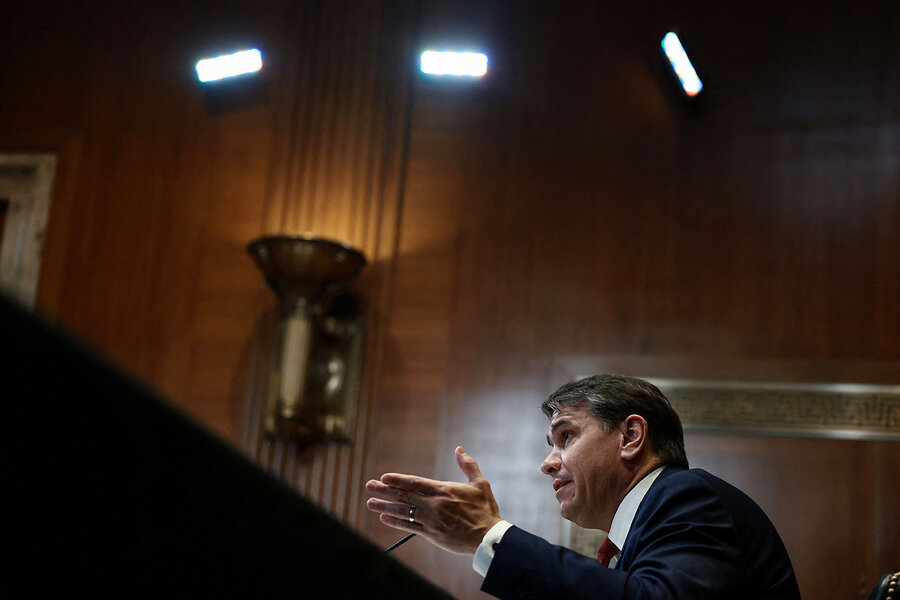
Since being the subject of four criminal indictments after his first term in office, Mr. Trump has claimed that the prosecutions were politically motivated. (One case resulted in a guilty verdict; three of the cases were dropped after his reelection.) The anti-weaponization fund will serve the broader goal of ensuring that future presidents and their supporters are not targeted in a similar way, said Todd Blanche, the Acting Attorney General, at a Senate appropriations subcommittee hearing on Tuesday.
“It is true that this [fund] is unusual,” added Mr. Blanche, who in 2023 and 2024 served as Mr. Trump’s personal attorney, “but it is not unprecedented, and it was done to address something that had never happened before.”
Pointing to precedent
The precedent the Justice Department has pointed to is Keepseagle v. Vilsack, a case in which the Obama Justice Department agreed to a settlement with Native American farmers and ranchers who claimed they had been discriminated against by a federal agricultural loan program.

J. Scott Applewhite/AP/File
Filed in 1999 and settled in 2010, the case resulted in the federal government awarding $680 million to claimants in the lawsuit. Half of that money ended up not being claimed, however, at which point a federal court approved an addendum to the settlement requiring that leftover funds be disbursed to groups not party to the lawsuit but with an active interest in helping Native American farmers and ranchers.
“The underlying case is not the same, but the structure of the commission is the same as the Keepseagle commission,” Mr. Blanche told senators on Tuesday.
Joseph Sellers, an attorney at the law firm Cohen Milstein and the lead counsel for the plaintiffs in the Keepseagle case, disagrees.
“There are vast differences between the settlement in the Keepseagle case and the fund that was created here,” he says.
A federal judge formally approved both the original settlement and the addendum relating to the disbursement of the leftover funds, for example. The addendum was challenged but upheld by higher courts as well.
Unlike the Trump settlement, which came less than four months after the lawsuit had been filed, Mr. Sellers notes, the Keepseagle settlement came after a decade-long public legal process.
While both lawsuits led to the creation of a separate fund to pay out similar but unrelated claims – lawfare and weaponization for one, and racial discrimination for the other – “there are such profound differences from how [the Keepseagle fund] was set up, who oversaw it, and the transparency provided,” says Mr. Sellers.
Drawing from the “Judgment Fund”
The Trump administration could have found a better precedent in a related case, according to Paul Figley, a professor at the American University Washington College of Law.
Hispanic farmers and female farmers had also brought discrimination lawsuits against the federal government over the agricultural loan program. Neither group had a judge formally certify a class of plaintiffs. But, facing political pressure to compensate minority farmers, the Obama administration settled the lawsuits in 2011 and created funding programs to do so.
The Hispanic and women farmers cases “are more akin to what I understand this new program for people treated badly by the government to be,” says Professor Figley, who served for three decades in the Torts Branch of the Justice Department’s Civil Division.
Those settlement funds, like the anti-weaponization fund, are being paid out of the Justice Department’s Judgement Fund, federal money set aside to pay for court judgements and settlements against the United States. What the Obama administration did, and what the Trump administration is now taking advantage of, reflect how rules around the Judgment Fund have changed.
Congress created the fund in 1956 so that federal agencies didn’t have to get a specific congressional appropriation for every successful legal claim made against them. Originally, the Judgment Fund – a permanent, automatic appropriation to the Treasury Department – could only be used to pay claims up to $100,000. Congress removed that cap decades later.
“Congress, under our system, should decide when claims are to be paid, especially when they’re significant,” says Professor Figley. Instead, “Congress has set up a system that can be manipulated.”