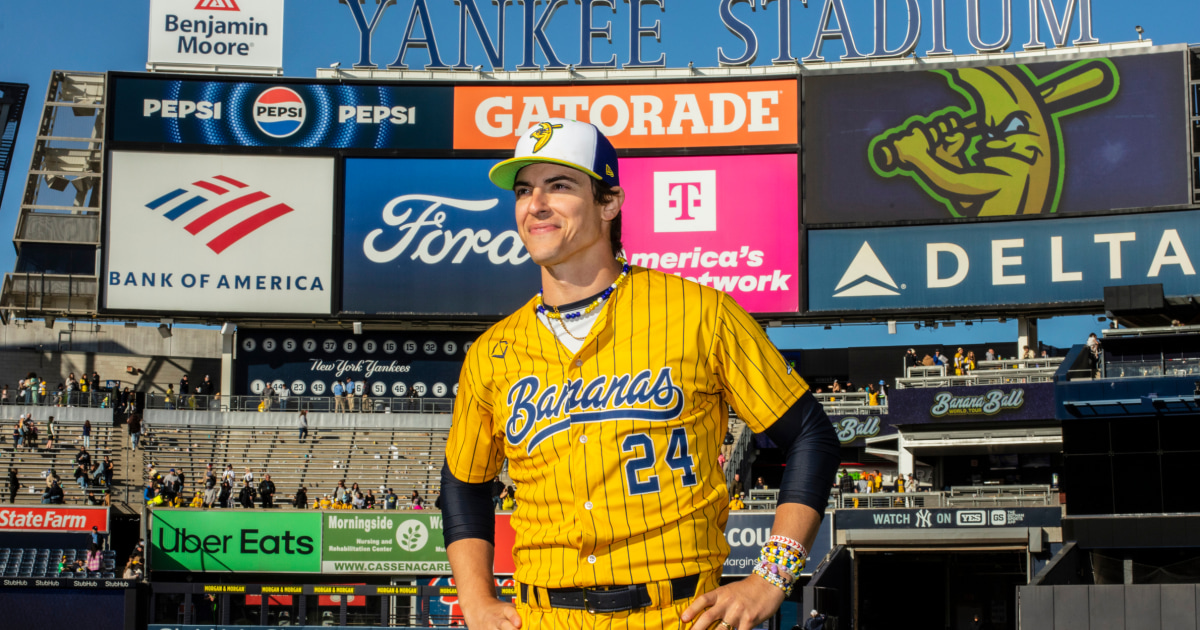
You’ve seen the viral dance videos. You recognize the bright yellow jerseys. Maybe you know someone who’s been to a game. But chances are you still have more questions about the Savannah Bananas than answers. That’s understandable. Just four years ago, the Bananas were one of thousands of summer baseball teams around the country. Now, they’re playing on ESPN, selling out Yankee Stadium and drawing 102,000 fans to college football stadiums.
Subscribe to read this story ad-free
Get unlimited access to ad-free articles and exclusive content.

If we’re being honest, the question you’re probably asking the most is: “Do they even play baseball?”
“We’ve got to have high-level guys to do what we do,” head coach Tyler Gillum said. “We have 150 players in-house between six teams. Thirty-five of those guys played minor-league baseball. The majority of them played [Division I] baseball, or they played independent ball, so we’ve got a highly competitive group.”
When Gillum began with the Bananas in 2018, he was coming off a season as an assistant coach in the prestigious Cape Cod League and had been a record-breaking coach in the Texas Collegiate League, where he had 35 players drafted in three summers. At the time, the Bananas were making headlines for their elaborate entertainment strategies, but they were just one of thousands of collegiate summer baseball teams.
Over the next five summers, Gillum and Bananas owner Jesse Cole laid the foundation for what the Bananas would one day become. While the heart of that is built on the fan experience, the glue that holds everything together is the caliber of baseball played on the field.
“Our goal is to make baseball fun, be fans first and entertain always,” Gillum said. “Where people get confused is they think, because we’re entertaining, we don’t care about the performance on the baseball side of it, and that couldn’t be further from the truth. … If there’s a bunch of errors, it’s sloppy and pitchers can’t throw strikes, this doesn’t work.”
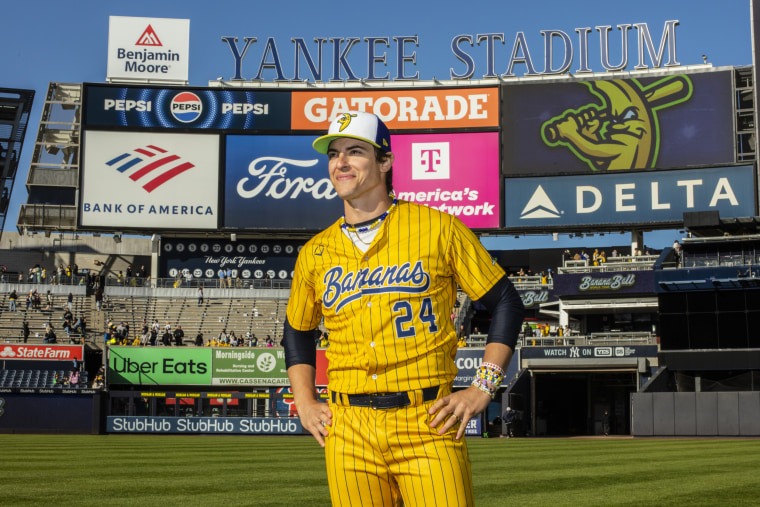
One of those high-level guys is left-handed pitcher Austin Drury, who spent three seasons in college at North Florida before he was selected in the 34th round by the Los Angeles Dodgers. After four seasons in the minors, he played in independent ball and foreign leagues before he joined the Savannah Bananas this year.
“Everyone here understands they have two jobs in one,” Drury said. “They have to entertain, and then, in the ballplayer sense, they’ve got to take care of the business that they’ve been doing their whole life.”
As Gillum mentioned, most players in the Banana Ball Championship League (BBCL) have played at a high level their whole lives. Reese Alexiades, after he wasn’t drafted out of Pepperdine, played two seasons in the Pioneer League, where he won MVP in 2023 — but he still didn’t hear from any MLB teams.
“That’s just how it goes,” Alexiades said. “I love baseball to death, so I’m going to play as long as I can. I believe this is where God meant me to be, making an impact greater than I could have ever had playing in the major leagues.”
Max Jung Goldberg, who also joined the Bananas after having played in the Pioneer League, said, “A lot of people misunderstand the grind that we go through because each week we’re almost preparing like it’s a football game.
“You go through three to four days of practicing to get ready for the show,” he said. “You have a travel day and then another travel day on both ends of the road trip. … You’re dialed in all week. It’s not just ‘show up to the yard and play.’”
In some ways, the players and coaches in Banana Ball believe their preparation for games is more challenging than in college or the minor leagues. Banana Ball rules take a regular game of baseball and speed it up to another level to keep an entire game within its two-hour time limit.
Even though Gillum said much of practice is “set up just like [he] did with practice in college,” he’s also aware that players need to adjust to playing the game with a slightly new style and a much faster pace. Since pitchers can catch the ball and go, Banana Ball has recorded strikeouts as fast as 8.6 seconds.
“You’ve got to train guys a little bit differently on the cardio side,” Gillum said. “Our game moves fast, so what we try to do is get our guys’ heart rates up so they can understand how to control that heart rate.”
While the added athleticism of backflip catches and other trick plays is appealing to fans, the Savannah Bananas heard the comparisons to the Harlem Globetrotters and tried to distance themselves from their basketball counterparts, who don’t play competitive games. The Bananas wanted to make it clear that when it comes to baseball, nothing is scripted. The teams plan celebrations for home runs, but they have no idea when or whether that will happen during the game.
Building and expanding the BBCL was central to assuring that it was a real league with real teams that could win on any given night. The first weekend in May, in front of 102,000 fans at Kyle Field in College Station, Texas, the Bananas lost both games to the Texas Tailgaters, and they lost another game the weekend before to the Party Animals at Yankee Stadium.
Creating a more legitimate league also meant adding teams, which it did last year with the Loco Beach Coconuts and the Indianapolis Clowns. That also meant adding more players, which wasn’t an issue.
“Over 5,000 people filled out the form,” Gillum recalled. “Some of these people have never played baseball before, so we filter those out. We invited about 200 players to six different tryouts around the country, and then we invited about 120 players into the Banana Ball Draft last November.”
Even if a little more than a fifth of the people who initially filled out the form were deemed worthy of tryouts, that still means over 1,000 players had substantial enough backgrounds to warrant tryouts. If you believe Gillum, that number will only increase in the coming years.
“I think here quickly you’ll start seeing guys that might get drafted in the 15th round, 18th round [of the MLB draft] and get offered $10,000 for a bus ticket to go to minor-league baseball, and those guys are going to start turning that down to set themself up to come play Banana Ball on a 12-month contract,” Gillum said.
The 12-month contract was a point of emphasis for Banana Ball. Gillum knew from his college experience that one of the biggest friction points as a “baseball guy” is the need to get an offseason job to make ends meet: “So we were like, ‘All right, let’s give these guys 12-month contracts and pay them just like an employee every two weeks.’”
Banana Ball players, on average, make $110,000 a year with healthcare. Many players have brand deals that supplement their incomes, and a few players push $200,000. Unlike in Major League Baseball, players can’t be released from their contracts unless there is a “breach of personal conduct.” That includes injured players, who are kept on in fan engagement roles.
And it’s not just money. Players like JT Sokolove, a first-year Banana who played at Michigan State, have a chance to compete in front of sold-out stadiums across the country less than a year after college.
“Every kid, when they grow up, wants to play in the major leagues,” Sokolove said with a smile. “This isn’t MLB, but to get to be on these fields is unbelievable. … Sometimes the stands don’t always fill up when you’re playing independent ball or minor-league ball, so when we get to show up in a stadium like [Yankee Stadium] and it’s full of fans that are excited to be there, I get goose bumps every single time.”
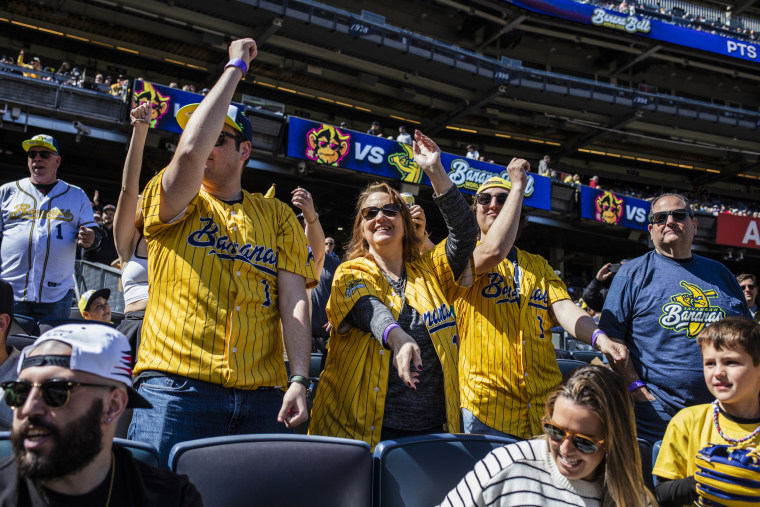
Players get goose bumps because this wasn’t supposed to happen for them. At one point, they all planned to wear MLB uniforms, but professional baseball has a way of beating you down. The grind of the minor leagues is designed to separate the players who really want this career from the ones who would simply enjoy it.
At their core, the players in the BBCL are players who have spent decades playing a sport they love in pursuit of a dream. Along the way, many of them were told “no” or beaten down by the odds stacked against them. Yet they continue to love the game and the way it can make people feel. They’re not the players who decided they didn’t want it enough. They’re the ones who decided they wanted it more than anything.
“You look at how serious you can take things, and how ‘businessy’ baseball can be,” Alexiades said. Sometimes you just lose the fun of it. I hear so many stories of ‘I just lost the love of the game.’ So what we’re really trying to do is bring fun into baseball.”
Gillum said: “Major League Baseball is going to be Major League Baseball. Those are going to be the best players in the world. One thousand percent. But what we’re trying to do, from the fan experience side, is different, and we have 4 million people on the wait list to get tickets.”
Maybe those fans want to see something they’ve never seen before. Maybe they just want to see athletes take their shirts off and dance on the field, but whether consciously or subconsciously, all of those fans feel a love for the game of baseball or are growing their own in the process.
“We all love the sport of baseball. That’s why we still do what we do,” Sokolove said. “But I do think it’s growing the sport of baseball, and people are reconnecting with the game. There might be people who say: ‘They’re not playing traditional baseball. I don’t like it,’ and that’s OK. They can have their opinion.”
“We still love them for how they think about the game of baseball because we love the regular game of baseball, too. … But we’re growing the game in the sense that more kids get to connect and people start to fall in love with baseball. I think it’s a good thing that we’re doing.”