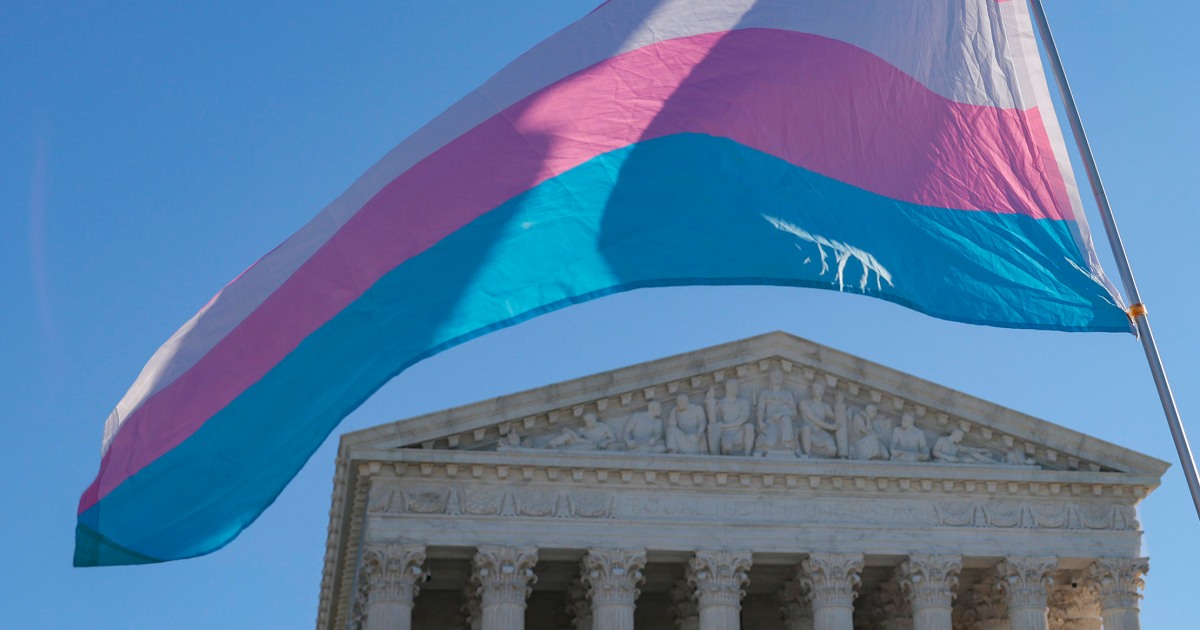
WASHINGTON — The Supreme Court on Monday barred California from enforcing state rules that restrict when schools can notify parents about students who come out as transgender and requires teachers to use a child’s preferred pronoun.
The court, on a 6-3 vote on ideological lines, allowed a federal judge’s ruling in favor of parents who oppose the policy on religious grounds to go into effect. The San Francisco-based 9th U.S. Circuit Court of Appeals had previously put the judge’s decision on hold pending further litigation.
The court’s ruling focused on the parents’ claim that their rights under the free exercise clause of the Constitution’s First Amendment were violated.
The court did not grant a similar request made by teachers who object to the policy.
“We conclude that the parents who seek religious exemptions are likely to succeed on the merits of their Free Exercise Clause claim,” the court said in an unsigned opinion.
“The parents who assert a free exercise claim have sincere religious beliefs about sex and gender, and they feel a religious obligation to raise their children in accordance with those beliefs,” the court added.
Liberal Justices Sonia Sotomayor, Elena Kagan and Ketanji Brown Jackson dissented.
Kagan criticized the majority for issuing a ruling in the case without hearing oral arguments and spending more time to address a novel legal question. The court’s handling of such emergency requests via what is known as the “shadow docket” has received close scrutiny, especially in the context of decisions throughout 2025 in favor of the Trump administration.
“The Court receives scant and, frankly, inadequate briefing about the legal issues in dispute. It does not hold oral argument or deliberate in conference, as regular procedures dictate. It considers the request on a short fuse—a matter of weeks. And then the Court grants relief by means of a terse, tonally dismissive ruling designed to conclusively resolve the dispute,” she wrote.
The challengers say that various policies, including guidance documents issued by the state’s Department of Education in 2016 and the attorney general’s office in 2024, violate their right to guide their children’s education.
They cite, in part, the Supreme Court’s ruling from last year in favor of religious parents who objected to the approval of LGBTQ-themed books for use in elementary school classrooms.
“California is requiring public schools to hide children’s expressed transgender status at school from their own parents — including religious parents — and to actively facilitate those children’s ‘social transition’ over their parents’ express objections,” lawyers for the challengers wrote.
Lawyers for the state argue in response that the policies are not as broad as the plaintiffs suggest and that the district judge’s ruling was far more sweeping than necessary.
“Currently, under California’s laws and constitutional provisions on privacy and antidiscrimination, schools may balance parental interests with students’ particular needs and circumstances, such as the risk of harm upon disclosure of the student’s gender identity without student consent,” they wrote.
The rules “allow disclosure to parents in some circumstances and limit disclosure in others,” the lawyers said.
The 2024 guidance specifically says that any school board that has a “forced disclosure” policy requiring parental notification about gender identity in every circumstance violates state antidiscrimination law as well as the student’s right to privacy.
The guidance covers students who, for example, ask administrators to use pronouns that are different from their gender assigned at birth.