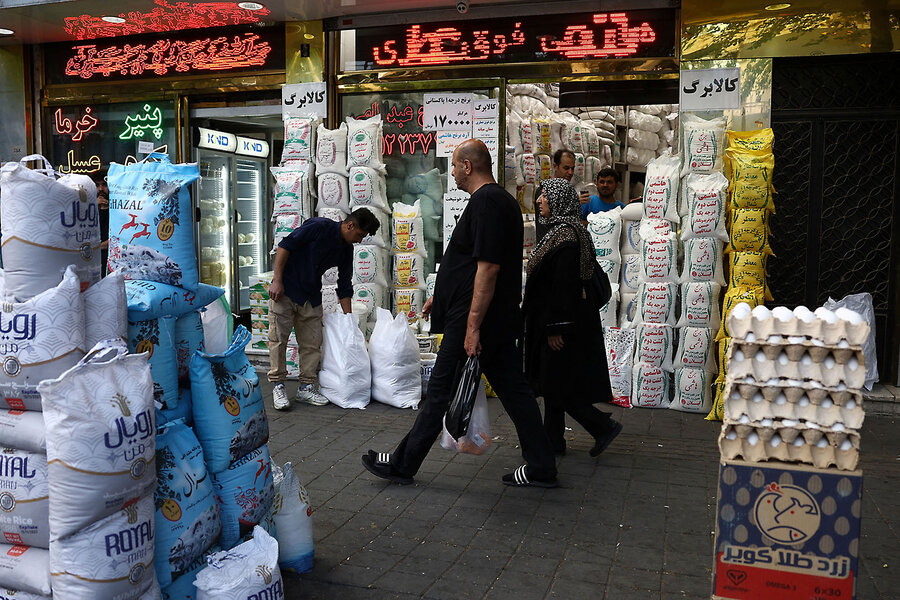
If there is a lasting peace deal to be struck between the United States and Iran, the biggest sticking point might be sanctions.
Iran wants the U.S. to step back its financial punishments, but President Donald Trump has said he will not make a bad deal simply to end the war.
When it comes to sanctions, however, what is a “good deal”?
Why We Wrote This
Sanctions have been perhaps the go-to geopolitical tool for the West over the past several decades. But as heavily sanctioned countries such as Russia and Iran keep pursuing their goals, many wonder: Are sanctions effective?
Experts say that is a question of clarity. For sanctions to be effective, the Trump administration will need to be clear and strategic about what it wants them to achieve in Iran now. Without this focus, sanctions don’t often accomplish much – certainly not regime change.
After all, the U.S. has had sanctions on Iran, in one form or another, since the Islamic Revolution in 1979. The country is still strong enough to defy American and Israeli airstrikes and hold the world ransom via the Strait of Hormuz.
Sanctions can inflict economic pain, and that is especially true in an Iran devastated physically and economically by war. But looking at the cases of Iran, Russia, and Venezuela, there are lessons about when sanctions work and when they don’t – and the rules can at times seem counterintuitive. Sanctions against airplane engine parts? Probably effective. Freezing oligarchs’ assets? Perhaps not.
At times, sanctions can seem little more than an attempt to show toughness. “We’re in a world that likes coercive tools, whether they work or not,” says Penny Naas, a sanctions expert at the German Marshall Fund of the United States in Washington.
But without clarity of purpose, sanctions create a new normal in which everyone adjusts. Sometimes, they can inadvertently help the country you want to punish. Usually, the big losers are the citizens already oppressed by an authoritarian regime.
When do sanctions work?
If there is a golden rule for sanctions, it is this: Know what you want to accomplish and then use targeted sanctions for a limited amount of time to achieve that defined goal. The danger is in setting too ambitious a goal. For example, sanctions alone will almost never bring about regime change. Venezuela and Iran are proof of that. They were also never going to get Russia to change course in Ukraine.
But was that their only purpose?
The U.S. sanctions imposed on Venezuela were intended to move the country toward free and fair elections, says Carrie Filipetti, a former deputy assistant secretary for Cuba and Venezuela in the State Department’s Bureau of Western Hemisphere Affairs. Ultimately, that was not a success, but there is evidence that after sanctions were loosened, the regime of Nicolás Maduro tightened its authoritarian grip.
“When I look at that, it’s not to say that sanctions made Venezuela free,” Ms. Filipetti says. “But you can see that they did seem to constrain some of the authoritarian impulses of the Maduro regime in ways that the release of sanctions did not.”
The same is true in Russia. The U.S. and European Union sanctions have not forced Russia to abandon its war in Ukraine, but that was not the only goal. They have caused economic trouble for Moscow. Interest rates are currently near 15%, largely to control inflation, which is running at around 6%.
Moreover, sanctions on Russian oil exports have significantly decreased oil revenue. Not only is Russia being forced to sell its oil to other buyers at a significant discount, it has also had to build a shadow fleet of ships that can deliver oil around the world without detection from international regulatory bodies. This has come at a significant price, both the cost of the fleet and the inefficiencies inherent in skirting international law. One estimate suggests these ships see a 30% decline in productivity.
With oil revenue central to the Russian economy, Russian government budgets have dipped into deficit spending. While this might be common in the West, it is unprecedented in the fiscally conservative era of President Vladimir Putin. Rising deficits had caused Moscow to prepare a list of spending cuts, tax increases, and other measures to cover the gap. But the Iran war, with its spike in global oil prices, has allowed Russia to avoid those choices for now.
The question is: Has the economic hardship caused by sanctions been enough to act as a deterrent to Russia in the future?
Some say the sanctions have been effective in that regard. “I don’t believe you can force Putin to change policy, but as a means of deterring Russia, you can hardly make it work better,” says Alexander Kolyandr, a Russia expert at the Center for European Policy Analysis.

When do sanctions not work?
Others say that the somewhat unfocused and long-term nature of the Russia sanctions means the country has essentially sanction-proofed itself.
This is the potential danger of sanctions. If not targeted and temporary, they can in some ways help the country they seek to punish.
“Sanctions have accelerated Russia’s turn to China, India, Africa, and other countries to establish lasting partnerships with countries of the non-West,” says Dmitry Suslov, an international affairs expert at the Higher School of Economics in Moscow.
And while sanctions have increased costs and forced workarounds, he adds, they have “also made some sectors of the Russian economy more agile, and the economy as a whole is more diverse and resilient than it was before sanctions.”
For example, when you remove furniture retailer Ikea from Russia (as sanctions did), Russian manufacturers as a result have more space to grow and innovate to meet market demand. Or when you target oligarchs’ financial holdings abroad, you encourage them to invest their money at home instead.
“They pushed all Russian capital stored abroad back into Mother Russia,” says Dr. Kolyandr. “The West helped Putin rally them around the flag and make them invest domestically.”
The years immediately following the invasion of Ukraine saw a domestic investment boom.
Far more effective are sanctions on things that Russia needs but cannot easily replace, like advanced aviation parts or semiconductors. By contrast, allowing Russian billionaires to keep their wealth abroad or to vacation in St. Tropez is not always a good look with Western voters politically, even if it hurts Russia economically.
“It is usually politically toxic,” says Dr. Kolyandr. “You can be accused of playing into Putin’s hands.”
Perhaps the hardest thing to achieve through sanctions is also the most important: buy-in from the international community. Many experts cite the Obama administration’s sanctions on Iran as among the more successful. But they took years to assemble. The clear goal was to move Iran back to the negotiating table on its nuclear program, and the effort won the backing even of Russia and China. That meant Iran had nowhere to turn – at least not until Mr. Trump pulled out of the deal in 2018, effectively shelving it and reopening doors for Tehran.
That was never the case in Venezuela.
“There are a lot of mechanisms for countries to evade sanctions these days, specifically because of the behavior of malign actors like China, Russia, and Iran, who are constantly helping each other bust U.S. sanctions,” says Ms. Filipetti, now a distinguished fellow at the Wilson Center in Washington. “Sanctions work much more when they’re not just U.S. sanctions, but they’re also sanctions from the European Union, from the United Nations.”

Who is punished by sanctions?
By one measure, the U.S. sanctions on Venezuela did have a devastating effect. According to the U.S. Government Accountability Office, sanctions placed on PDVSA, Venezuela’s state oil and gas company, in 2019 played a key role in the Venezuelan economy shrinking by more than one-third that year and by one-quarter the following year.
But what did that accomplish?
“We thought, ‘Well, if we deprive the regime of the resources that it needs to govern, then it will choose to negotiate,’” says Ms. Filipetti. “But really the only resources they needed were resources that they could use to pay off their loyalists. … They didn’t care about governing. And so we had underestimated their willingness to sacrifice their own people in order to keep themselves in power.”
Research suggests that smaller countries are more vulnerable to sanctions, especially ones so dependent on exports. But if they are willing to rule by intimidation, broad sanctions become less effective.
Cuba, long subject to debilitating U.S. sanctions, is an even starker example.
“What is amazing to me is that supporters [of the U.S. embargo on Cuba] always say Cuba is a cruel and repressive government,” says Christopher Sabatini, senior fellow for Latin America at Chatham House, a think tank in London. “But, if they are so cruel, why would they let people protest and overthrow them? They don’t care about human suffering. Their interest is in their own survival.”
This underlines a key point. Sanctions are only one tool. Problems arise when sanctions simply drag on or are not used in concert with other efforts to reach an achievable outcome.
In Russia, the sanctions did have an initial sharp effect, says Elina Ribakova, a sanctions expert at the Peterson Institute for International Economics in Washington. But that was never exploited by other means. Had those initial sanctions been paired with military action, she says, Russia might have been significantly weakened.
The complementary action doesn’t have to be military, but it has to be something, she says. “Ultimate success is in coordinating all these measures.”