Saboor’s son asks him one question over and over.
When can they go to the United States?
The Afghan family – Saboor, his wife, and their 11-year-old son – has been stranded in Mexico since Donald Trump returned to office more than a year ago and suspended asylum access at the southern border. The boy, wanting to connect with other children, has tried to learn Spanish.
Why We Wrote This
For nearly a year and a half, access to U.S. asylum has been suspended at the border. Recently, federal courts have ruled against the ban, renewing hopes for thousands of asylum seekers waiting in northern Mexico that they might be allowed one day to make their case.
Northern Mexico, where they live in a migrant shelter, was never the final destination. But it has become a bleak waiting room where their lives have paused, with the protection of American asylum law just beyond reach.
Saboor, who requested that the Monitor use a pseudonym in this story for security, says he has been displaced as a former Afghan government employee since the Taliban retook power in 2021. He also belongs to a religious and ethnic minority in Afghanistan. The Trump administration cut short his family’s yearslong journey toward the U.S. when it ended several humanitarian pathways in January 2025 and moved to seal the southern border. Saboor still wants to apply for American asylum – but that requires planting his feet on U.S. soil.
Blocking access to asylum “is like pouring cold water on someone’s hopes,” he says.
Limits to president’s power
Across the border, two federal U.S. courts have renewed Saboor’s hopes.
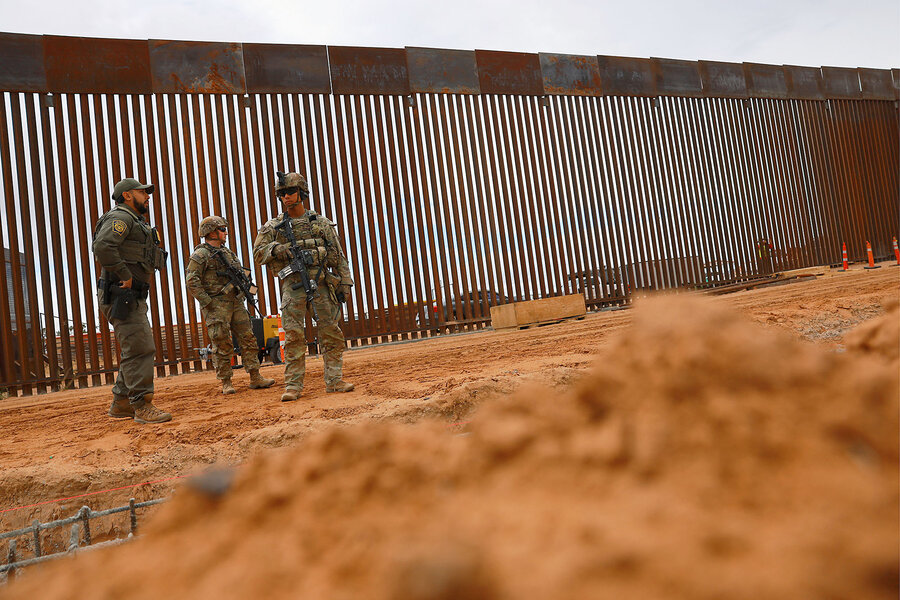
On his first day back in office, Mr. Trump announced he was suspending the entry of immigrants “involved in an invasion into the United States across the southern border until I determine that the invasion has concluded.” Additional policies set up a summary deportation process and blocked migrants’ ability to apply for asylum and other protections under U.S. law.
During the Biden administration, record-high illegal border crossings often resulted in releases of unauthorized immigrants, with little vetting, into the country’s interior, where they could wait years with pending asylum claims. Yet after the Biden administration adjusted border policies and Mexico aided with enforcement, illegal crossings were lower when Mr. Trump returned in January 2025 than when he left in 2021.
Affirming a district court decision last year, the U.S. Court of Appeals for the District of Columbia Circuit in April ruled the president’s “invasion” proclamation, and related border policies, unlawful. Mr. Trump used those directives to justify the blocking and swift removal of border-crossers, even if they sought protection under the law.
Congress gave the president power to suspend entries, but not the “expansive removal authority” that he claims, the appellate court wrote. His “invasion” proclamation and related policies were deemed unlawful because they circumvent the deportation processes and right to seek asylum already written into law.
Asked for comment, a spokesperson for Customs and Border Protection replied: “The border remains closed.” The agency “strongly disagrees with the reasoning and expects to ultimately prevail in this litigation.”
The Justice Department “will continue to vigorously defend the President’s immigration enforcement agenda whenever it’s challenged in federal court,” a DOJ official said in a statement.
The administration may continue challenging the court rebuke. Meanwhile, uncertainty of future asylum access has left Saboor and thousands of others waiting.

“Tension only Congress can fix”
Laura St. John, legal director at the Florence Immigrant & Refugee Rights Project – one of the nonprofit plaintiffs – says she hopes full asylum processing will return after its absence “put a lot of people in very real danger.”
Ms. St. John recalls one client from an African nation who, soon after the president’s proclamation, approached the border and tried to seek asylum. Instead, officials put her on a plane to Panama, a country to which she had no ties. Ms. St. John says the client tried to seek asylum in Mexico, but was kidnapped and sexually assaulted there.
After she escaped, the client successfully obtained a screening at the border that allowed her to enter, which has been rare, says Ms. St. John. That woman, who became pregnant from the violence she endured, eventually gained asylum in the U.S.
“People being sent to places where they will be severely harmed or tortured or killed without any screening, without any review of their case – that’s deeply problematic,” says Ms. St. John. “Frankly, it’s un-American.”
U.S. law makes it illegal to cross into the country outside official ports of entry. Yet once someone has entered the country – even if they came in illegally – the law allows them to apply for asylum, along with other relief.
“That is a tension only Congress can fix,” says Ammon Blair, a former Border Patrol agent and senior fellow at the Texas Public Policy Foundation.
Mr. Blair points to the Secure Fence Act of 2006, which called on the secretary of Homeland Security to achieve “operational control” by preventing all illegal entries. In a literal sense, the government has yet to achieve that goal.
“We still have the duty and authority … to make sure that no one enters” unlawfully, Mr. Blair says. “But, if they do, then they have the right to claim credible fear.”
Fewer legal options
When the Taliban took back Afghanistan in 2021, Saboor says, he was working for the Afghan government in Iran, aiding Afghans there. Iran was inhospitable to former Afghan officials like him, and many couldn’t return home due to security concerns. Through a humanitarian visa, he says, he fled to Brazil.
The goal was the U.S. But along the way, he says, “we lost everything,” including money. At one point, he says Mexican law enforcement raided the place they were staying. Terrified, his family was told to leave the country in a month. They relocated to northern Mexico.
Several policy changes narrowed his ability to enter the U.S. lawfully. Saboor says his family sought lawful entry through a program called CBP One, whose cancellation Mr. Trump called for on his first day back. Saboor also says he sought refugee protection through the United Nations. Yet Mr. Trump suspended the U.S. refugee program, also on Day 1, and has since prioritized the resettlement of white South Africans.

Carlos Moreno/NurPhoto/AP
“The hope is never gone”
On the border, policy whiplash has been constant. Customs and Border Protection oversaw seven different asylum-processing policies at ports of entry within the span of eight years, according to a report from the University of Texas at Austin.
An estimated 5,190 migrants like Saboor remained in Mexican border cities as of May, according to the study, down from more than 12,000 in early 2025. With tent encampments gone, many now live in rented rooms after moving out of shelters, the report said.
To help stranded people and families in Nogales, Mexico, across from Arizona, the Center for Victims of Torture has started offering mental-health services at a shelter. Many are internally displaced Mexicans fleeing violence, says Ariadna Gudiño, a psychotherapist and trainer for the nonprofit.
“When we speak with them, they say our goal is to go to [the U.S.], but we don’t know when,” she says. “The hope is never gone.”
Meanwhile, Saboor and his family wait.
Saboor says he relies on news but also word of mouth to understand dynamics at the border. The grapevine says some families who have crossed into the U.S. are detained and then released, while single adults can sit in detention for a year or more. Others are deported or aren’t heard from again.
Saboor, who grew up amid war and discrimination, says he wants to spare his son a similar upbringing.
“I want him to grow up in a peaceful environment, to go to school,” says Saboor. “To be able to take care of himself, and take care of others as well.”