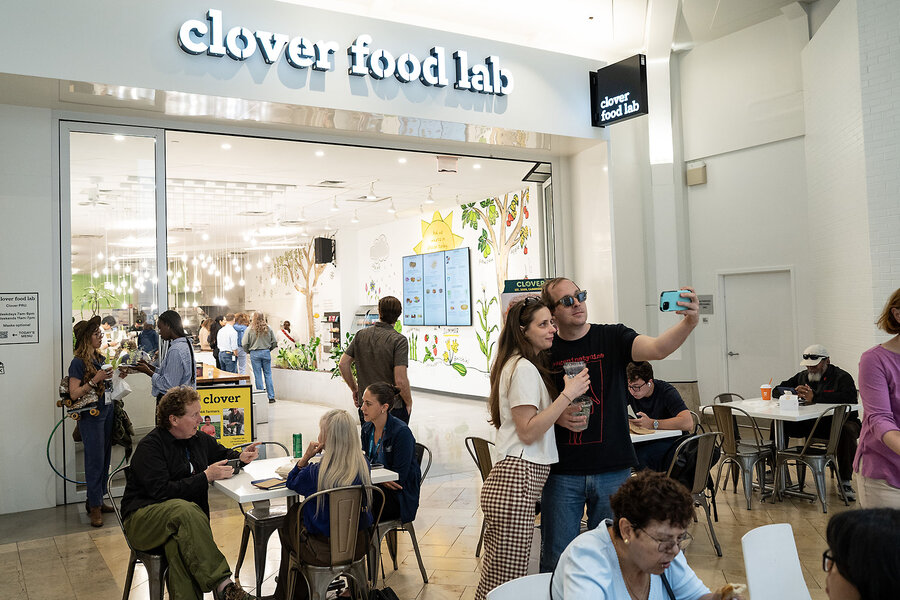
When a popular Boston eatery announced it was closing all stores at the end of May, streams of regulars queued up for one last lunch. They came for the rosemary fries, the chickpea platter, and mushroom poppers. Customers took selfies beneath its illuminated sign and hugged staff. One even composed a ukulele-accompanied tribute.
Clover Food Lab, launched by Ayr Muir in 2008 as a food truck at the Massachusetts Institute of Technology, sought to change perceptions of vegetarian food from raw salads and tofu that left you hungry to a constantly evolving sandwich-and-soup menu made with in-season produce from local farms. Customers in nearby Cambridge and in Boston quickly became loyal to the fast-casual restaurant, which prided itself on a mission of discreet environmental activism to reduce meat consumption.
The company grew, eventually opening 12 locations and launching a meal-kit delivery service. But the pressures of the pandemic, the slow return of office workers, the ongoing rise in food prices, and a profit shortfall left the company unable to cover costs. Unfruitful efforts to secure a buyer over the past few months led the company to lay off its 170 employees and close up shop.
Why We Wrote This
Clover Food Lab was a homegrown vegetarian eatery that grew on its ever-changing seasonal offerings in the Boston area. The pandemic, rising food costs, and other factors pushed it to close its doors, but that turned out to not be the end of the story.
But then, like a falafel-stuffed pita from the sky, a mystery investor emerged amid the melee of customer lament. Because the company had already developed a plan for a reduced footprint if it had found a buyer, says Julia Wrin Piper, chief executive of Clover Food Lab, the new investor will allow it to quickly pivot and open a select number of stores for lunch as soon as June 9.
“The world of restaurants and retail changes so fast, especially in response to these other larger forces at work, whether it be a horrific winter, inflation, or a war,” says Ms. Wrin Piper, who declined to name the investor.
Clover’s rise, fall, and tentative rise again might serve as a sign of the times, but it’s also part of a larger story around Boston’s innovative restaurant scene, says William Masters, a professor in the Friedman School of Nutrition at Tufts University. Food entrepreneurs here have regularly launched food trucks that have led to brick-and-mortar locations. In addition, people in this metropolitan area, home to around 50 colleges and universities, are receptive to affordable plant-forward options. Life Alive, another local vegetarian fast-casual chain, continues to expand. Purple Carrot, a vegan meal-kit service, launched in the Boston area in 2014 and is still going strong.
“Boston is particularly good at offering an on-ramp to try new things,” Dr. Masters says. “But you cannot try new things if you don’t close the things that don’t work. There’s no way to have innovation without failure … and there’s no stigma in that. You want [a restaurant] ecosystem that allows new startups to begin, experiment, and try.”
Clover’s revamping comes at a time when meat sales in the United States are at an all-time high, reaching $112 billion in 2025, according to the Meat Institute, with millennials and Gen Z driving the growth. Vegetarians make up only 4% of American consumers, according to a 2023 Gallup poll, but that figure doesn’t reflect that nearly 37% of Americans who consider themselves “flexitarians,” or willing to give up meat a few times a week. A 2022 poll commissioned by the Vegetarian Resource Group and Vegan Journal shows that nearly 60% of Americans “always, sometimes, or usually” eat vegetarian meals.
One of Clover’s defining characteristics is its use of locally grown, in-season produce from New England, even though it can increase complexity and overhead costs. This aligns with the region’s growing emphasis on supporting local farmers. For example, Massachusetts passed a bill this spring that will make it easier for school systems to include locally grown food in cafeteria offerings.
“Farm-to-table and local procurement is fundamental to community building,” says Dr. Masters. It adds an extra level of perceived enjoyment for consumers who are aware of the connection, he says, even if it is more expensive. “People want to identify and buy from and sell to others in their own community because that’s how we build relationships and feel rooted.”
Clover sources 80% of its produce from about 12 New England farms, Ms. Wrin Piper says. It’s a relationship local farmers have come to depend on.
Luke Mahoney of Brookford Farm in Canterbury, New Hampshire, who grows mostly root vegetables, says Clover is one of its biggest buyers. He had heard there was a possibility that the restaurant might close, which meant he had to take a calculated risk this growing season.
“I’ve already planted the vegetables that I was planning on selling Clover next June, a year from now,” says Mr. Mahoney, who determines the coming season’s plantings in February.
“There’s really not a lot of authentically farm-to-table places left. A lot of people claim they do, but they really don’t. Clover [is] one of the few that actually are farm-to-table,” he says.
Red Fire Farm in Granby, Massachusetts, has long sold Clover fresh salad mix for its meal box delivery, tomatoes for its sandwiches, and fresh berries for its drinks. Farmer Sarah Voiland posted an appreciation on Instagram after hearing that Clover was closing, before the latest turn of events.

Medara Udoekong/The Christian Science Monitor
Clover is “a rare type of customer that’s willing to take what’s available and figure out how to fit it into their menu,” says Ms. Voiland, who expressed admiration for what Clover has accomplished over its nearly two decades of vegetable-first menus. She says she is relieved to hear that, for now, Clover plans to reopen.
Ms. Wrin Piper says Clover Food Lab remains committed to local sourcing moving forward, adding that those relationships were likely a major reason for the outpouring from customers upon news of their closure.
“I think there’s a real authenticity in a connection to the little corner of the world that produces this food,” she says. “There’s a lot of joy from that.”
Many of Clover’s customers do not consider themselves full-time vegetarians. Some are attracted to the founder’s mission of reducing meat consumption to protect the environment.
Phillip Deen came to the Clover location in Boston’s Prudential Mall on May 28 to mark what he assumed was its final day of operation. He ordered the chickpea platter: falafel fritters made with fresh herbs and toasted spices, hummus, a freshly chopped cucumber-tomato salad, tangy pickled vegetables, and a tahini drizzle.
“Eating vegetarian is better for your health, it’s better for the planet, and it’s definitely better for animals,” says Mr. Deen, a philosophy professor who teaches environmental ethics and climate ethics at the University of New Hampshire. He says he tries to eat vegetarian when he can, though there aren’t many options in his East Boston neighborhood. “I can’t sit and teach my students about helping the environment if I’m not willing to follow the directions I’m giving them,” he says.
For now, Clover’s imminent return will allow him to continue that practice.
Ms. Wrin Piper says she is proud of her team for sticking together through the turbulent, uncertain months and remaining committed to their mission. Now, their focus is on finding a way forward that makes sound business sense.
“I think that there is a clear path to be economically competitive at a larger scale, but you have to grow in the right economic moment,” says Ms. Wrin Piper. “Right now, we are not in the right economic moment, but that doesn’t mean that we won’t be in the future.”
Staff writers Olivia Fletcher and Kelenna Onukwugha contributed to this report.