When the Second Continental Congress declared independence from the British crown on July 4, 1776, it would be another 15 years before the Founding Fathers adopted a constitution that enshrined the “free exercise” of religion.
But the yearning for that ideal – and the American distaste for established churches – had much earlier roots. In 1644, Rhode Island founder Roger Williams called for a “wall or hedge of separation” between the church and what he called “the wilderness of the world.” Five years later, Maryland’s General Assembly passed “An Act Concerning Religion,” which aimed to keep the peace among settlers of competing Christian faiths, at a time when Protestants and Catholics were killing each other back home in England.
The Toleration Act, as it became known, was a far cry from the First Amendment, and it only lasted about 50 years, says Anna Majeski, the Lilly Endowment curator of religious history for the Maryland Center for History and Culture in Baltimore.
Why We Wrote This
In the mid-1600s, Maryland settlers pioneered a form of religious liberty, in part, as a way to bring in more settlers. Their Toleration Act didn’t last, but its spirit is present in America’s founding documents.
Even so, the act still had the power to inspire European settlers to reimagine how society could be built. It proposed and field-tested a new way of behavior that created, briefly, a safe space for religious expression for both Catholics and Protestants. While the act was repealed twice and reinstated twice, it provided a precedent that later inspired the First Amendment.
“The 1649 act is the opening of a 200-year argument about religious liberty,” says Fatimah Fanusie, a religious historian and director of the Civic Leaders Fellowship program at the Institute for Islamic, Christian, and Jewish Studies in Baltimore. “It has progressive language within it, but it also has religious exclusions for non-Trinitarian Christians, Unitarians, and Jews.”
Professor Fanusie says that free expression was a powerful concept that outlived the 17th-century restrictions of who qualified for religious liberty, just as the broader concept of liberty outlived the 18th-century limitations imposed when the Founding Fathers wrote that “all men are created equal.”

Scott Baldauf/The Christian Science Monitor
“We’re still having that 200-year argument today, but I do think we have moved significantly beyond the types of exclusions – at least legally – that existed in the 17th century,” Professor Fanusie says. Over time, those who were excluded from religious protection “helped to create the climate that produced the Declaration of Independence and Constitution.”
One major hurdle was that each of the 13 Colonies had its own dominant churches, with Puritans and Congregationalists in New England, the Church of England in the mid-Atlantic states, and Baptists farther south. Maryland’s experiments in religious tolerance sounded great on paper, but proved difficult to enforce in people’s behavior.
“This was an experiment born out of pragmatism,” says Dr. Majeski. Maryland’s founders, brothers Cecil Calvert (the second Lord Baltimore) and Leonard Calvert, were Catholics and wanted to create a haven for Catholics from persecution back in England.
“They knew they needed people of other faiths to populate the colony. The only way to do that was tolerance.”

Scott Baldauf/The Christian Science Monitor
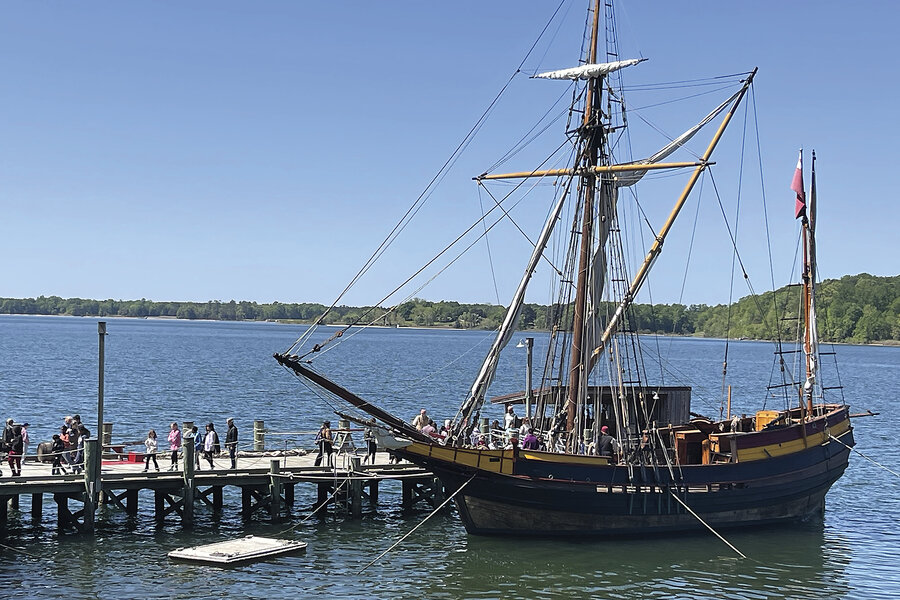
With the arrival of settlers in 1635, St. Mary’s City became a bustling town of inns and trading posts and taverns. It was a port town on the Chesapeake Bay, where ships would offload goods from Europe and take away the colony’s biggest cash crop, tobacco. It was also the home of the provincial governor. Today, this spot is an archaeological site, where excavators brush and trowel away the dust of time, sifting the soil for artifacts. Elsewhere, Historic St. Mary’s City is slowly taking form. Private donations have rebuilt the city’s chapel, a scattering of inns, and the State House, where the General Assembly met until the capital was moved to Annapolis in 1694.
By today’s standards, the Toleration Act would be considered deeply flawed. It only protected religious practices for Trinitarian Christians who followed “the father, sonne, and holy Ghost.” Those of other faiths, including Quakers, Unitarians, Jews, and followers of Native American faiths, enjoyed no such protection.

Scott Baldauf/The Christian Science Monitor
The act also proved unable to prevent the civil wars back in England from reaching Maryland’s shores. In 1654, after Puritan Parliamentarian Oliver Cromwell toppled King Charles I, Puritan settlers in Maryland toppled their provincial government and rescinded the Toleration Act. The pendulum swung back and forth between Catholics and Protestants over the next four decades, until it was rescinded for a final time in 1692.
Peter Friesen, director of education at Historic St. Mary’s City, says that Marylanders celebrate the role their state had in establishing the concept of religious freedom in the Colonies, but tend to forget the Toleration Act was made null and void multiple times.
“To me, it’s always important to remind people that rights can come and rights can go,” Mr. Friesen says. “It’s up to us to keep our rights and to fight for them and to be diligent with our rights, because as soon as you take them from other people, then it’s easier to take them from more people.”