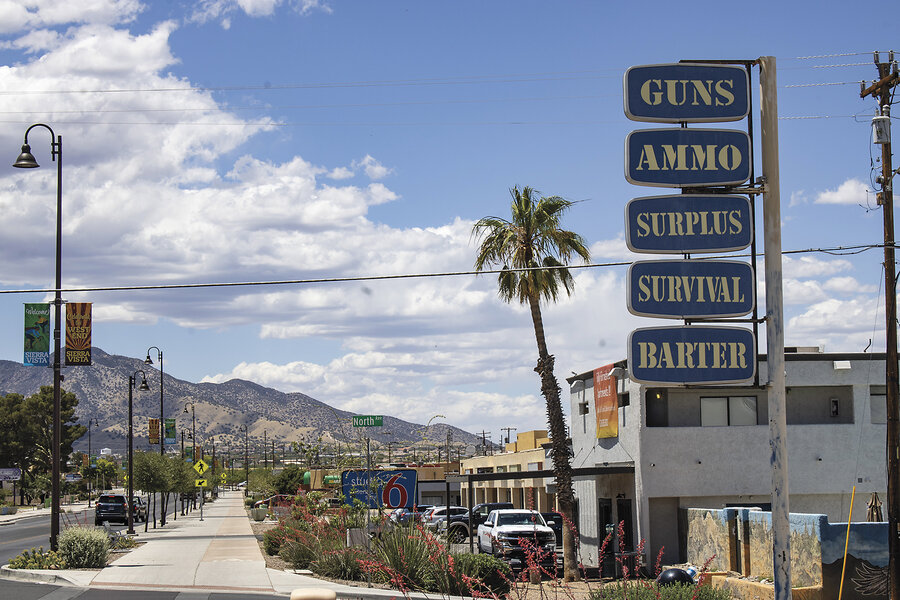
With fewer than 50,000 people, Sierra Vista is a town of military discounts and very little shade. At a nearby U.S. Army fort, a white surveillance blimp sits in the Arizona sky like a mechanical cloud.
A drive 50 miles south will get you to the border with Mexico. That’s where an untold number of guns purchased in the United States have long shown up at deadly cartel crime scenes. Over the years, both the U.S. and Mexico have tried to stop what’s sometimes called an iron river of guns.
Last year, the Trump administration gave prosecutors a new tool. The U.S. government declared some of those cartels foreign terrorist organizations.
Why We Wrote This
The U.S. government has been unable to stanch the flow of guns purchased in American stores then handed over to Mexican drug cartels. But since President Donald Trump declared cartels foreign terrorist organizations, prosecutors have a tool that some believe could make gun dealers more careful about who they sell to.
In March, Laurence Gray, an Arizona gun seller, was indicted on charges that include attempting to provide material support to a foreign terrorist organization – Mexico’s Jalisco New Generation Cartel – and of conspiring with others to do so for that cartel and its rival, the Sinaloa Cartel. Neither Mr. Gray nor his lawyer responded to requests for comment.
Gun-trafficking experts say those terrorism-related charges against an American firearms dealer are likely a first. The accusations appear to respond to Mexico’s demand for action on arms trafficking, marking potential progress in the United States’ fraught but vital relationship with Mexico.
“There is a material weakness in the laws when it comes to firearms trafficking,” says Bernard Zapor, a criminal justice professor at Arizona State University and former official at the Bureau of Alcohol, Tobacco, Firearms and Explosives, known as ATF.
Leveraging terrorism-related charges is a “good enhancement that puts some teeth into this, and potentially would cause some deterrence,” he says.
Drugs north, guns south
The U.S. has long accused Mexican cartels of pushing lethal drugs north. The Mexican government, meanwhile, has pleaded with American officials to stop the illicit flow of firearms south.
In Mexico, the only legal gun seller is the military. Arizona alone has more than 1,200 licensed firearms dealers.
Federal data from 2022 to 2023 shows Texas as the top source state for crime guns recovered in Mexico and traced to a purchaser (7,825), followed by Arizona (3,969). Along the southern border, a route from Arizona to the Mexican state of Sonora trafficked the most.
Mexican President Claudia Sheinbaum Pardo has urged the U.S. to respect her country’s sovereignty. She appeared pleased that the White House’s 2026 National Drug Control Strategy mentions the need to disrupt the flow of guns used by criminal groups to exert control – and the need to curb U.S. demand for illicit drugs.
The sales
Mr. Gray’s business, Grips by Larry, was incorporated in Nevada over a decade ago, according to state business records. While that name was tied to a federal firearms license, the related storefront in Sierra Vista was called The Other Guys Guns Ammo & Accessories.
Mr. Gray sold firearms, ammunition, optical gadgets, and gun grips made of mammoth tooth. The gun dealer modeled his rifles, pistols, and even a fire-breathing flamethrower for social-media clips.
“We have the largest selection of handguns in the county, I think,” Mr. Gray told local media at his shop. “We have picked up just a horrendous amount of product.”
Before the terrorism-related charges, Mr. Gray was named in another federal case against one of his employees. Special agent James Cauble from the ATF described in an affidavit how the employee and Mr. Gray had allegedly been “selling large caliber, belt-fed, rifles and other weapons of choice to individuals they know are coordinating the trafficking of these items into Mexico.”
That criminal complaint alleged that Mr. Gray sold a confidential informant a Colt .38 Super pistol for $4,000 and grips for $250 that had a rooster design, though someone else – an undercover agent – filled out the federally required paperwork for the sale. The informant told Mr. Gray’s employee that the rooster represented the Jalisco New Generation Cartel, which would be the actual recipient – to which the employee allegedly said he understood and continued with the sale.
A year after the store opened in May 2024, an initial federal indictment against Mr. Gray, and a co-defendant, charged him with several gun-related crimes. Those included allegations of aiding and abetting illegal gun purchases, such as a .50-caliber rifle.
The updated indictment in March 2026 – a year after the Trump administration designated the cartels as foreign terrorist organizations – added five new charges against Mr. Gray, including the two terrorism-related ones.
The ATF and the U.S. Attorney’s Office for the District of Arizona declined interview requests.
Those agencies’ collaboration on the case stands in stark contrast to their shared scandal in Arizona over a decade ago.
Operation Fast and Furious, as it was dubbed, was “truly a national embarrassment,” says Peter Forcelli, a retired ATF official who became a whistleblower. ATF agents, with agreement from federal prosecutors in Arizona, allowed around 2,000 firearms to “walk,” instead of seizing them, in hopes of tracking illegally purchased weapons to cartel-related crimes. Whistleblowing exposed the strategy following the 2010 murder of Border Patrol Agent Brian Terry, where guns tied to the operation were found at the scene.
Mr. Forcelli sees the use of terrorism-related charges now as a “positive step.”
“Is it dramatic, perhaps? Yeah, maybe,” he says. “But again, the alternative wasn’t working.”
Working together
Mr. Gray’s business in Sierra Vista is closed. In early May, the shop, which sat next to a nail salon, looked bare inside.
Another dealer, West-End Pawn & Gun, advertises on Mr. Gray’s shuttered storefront. “Need Ammo?” ask the handwritten signs, directing customers four blocks down.
“Just like everyone else in the American judicial system, he’s innocent until proven guilty,” says Jim Adams, who manages the pawn shop.
At the same time, “We’re very cognizant of the need to control the flow of firearms and ammunition and the currency that supports it going back and forth across the border,” says Mr. Adams. “We’re very careful here who we do and do not do business with.”
Several Sierra Vista gun dealers work together to avoid “straw purchases” – illegally buying a gun intended for someone else, such as a person who’s barred from buying them. Shops warn each other of suspicious buyers, says Craig King, owner of King’s Armory.
“We will refuse them,” says Mr. King. “Then we’ll notify the other shops that we had this person in here … and be on the lookout in case they walk through your store, too.”
Firearms experts estimate that a small fraction of licensed gun sellers are linked to gun trafficking. Still, such accusations in a community of licensed dealers “looks bad on everybody else,” says Sheena Chavez, King’s Armory manager.
Mr. King supports the use of terrorism-related charges.
“You keep your nose clean, you don’t have that problem,” he says.

Defining terrorism
The United States has long debated what terrorism means. While the first Trump administration singled out “radical Islamist terrorists” in a counterterrorism strategy, the latest such report from May added “violent left-wing extremists” and “narcoterrorists.”
Typically, terrorism has meant political violence targeting civilians – a label that doesn’t make sense to apply to Mexican cartels lacking political goals, says Wadie Said, a criminal law professor at the University of Colorado Law School. Those criminal groups are “just into self-enrichment,” he says.
Professor Said has criticized the 30-year-old “material support” law as dangerous, and broadening in its scope. The type of charge against Mr. Gray brings the potential of up to 20 years in prison.
As president and founder of Global Action on Gun Violence, Jonathan Lowy supports the terrorism-related charges as a legal tool.
In his view, the best way to stanch the iron river isn’t by going after individual straw purchasers. Instead, turn off the spigot at the source: gun dealers, manufacturers, and distributors, he says.
“Any step by law enforcement to go higher up the food chain is very significant, and that’s what this indictment signifies,” says Mr. Lowy.
“If it were done by a Democratic administration, I think you would hear tremendous applause from the gun-violence prevention community.”
Global Action on Gun Violence has represented the Mexican government in U.S.-based litigation. In 2021, Mexico sued gun manufacturers, alleging that their negligence caused gun violence in Mexico. The Supreme Court last year ruled that the lawsuit was barred by U.S. law. Mexico filed a separate, ongoing lawsuit in 2022 against Arizona firearms dealers alleging negligence in allowing straw purchasers to buy guns.
The National Shooting Sports Foundation, a firearms industry trade association, says it works closely with the ATF to prevent straw purchases.
The foundation “supports the efforts of the Department of Justice to prevent illegal firearms trafficking to criminal elements within the borders of the United States,” as well as criminals and terrorists beyond U.S. borders, spokesperson Mark Oliva said in a statement.
The trial involving Mr. Gray is slated to begin Aug. 4 in Phoenix, according to court records.
Meanwhile, Customs and Border Protection reports seizing over 900 firearms headed outbound at the southern border so far this fiscal year. Those seizures surpass the totals for fiscal year 2025.
Customs officials at Arizona ports continue screening for southbound guns. Like the more than dozen rifles and a grenade launcher tube recently found beneath the back seat of a Lexus, driven by an American woman with three kids in the car. Another U.S. citizen’s van held seven AK-47s and 11,000 rounds.
“Public safety matters on both sides of the border,” says Mr. Forcelli, the former whistleblower. “People living in Mexico are human beings, and they deserve to live in safety.”