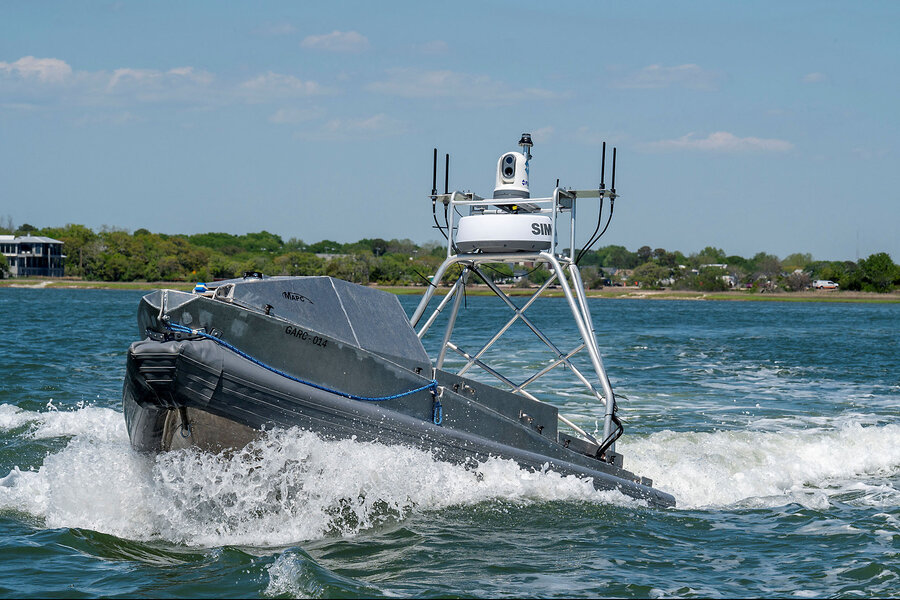
The dramatic rescue of two downed Apache helicopter pilots this week by an unmanned U.S. military boat promises to add to an already significant demand for seafaring drones throughout the U.S. Navy.
Dozens are already under development, including everything from small robotic speedboats to the Orca, an large submarine without a human crew, capable of disappearing underwater on missions for months at a time, according to the Pentagon.
Just last week, U.S. lawmakers told the Defense Department to speed up its current use of unmanned surface vessels, as they are known in Pentagon parlance. They also asked for more details about the sorts of missions that these drones can help the Navy do.
Why We Wrote This
The unmanned boat that helped rescue an Apache helicopter crew on Monday night was the equivalent of a seaborne pickup truck. The U.S. has “urgent mission needs” for such autonomous Navy vessels, lawmakers are saying.
A real-life answer to that question arrived this week in the Strait of Hormuz amid the Iran conflict.
The drone that helped the U.S. military rescue the Apache helicopter crew on Monday night was a Corsair unmanned surface vessel – a sort of robotic oceangoing truck – operated by the U.S. Navy’s 5th Fleet Task Force 59, according to U.S. Central Command, which runs Pentagon operations in the Middle East.
American service members at U.S. bases around the world have “urgent mission needs” for such drones, lawmakers warned in the 2027 draft defense bill, passed by the House Armed Services Committee last Thursday. The key is to make sure the drones, which have also been plagued with software glitches and crashes, can operate when their navigation systems are being jammed and communications with crewed ships are cut off, the committee noted.
Task Force 59 began using Corsairs in the Middle East in late March. Named for the sea raiders given government permission to attack enemy shipping from the 1500s to the early 1800s, the Corsair was called into action for the rescue mission this week because of “proximity and capability factors,” according to a U.S. Central Command spokesperson.
The drone picked up the two soldiers within approximately two hours of their crash, and took them to a location where they could be airlifted to safety by helicopter. The crash of their Apache may have been caused by a collision with an Iranian drone, according to news reports. Central Command last week warned of Iranian drones operating over the Strait of Hormuz.
The Navy launched a special Task Force 59 group in early 2024 to “bolster maritime security across the Middle East,” according to a Jan. 16, 2024, statement, and soon began using fast robotic speedboats such as the T-38 Devil Ray as well. A 38-foot vessel with no cockpit or crew, the Devil Ray is packed with sensors, communications gear, and weapons designed to “advance lethality at sea,” the statement said.
As the Navy’s first sea drone and artificial intelligence task force, established in 2021, Task Force 59 has since tested dozens of drones. It often operates as a sort of technology startup embedded inside the Navy’s Fifth Fleet headquarters in Bahrain.
The Navy’s drone development programs have run into challenges, including struggles with the salt corrosion, barnacles, extreme heat, and heavy seas that can keep vessels from operating reliably in the ocean.
As with self-driving cars, other perils involve avoiding collisions in, for example, crowded shipping lanes.
At a U.S. Navy showcase test attended by the media last August in California, while officials scrambled to fix a software malfunction in one drone boat, another unmanned vessel crashed into it, Reuters reported at the time.
The Navy ultimately hopes to turn groups of hand-picked troops into “pioneers” in seafaring drones, as it has done with Task Force 59, its commodore, Capt. Colin Corridan, said in 2024.
Such “trust and experience with robots is ultimately developing the next generation of sailors,” he added, to spearhead “the hybrid fleet” of the future.