So is a peace deal with Iran just around the corner – or is President Donald Trump on the verge of restarting the war?
Given his statements of just the past few days, it’s hard to say.
On Monday, Mr. Trump struck a familiar chord, telling reporters that negotiations to end the Iran war were in their “final throes” and that a deal could be reached “within days.”
Why We Wrote This
As the U.S.-Israel war with Iran has dragged on far longer than President Donald Trump perhaps anticipated, he has alternately predicted an imminent peace deal and threatened punishing attacks. Is this calculated, or a sign he has lost control of the conflict?
Then, Monday night, an Iranian Shahed drone downed a U.S. Apache helicopter near the Strait of Hormuz. The two aviators were rescued (by an American sea drone), but Mr. Trump promised retaliatory strikes – which were indeed carried out on Tuesday.
More ominous still, early Wednesday, the president took to Truth Social to declare that the Iranians have “taken too long to negotiate a deal that would have been great for them, now they will have to pay the price!!!”
Then, speaking to reporters at the Oval Office later in the morning, he said, “We hit them hard yesterday and we’ll be hitting them hard again today,” before adding he is still hoping for a deal.
The renewed hostilities and threatening language amid a shaky ceasefire might be expected to put off at least the rosy rhetoric of an imminent peace agreement. But then again, maybe not.
Over recent weeks, Mr. Trump has claimed dozens of times in various settings – chatting with reporters, speaking to supporters, and in late-night social media posts – that peace talks were making “incredible” or “very rapid” progress. An “amazing” deal was just around the corner, he has predicted: in “two or three days,” or “a few days,” or “next week.”
It’s a tune Mr. Trump has sung repeatedly over recent weeks, as the ceasefire has smoldered, flare-ups between Iran and Israel have threatened escalation, and public opinion has further soured on a war the president launched alongside Israel in February.
Is there a strategy?
After months of the same, Mr. Trump’s style of “we’re almost there, we’re so close” diplomacy raises questions among some analysts as to whether there is some strategy behind the approach:
Are the pronouncements the mark of an optimistic leader whose preference is for quick action and short time frames? Or do they compensate for a reality in which Mr. Trump is not in control of a conflict that is dragging on substantially longer than he first envisioned?
“So much is shaped by this president’s short-term desires, what he wants to see happen quickly, and how he wants others to see the situation,” says Behnam Ben Taleblu, senior director of the Iran program at the Foundation for Defense of Democracies in Washington.
“This may be the president cheerleading, but I do think there is a semblance of strategy to what he’s saying,” he adds.
“He wants to inject some optimism into the idea that the talks are going somewhere,” he says. “But he’s also blunting the impact of a more skeptical media and more skeptical markets about the course of this war and the prospects of these talks.”
Indeed, markets fell Wednesday in response to Mr. Trump’s suggestion that talks with Iran might have failed.
For some analysts, what might be emerging is an indefinite period of talks proceeding even as tit-for-tat military actions occasionally flare, as bitter enemies Iran and Israel both test the limits of military operations within a shaky ceasefire.
“It may be too soon to look at what’s going on as the new normal in the Middle East,” Mr. Taleblu says. “But I do think we’ve entered what might end up an extended period of ‘shoot and talk at the same time.’”
Still, what some see as Mr. Trump’s underlying desire to get a deal and move on from what has been for him a disastrous war might yet prompt an agreement that stops the shooting.

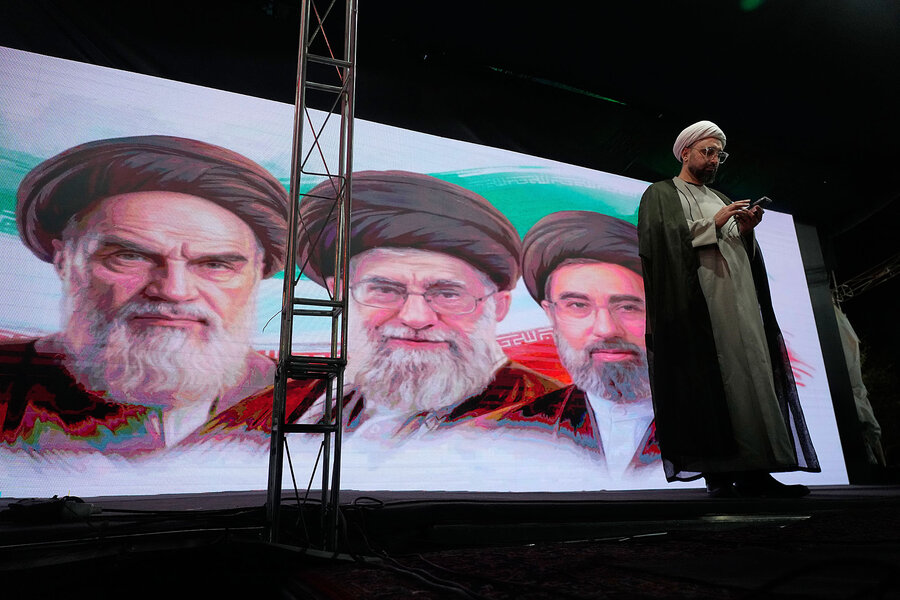
Amirhosein Khorgooi/ISNA/WANA/Reuters
Iranian leverage
That is a worrisome scenario for some Trump critics.
“Donald Trump clearly wants an agreement allowing him to declare victory and move on from the conflict, [but] the risks for U.S. national security, however, are potentially enormous,” comments former Trump national security adviser John Bolton, a noted Iran “hawk,” in a column Wednesday in Independent Arabia.
He writes that the president’s “zeal for a deal” risks leaving Iran with too much leverage in the region, and with big wins – especially financial – in exchange for strict limits on its nuclear program.
Mr. Taleblu says that even though he sees a method to the president’s upbeat pronouncements, he also draws a line at some he says have gone too far.
Noting that Mr. Trump said last week he would be “honored” to meet with Iran’s supreme leader, Ayatollah Mojtaba Khamenei, if a deal can be reached, Mr. Taleblu says such cheery comments are “tone-deaf and extremely unwise.”
This is essentially the same Iranian leadership that by some counts killed tens of thousands of its own citizens in anti-protest crackdowns in January, he says, adding that, at the outset of the war, Mr. Trump invoked the memory of those Iranians killed by the state.
“This kind of remark is putting him into the same unappealing place that [President Barack] Obama was in and for which Trump criticized him in 2009 for not supporting the Iranian people,” Mr. Taleblu says.
Whether it’s a deal with Iran or renewed war that is very close remains uncertain. But Vice President JD Vance appears to have jumped onto the president’s “deal very close” bandwagon.
In an interview with CBS News taped Tuesday for airing later in the week, Mr. Vance says the U.S. is “very close to achieving” a deal that both opens the vital Strait of Hormuz and assures that Iran won’t have a nuclear weapon far beyond Mr. Trump’s presidency.
Quipping “We still got some wood to chop,” the vice president said he was certain there would be a deal before November’s midterm elections.