


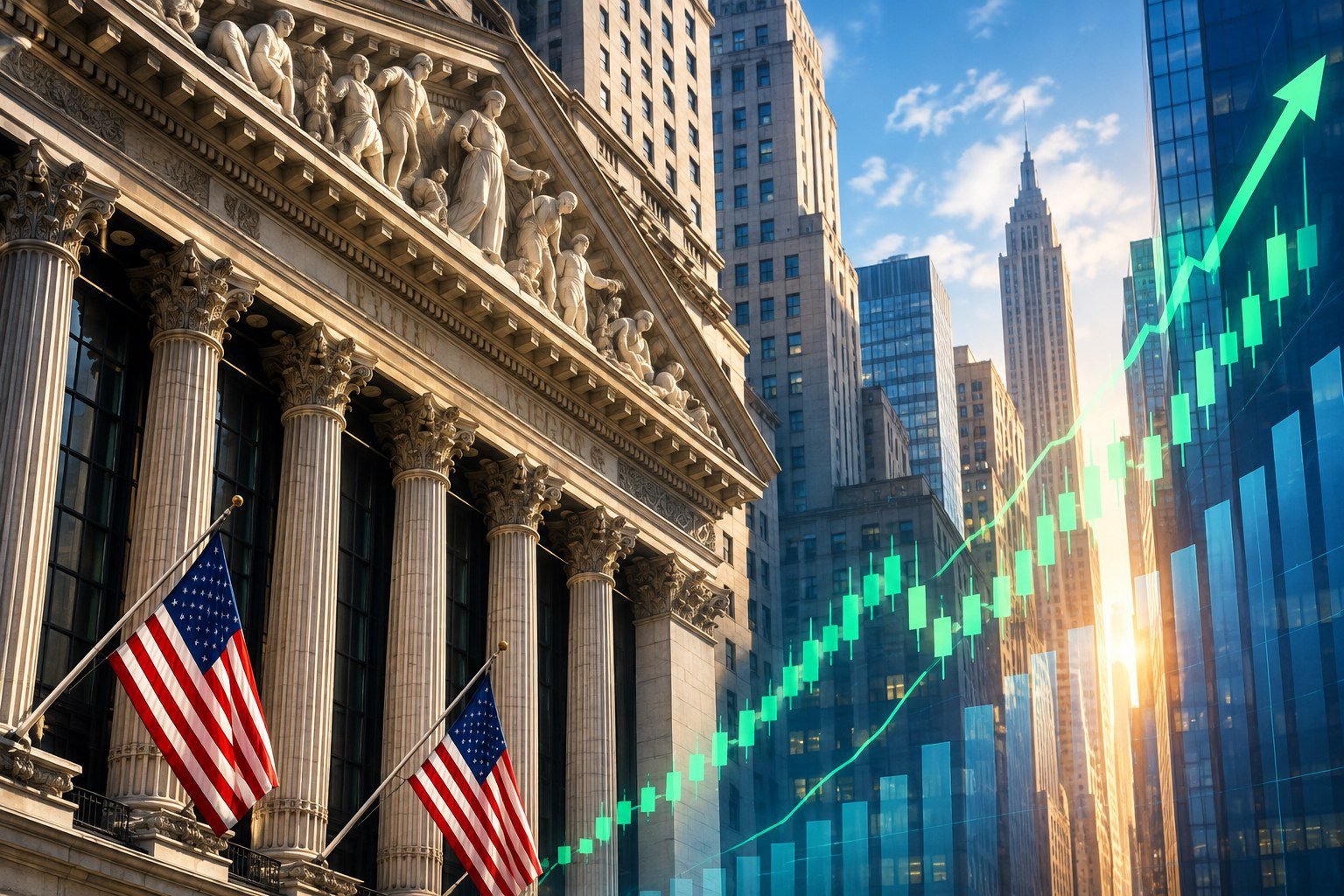
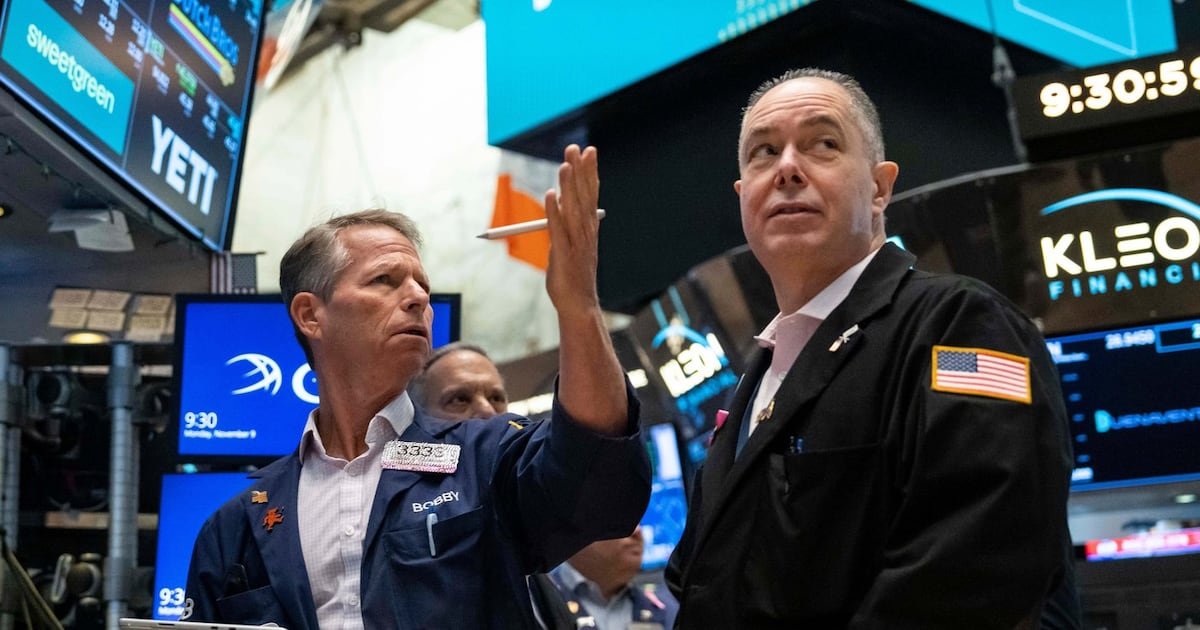
US stocks surged on November 23 as Nvidia’s decision to reinstate Jensen Huang as chief executive triggered a sharp recovery in technology shares following one of Wall Street’s worst weeks in years.
The Nasdaq Composite advanced 6.5%, while the S&P 500 gained 4.6%, interrupting a seven-session losing streak. The Dow Jones Industrial Average jumped more than 1,500 points, or approximately 3%, after recording its largest weekly decline since the pandemic-driven sell-off of 2020.
At approximately 1:57 p.m. ET, the Dow traded at 49,603.07, up 1,455.74 points, or 3.02%. The rally followed a week in which both the Dow and S&P 500 entered correction territory, defined as a decline of at least 10% from their recent highs.
- The Nasdaq Composite rallied 6.5%, the S&P 500 rose 4.6% and the Dow Jones Industrial Average gained more than 1,500 points on November 23, reversing part of the previous week’s heavy losses.
- Nvidia shares surged more than 30% after its board reinstated Jensen Huang as CEO, adding more than $1 tn in market value at the stock’s intraday peak.
- Goldman Sachs identified three potential conditions for a sustained market recovery, while Nomura warned that forced short covering and options-related buying could be amplifying the rebound.
Technology stocks led the recovery, with semiconductor companies and AI infrastructure providers reversing some of their steep losses. Nvidia’s announcement was the principal catalyst, although the scale of the rebound also reflected buying by investors closing bearish positions.
Nvidia stock surges after Jensen Huang returns as CEO
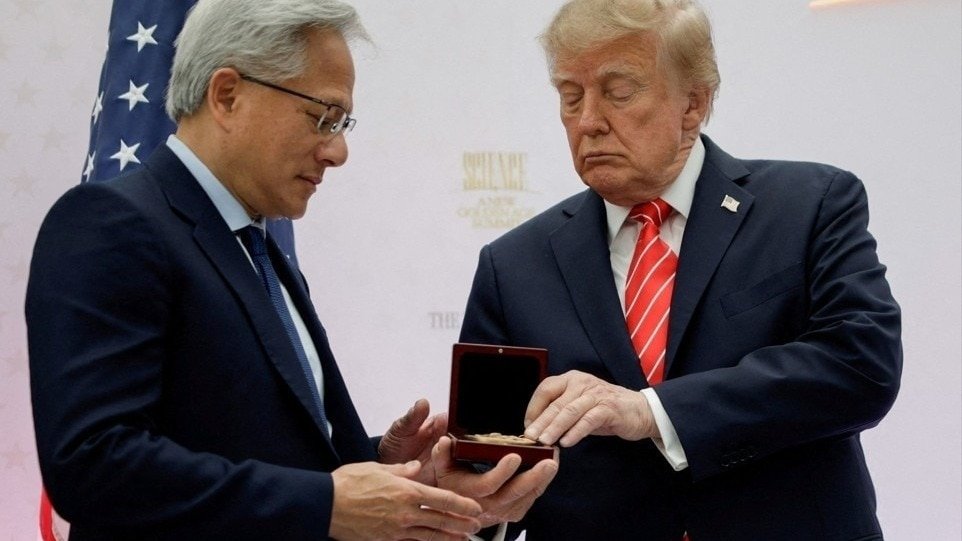
Nvidia (NASDAQ: NVDA) shares rose more than 30% after the company’s board unanimously reinstated Jensen Huang as president, chief executive officer and director, effective immediately.
The stock climbed as much as 35% intraday, adding more than $1 tn to Nvidia’s market capitalisation at its peak, according to Bespoke Investment Group. At approximately 1:57 p.m. ET, Nvidia traded near $163.94, up $38.41, or 30.60%.
A gain of that magnitude would rank among the five largest single-day percentage increases in Nvidia’s history and represent its strongest performance since May 2003.
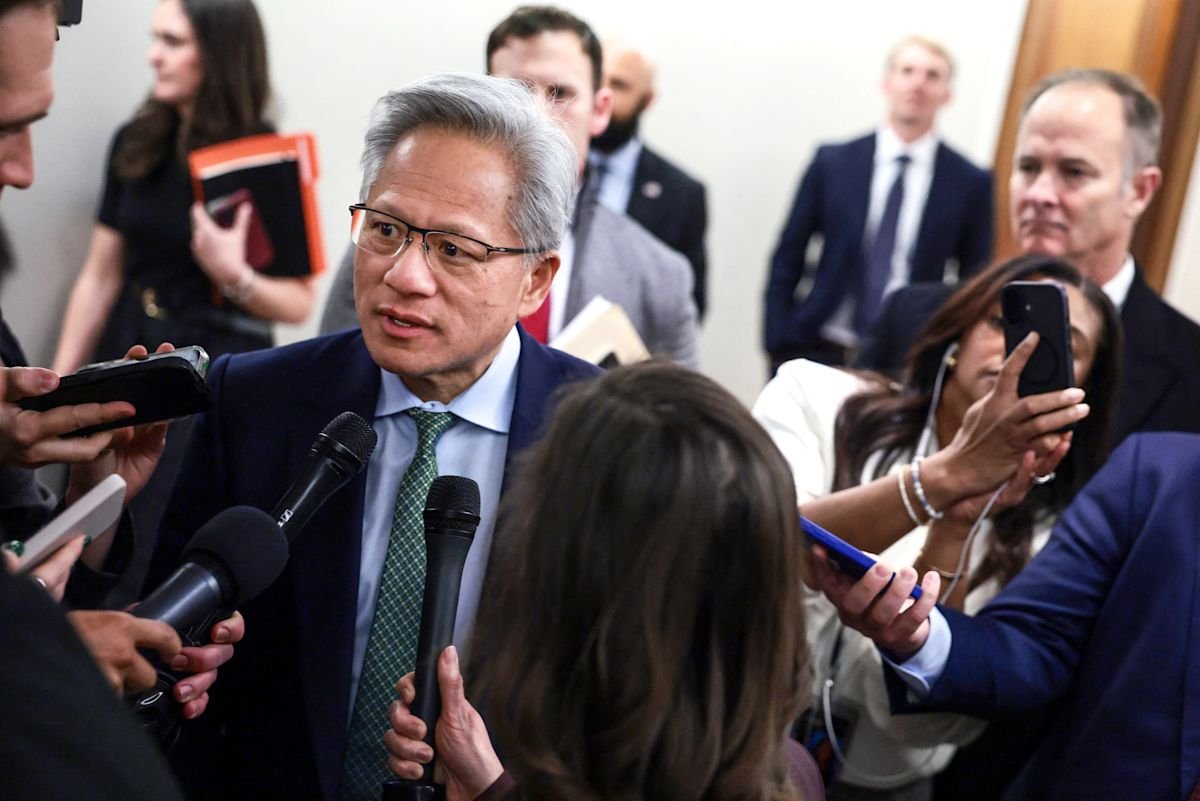
The reinstatement came less than two weeks after Huang resigned following reports about personal relationships, including one involving a person suspected of connections to Chinese intelligence.
Nvidia’s board said it had conducted discussions with Huang and consulted senior US government officials before deciding that his return posed no national security risk.
The company said its independent investigation into reports that Huang had been targeted by a foreign intelligence effort would continue. Nvidia also established a National Security and Export Control Committee to oversee related risks.
The rally followed seven consecutive sessions of losses in Nvidia shares, with the company’s decline contributing heavily to the broader semiconductor sell-off.
Nasdaq-100 records historic opening rally
The technology-led recovery produced unusually large gains in exchange-traded funds tracking major US equity indexes. The Invesco QQQ Trust (QQQ), which follows the Nasdaq-100, opened almost 8% higher, its largest opening increase since the fund launched in 1999.
Comparable opening rallies occurred during the technology market volatility of 2000 and 2001, when several sharp recoveries were followed by renewed declines.
The SPDR S&P 500 ETF Trust (SPY) opened approximately 5% higher. Among Monday sessions since 1993, only October 13, 2008, during the global financial crisis, recorded a larger opening advance.
The rebound followed substantial losses on Friday, when the S&P 500 declined 3.7% and the Nasdaq-100 fell approximately 5.6%.
The Nasdaq-100 had approached bear-market territory, trading nearly 20% below its October 6 peak. The S&P 500 had lost approximately $8 tn in market capitalisation since its own October high.
Monday’s advance recovered part of those losses but did not resolve questions about technology valuations, AI infrastructure spending and the outlook for corporate earnings.
The recovery extended beyond Nvidia to other companies exposed to AI investment and semiconductor demand.
Advanced Micro Devices (NASDAQ: AMD) and Broadcom (NASDAQ: AVGO) gained approximately 4% in early trading after experiencing double-digit percentage declines during the preceding week.
Memory manufacturers also advanced. Micron Technology rose approximately 5% in premarket trading, while SK Hynix gained about 9%. AI cloud infrastructure providers recorded particularly large increases.
CoreWeave (NASDAQ: CRWV) and Nebius (NASDAQ: NBIS) climbed as much as 30% during the session as investors returned to companies supplying data centres and AI computing capacity.
CoreWeave, in which Nvidia holds a substantial investment, traded at approximately $47.36 by 1:57 p.m. ET, a gain of 19.86%. The company remained down roughly 30% year to date despite Monday’s recovery.
Arm Holdings also advanced after announcing that CEO Rene Haas had extended his contract through 2033. Haas had reportedly been considered a potential replacement for Huang during Nvidia’s leadership uncertainty.
The breadth of the technology rally contrasted with the previous week’s selling, when concerns about AI spending and financing requirements pressured semiconductor manufacturers, cloud infrastructure companies and software stocks.
Anthropic shares decline despite broader AI recovery
Anthropic (ANT), which completed its initial public offering the previous week, failed to participate consistently in Monday’s technology rally. The company’s shares briefly moved higher at the opening before reversing direction.
By approximately 1:57 p.m. ET, Anthropic traded at $87.69, down 1.37%. Earlier in the session, the stock had fallen as much as 1.7%. Anthropic gained 17% during its market debut on Thursday but declined 9% on Friday, leaving its shares only modestly above the $83 IPO price.
Investor concerns centre partly on the company’s substantial financing requirements. Anthropic has committed to approximately $900 bn in computing and infrastructure expenditure over the next two decades.
Market participants expect major credit rating agencies to assign the company a high-yield debt rating, although no official assessment had been announced. The stock’s performance differed from the strong gains in established semiconductor companies, indicating that investors were distinguishing between different segments of the AI industry despite the broader rebound.
Goldman Sachs identifies three conditions for a sustained market recovery
Goldman Sachs analysts outlined three developments that could help establish a durable bottom following the market correction.
- In a Friday research note, a team led by Ben Snider identified stronger confidence in future earnings from AI investment as one potential catalyst.
- The second would be an improvement in macroeconomic conditions, including a more accommodative signal from the Federal Reserve.
- The third involved a substantial reduction in investor positioning, which has historically accompanied some market bottoms.
One catalyst would be news that increases investor confidence in the trajectory of future earnings associated with AI investment and monetization.
Goldman Sachs cautioned that uncertainty surrounding earnings expectations created a wide range of possible near-term market outcomes. The assessment came after the S&P 500 entered correction territory and technology stocks experienced sustained selling pressure.
The bank’s conditions suggest that a lasting recovery would require more than a short-term rebound in share prices, particularly given investor concerns about the profitability of expanding AI infrastructure.
Charlie McElligott offered a more cautious interpretation of Monday’s advance. Much of the move to mechanical market activity, including short sellers closing bearish positions and options dealers adjusting their hedges. These transactions can accelerate price increases without necessarily indicating a change in investors’ fundamental expectations for corporate profitability.
Federal Reserve rate expectations remain a market risk
Expectations of another Federal Reserve interest rate increase continued to influence the market outlook. The S&P 500’s seven-session losing streak was its longest since the pandemic-related market decline, yet investors still expected the central bank to tighten monetary policy at its December 9 meeting.
Polymarket assigned approximately a 91% probability to a rate increase, down from 98% on November 12, while bond-market pricing indicated a probability near 92%.
Federal Reserve Governor Lisa Cook warned on Friday that delaying additional rate increases could leave monetary policy behind inflation developments. “Waiting longer to implement rate increases risks getting behind the curve,” Cook said.
Higher interest rates remain particularly important for technology companies because they increase financing costs and can reduce the present value of expected future earnings.
The Federal Reserve’s policy outlook therefore remains a potential constraint on equity valuations even after Monday’s substantial recovery.
Oatly shares surge after Verlinvest increases stake
Outside the technology sector, Oatly (NASDAQ: OTLY) recorded one of Monday’s largest individual stock gains after Belgian investment company Verlinvest increased its ownership in the Swedish oat milk producer.
Verlinvest acquired shares from China Resources, the Chinese state-owned group with which it previously operated a joint venture involving Oatly. The transaction increased Verlinvest’s holding to approximately 42.6%.
Oatly shares surged as much as 108% before giving back part of their gains. At approximately 1:57 p.m. ET, the stock traded at $13.15, up 88.79%.
Oatly confirmed on November 20 that Verlinvest had issued a tender offer at $4.13 per American depositary share to comply with Swedish takeover regulations. The company’s board described the offer as a technical requirement and advised shareholders not to tender their shares.
Oatly had declined approximately 98% from its May 2021 IPO before Monday’s rally. Short interest stood at just 2.3%, according to S&P Global Market Intelligence.
Wall Street faces shortened Thanksgiving trading week
Investors enter a shortened trading week with major indexes attempting to recover from correction territory. US stock exchanges will close Thursday, November 26, for Thanksgiving, while Friday’s trading session will end early at 1 p.m. ET.
Corporate earnings remain on the calendar, with Hewlett Packard Enterprise and Zoom Communications scheduled to report results on Monday as the third-quarter reporting season approaches its conclusion.
The immediate market focus remains on Nvidia’s leadership transition, technology-sector earnings expectations and the Federal Reserve’s December policy decision.
Monday’s rally has produced historic opening gains in major technology ETFs and one of Nvidia’s largest single-day advances. Its durability will depend partly on whether buying extends beyond short covering and hedging adjustments into sustained investor demand.
Goldman Sachs continues to focus on earnings confidence, monetary policy and investor positioning as potential conditions for a market bottom, while Nomura cautions that the scale of a one-day recovery does not eliminate the economic and valuation pressures responsible for the preceding decline.
Start Selling Online with ShopOpen24
Are you a small business owner or entrepreneur? Discover seller opportunities and connect with customers through ShopOpen24.
Explore ShopOpen24 →ShopOpen24 | Local Products. Global Reach.







Leave a Reply