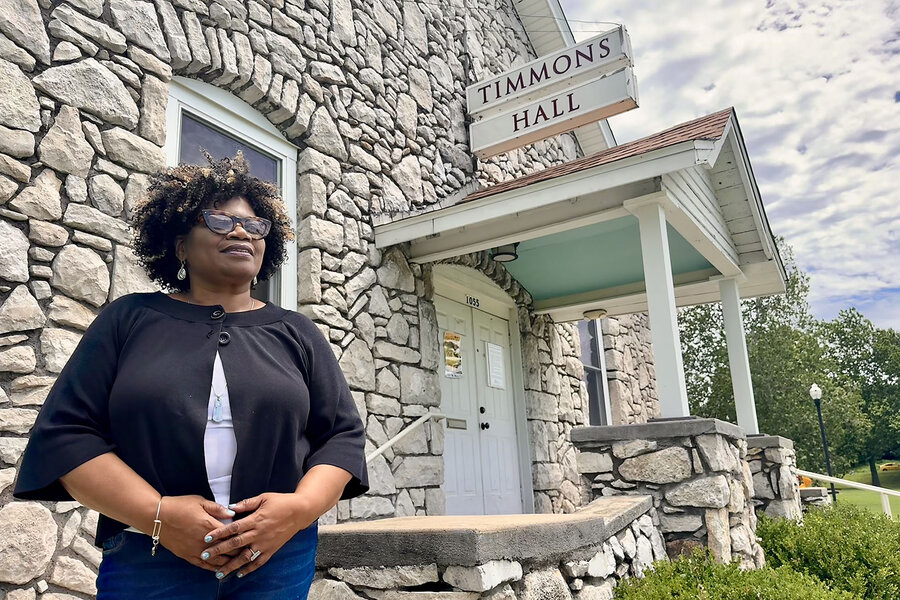
Christine Peoples feels the weight of an ancient task.
She is, in many ways, a community storyteller, a bearer of memory and meaning.
Today, one of the stories she tells begins inside her workplace: Timmons Hall, a former Black church lifted from its foundations and preserved in Silver Springs Park – once the only public park open to Black residents in segregated Springfield, Missouri.
Why We Wrote This
Alberta Ellis was a prominent businesswoman in segregated America. But like other historical figures, her story could fade were it not for people who believe in carrying forward the ways our past informs who we are today.
Ms. Peoples explains how, once upon a time, the old Timmons Temple was one of the spiritual centers of a thriving community. It helped organize Park Day, a late-summer celebration of reunions and beauty contests, food and music, and back-to-school fellowship that, at its peak, drew an estimated 3,000 to 4,000 people.
“Park Day was a huge deal,” says Ms. Peoples, the education coordinator of Timmons Hall, which is now run by the Springfield park board. “It was made of mothers, fathers, and folks that really knew that they had to carry this baton for the next generation.”
To her, a city worker, carrying that baton is more than a civic task. It remains sacred. “I never wanted to just do something to do it,” says Ms. Peoples, also an outreach minister at a local church. “It had to have meaning.”
That search for meaning has led her, again and again, into the hidden rooms of her city’s past. She collects artifacts, oral histories, remembrances of her community’s forebears and their children, many who now, too, carry the weight of years, the joys and sorrows of Springfield’s past.
Those remembrances include a woman named Alberta Ellis, who once provided a haven for Black travelers on Route 66 during segregation that became a thriving space frequented by well-known musicians, athletes, and writers. Ms. Ellis has been, in many ways, a spiritual inspiration for the community work Ms. Peoples now does here at Timmons Hall.
Springfield is where Route 66 got its name in 1926 – a fact the city proudly celebrates as part of its claim on America’s most famous roadway. But Ms. Peoples’ story about Ms. Ellis reveals another side of the Main Street of America – one that begins with a question:
What did freedom of the open road mean if that freedom was not open to everyone?
***
For generations, Route 66 has lived in the American imagination as a promise: a highway west, a ribbon of asphalt that moved people toward personal reinvention, a road trip through neon-outlined diners and motels, a path of endless possibility.
But for Black motorists during segregation, that promise required another map. They often traveled with food, water jugs, and a copy of “The Negro Motorist Green Book,” the guide that told Black Americans where they might safely buy gas, eat, or find a place to sleep.

In Springfield, one of those places was Alberta’s Hotel.
The woman who ran it was Ms. Ellis, a Black entrepreneur born in Springfield in 1909. By the mid-1950s, her hotel had become one of the city’s most important destinations for Black travelers – musicians, soldiers, and athletes, as well as families passing through the Ozarks.
For Ms. Peoples, Alberta Ellis is more than a name on an old travel guide. She is the woman who helped her understand what her own work at Timmons Hall was for.
“I see my grandmother’s richness in her,” Ms. Peoples says. “The way she dressed or she carried herself. And as I began to research her, guess what she did? She created sanctuaries. For kids and families in the community during that time.”

Harry Bruinius/The Christian Science Monitor
That word — sanctuaries — is the hinge between Ms. Ellis’ work and Ms. Peoples’s own. As an outreach minister, Ms. Peoples had long believed that churches and community institutions were supposed to be places where the vulnerable could find safety, dignity, and practical help. In Ms. Ellis, she saw a woman who had done that work along the highway.
Alberta’s Hotel stood on Route 66. It had been the old city hospital before Alberta bought it at auction and converted it into something the highway had created a need for: a place where Black travelers could stop.
“When you came to Alberta’s, you had all these other amenities, too,” Ms. Peoples says. “She had barbers in there. She had beauticians. You can get your meal there. Hot bath, a room, welcoming, hospitality, plus the connections with the other folks in town. She had the best musicians.”
The musicians came because Route 66 brought them through Springfield, and Springfield had almost nowhere else for them to go. The Chitlin’ Circuit – a network of Black-owned venues that made touring possible for Black performers during segregation – ran through the Ozarks on the same road that ran through the front door at Alberta’s. They were performing for white audiences at the Shrine Mosque downtown, but could not stay where they were playing.

Courtesy of Christine Peoples
Irv Logan Jr., Ms. Ellis’ grandson, carried guests’ bags upstairs as a boy. Frankie Lymon and the Teenagers. Little Stevie Wonder, 13 years old, playing “Fingertips” at the Shrine Mosque and sleeping at Alberta’s that night. The Harlem Globetrotters. Nat King Cole.
“And she had the Crystal Palace,” Ms. Peoples says. “All of this – she kept making safe havens.”
The Crystal Palace was Ms. Ellis’ nightclub, a cinder-block building on Route 66 west of Springfield, open on weekends, featuring live music. Ten miles further west on the same road, she had a farm – 10 acres, a working orchard, chickens, a circular drive with picnic tables. Across the road was a public roadside park. When the hotel was full, or when a traveler came through too late to find a room anywhere in Springfield, Ms. Ellis would tell them they could sleep in the park, and in the morning she would fix them something to eat and give them provisions to go on further west.
“You were relieved to come off the road and be at Alberta’s,” Ms. Peoples says.
***
Ms. Peoples first learned about Ms. Ellis through an article by Irv Logan. The headline was “What Money Couldn’t Buy.” It described the precautions Black families took on the road.

Scott Blanchard/The Christian Science Monitor
She connected with Mr. Logan and with Ms. Ellis’ granddaughter, Elizabeth Logan Calvin. She traveled to St. Louis and spent days going through family archives with them.
Among the materials, Ms. Peoples found small personal objects: a handkerchief embroidered with Ms. Ellis’ initial, and a drop pin engraved with an “A.” “I knew she knew who she was,” Ms. Peoples says.
To her, Ms. Ellis’ confidence mattered as much as her résumé. She had worked for Southwestern Bell. She owned property. She had stock. She knew travelers, musicians, railroad people, church people, ballplayers, and families. She was not just reacting to segregation. She was building inside and around it. “She was already ready,” Ms. Peoples says.
In that world, a hotel was not only a business. It was infrastructure. The road gave Alberta Ellis traffic. Segregation gave her a market. Her own gifts turned that market into a community.
But this is the complicated inheritance Ms. Peoples is trying to teach. Ms. Ellis’ success was born partly from exclusion. She created safety because danger existed. She built a business ecosystem because Black travelers were barred from so much of the larger one.
And then the very integration that Black citizens had long fought for helped bring that world to an end.
Mr. Logan was a young civil rights activist in the early 1960s, president of a junior NAACP chapter in Springfield. In a 2015 interview for Missouri State University’s Greater Springfield Route 66 Oral History Project, he remembered the absurdity of local rules that allowed Black people to work in major hotels but not stay in them. Young activists pushed back.
At some point, Mr. Logan recalled, his grandmother sat him down.
“Junior,” Ms. Ellis told him, “you know this means that all that we have worked for up to this point is going to be gone. And it will just about disappear overnight.”

He asked what she meant.
“You’re doing it for the right reason,” she told him about his civil rights activism. “Well, when people have the right to go anywhere they want to go, they don’t have to go where they must go. And if it’s new, folks are going to go and check it out. So that means once all of this has gone away and you can go wherever you want to, our business will probably fade away.”
“And that was prophetic,” Mr. Logan said, remembering that conversation decades later.
It is a hard irony to hold. Integration was justice. Yet it also helped dissolve the Black business districts and travel networks that had sustained people through injustice. The Green Book was no longer needed. Alberta’s Hotel closed. Its building was eventually taken by the city through eminent domain and demolished. Ms. Ellis died in 1966, at age 56.
“There was a richness that was created,” Ms. Peoples says. “There was an enclave of businesses and business people that were servicing other folks that look like them and within their community.”
***
On a Saturday evening in June, Ms. Peoples is telling the story of a forgotten fashion designer, creating memory and meaning with what she calls a “living history.”
Guests are arriving for the Living Histories Freedom Ball, a program of music, fashion, and remembrance at the city’s Library Center auditorium. Near the entrance is an exhibit created by Marcella Donson, a high school student who goes by Rae Rae.
She remembers going to Park Day at Silver Springs Park as a little girl with her grandparents. It was Ms. Peoples who pointed her toward her exhibit’s subject, Alberta Ellis.
Her project traced Ms. Ellis’ world – the Green Book, the family networks, Ms. Ellis’ daughter, known as “Cricket,” who helped keep Park Day alive. It won first prize in a community award ceremony earlier in the day. Now, it stands in the entrance hall, where guests pass it on their way into the auditorium.
For Ms. Peoples, this is what the old church people meant by “carrying the baton.” It is not enough to save a building, or preserve a photograph, or place a name on a historical marker. The story has to keep moving. It has to be handed to someone who did not live it, but can still recognize themselves inside it.
Rae Rae understands that now, too. Learning about Ms. Ellis, she says, meant learning about “something that’s unknown in Springfield.”
Outside, Route 66 is still celebrated for its promise of freedom. Inside, Ms. Peoples is teaching what it took to make freedom real: a room and a meal, a church, a dress and a story – and another generation willing to carry it.