As President Barack Obama was pursuing a diplomatic solution to Iran’s nuclear program during his second term, he waged a rearguard battle with hawkish Republicans in Congress who tried to scuttle his accord. Among the loudest critics was Donald Trump, who decried a “one-sided transaction” that would provide $150 billion to “the No. 1 terrorist state.” Once he was in the Oval Office, Mr. Trump pulled out of the 2015 multilateral agreement.
Now in his second term, after failing to inflict a military defeat, President Trump is giving diplomacy with Iran a chance.
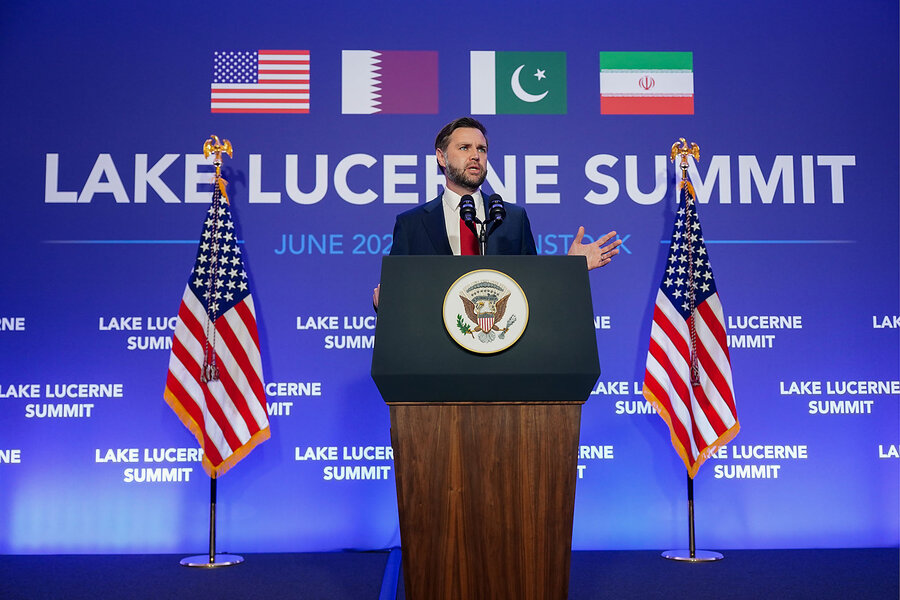
And his negotiators are taking a familiar approach of offering sanctions relief to Iran in return for limits on its nuclear program, just as Mr. Obama’s team did more than a decade ago in negotiating the Joint Comprehensive Plan of Action, or JCPOA. Vice President JD Vance has spoken of a deal that would “transform the Middle East for a generation.” The United States has already begun to relax sanctions on Iranian oil and has agreed to a raft of other sweeteners – including a $300 billion investment fund for Iran’s reconstruction.
Why We Wrote This
Could the Trump-Vance administration reach détente with Iran? That would run against the views that President Donald Trump himself espoused in going to war, but the administration is eager for a peace deal and voices optimism about the talks.
Mr. Trump’s turnabout on his war goals has drawn barbs from across the political spectrum. While Democrats have derided the waste of U.S. blood and treasure, some Republicans have balked at concessions to Tehran and the sidelining of Israel, which jointly waged war against Iran. But Mr. Trump might face an easier path than Mr. Obama did in advancing a rapprochement, because of both his own political coalition and a changed geopolitical climate, in part of his own making, even as the path to negotiating a successor to the JCPOA remains perilous.
Politically, a nuclear deal “could be more tenable now than ever before because the majority of the American public – including among President Trump’s own coalition – would want an end to the decades of U.S.-Iran hostility,” argues Arta Moeini, the research director at the Institute for Peace and Diplomacy, a foreign-policy think tank with offices in Washington and Toronto. Crucially, Mr. Trump might be able to secure congressional approval for any peace treaty, given his grip on the GOP, Dr. Moeini says.
Just as President Richard Nixon’s détente with China in the 1970s was feasible because he was a staunch anti-communist, so Mr. Trump could point to decades of hostility toward the Islamic Republic to justify a 180-degree turn to his base. But that analogy only goes so far, says Rina Shah, a GOP strategist and former congressional aide. “Nixon went to China with a real, clear strategic goal, and he delivered results that reshaped the Cold War,” she says.
Skepticism about Iran is bipartisan, and any nuclear deal will be closely scrutinized, Ms. Shah says. “Trump’s base might give him more leeway initially, but if a deal fails to contain Iran’s nuclear ambitions or their proxy threats long term, then even he faces backlash.”
So far, the public appears far from convinced by Mr. Trump’s claims about Iran. Few believe that Tehran’s nuclear program is no longer a threat, though most want the war to end regardless, according to a CBS News poll. Among Republicans, though, 4 in 10 support continuing to use military force against Iran to overthrow the regime.
The war’s inflationary pressures have been a drag on GOP hopes of holding on to Congress after November’s midterms. The administration’s shifting reasons for going to war could complicate Mr. Trump’s ability to sell any deal to voters, says Dave Wilson, a Republican strategist based in South Carolina. “There has not been enough of a firm wall of definition that Trump has put out there to the public to explain to them why they are financially suffering, why there are lives that are being lost to do what we’re doing in Iran,” he says.
Mr. Obama’s outreach to Iran faced fierce opposition from Israel, whose Prime Minister Benjamin Netanyahu rallied opposition among Republicans in Congress. The JCPOA also faced resistance from Saudi Arabia and other U.S. allies who saw Iran as an implacable enemy. While Mr. Trump’s peace process with Iran has gone over poorly in Israel, Gulf states have pledged billions of dollars to the proposed reconstruction fund for Iran.
Analysts say Gulf states have been rattled by Iran’s retaliatory attacks and the disruption from the closing of the Strait of Hormuz. “They’re incentivized now to play nice with Iran,” says Max Abrahms, an international relations professor at Northeastern University who is critical of the Trump administration’s diplomacy. Gulf leaders have also begun to question the United States’ commitment to protect the region after the conflict is over, he says.
During the fighting, which began as a joint operation with Israel on Feb. 28, the U.S. military inflicted damage from both the air and sea, but was unwilling to send in ground troops to accomplish the White House’s goals – including regime change and the removal of Iran’s enriched uranium stockpiles.
“For coercion to work, there must be a credible threat,” he says. “This war, ironically, has undercut the credibility of the U.S. military threat against Iran.”
The Trump administration insists that it is in a strong position to extract concessions from Iran after decimating much of its military and industrial base. Mr. Vance has argued that this economic pain is conducive to making diplomatic progress and that the two countries can now turn a page. He told CNN last week that “people within the Iranian system – senior leadership, even IRGC officials – say, ‘You know what? We may have some animosity, we may have some mistrust. But we recognize the way that we’ve done business with the United States for 47 years is a mistake. Let’s try something else.’”
Aaron David Miller, who worked on Middle East policy and peace negotiations for the State Department under Republican and Democratic administrations, says this rhetoric is misleading. “This regime still prides ideology over prosperity,” he says. Iranian officials would welcome economic growth that means less popular discontent, he adds, but their idea of prosperity is about “enriching the regime and building its military and proxy assets.”
“The notion that somehow you’re going to change the nature of the regime [with economic investments] … is just crazy,” says Mr. Miller, now a senior fellow at the Carnegie Endowment for International Peace.
Mr. Obama had also suggested that the deal he made could lead to regime change, but wasn’t dependent on that happening. He told NPR before it was signed: “It is possible that if we sign this nuclear deal, we strengthen the hand of those more moderate forces inside of Iran.”
On sanctions, Mr. Trump has put far more on the table than the JCPOA ever did, says Robert Einhorn, a special adviser on nonproliferation and arms control during the Obama administration, and who was involved in the negotiations. The JCPOA eased nuclear-related sanctions in return for compliance with limits on uranium enrichment and international inspections. But it didn’t lift the sanctions that prevent U.S. companies and individuals from doing business in Iran.
“The Iranians were very upset [in 2015] that they didn’t realize the benefits from sanctions easing that they expected. I think this time around, they basically said that the Trump administration has to get rid of them all,” says Mr. Einhorn, now a senior fellow at the Brookings Institution.
The JCPOA was also a multilateral agreement joined by China and Russia. As part of the deal, Iran agreed to send enriched uranium to Russia. So there was greater international cooperation. “We operated as one team. It was Iran against all the rest. The Russians and the Chinese were very helpful in getting a deal,” Mr. Einhorn says.
He is also skeptical that the Trump administration can negotiate a watertight deal to limit Iran’s nuclear program in 60 days, as the memorandum of understanding envisions. But he expects Iran to stay at the negotiating table for as long as it takes. “It’s clear from the way the Iranians are negotiating [that] they believe they are in the driver’s seat,” he says.
Staff writer Sophie Hills contributed reporting.