


Workers are spending a median of 12 hours in a 40-hour week briefing and reviewing AI agents, according to new research from Supercut – a finding that should make enterprise leaders pause before declaring the agentic workplace a productivity fait accompli.
The study of 547 US and UK workers who use AI agents to take actions in workplace tools found that 49% now hand a task to an agent before a colleague. The AI agents are getting work first. Yet the time and care required to provide context, check outputs and correct mistakes suggest that delegation is far from frictionless.
For organisations rolling out AI agents across collaboration, productivity and business applications, the issue is becoming less about whether employees will use them. They clearly will. The bigger question is whether enterprises have given employees the information, guardrails and accountability structures to use them without creating a new administrative tax.
TL;DR
-
Supercut found workers spend a median 30% of their week briefing and reviewing AI agents.
-
Almost half of surveyed agent users turn to an agent before a colleague for help with a task.
-
The chief challenge is not simply prompt-writing: it is transferring background knowledge, rules and context safely.
Why is AI agent briefing taking so much time?
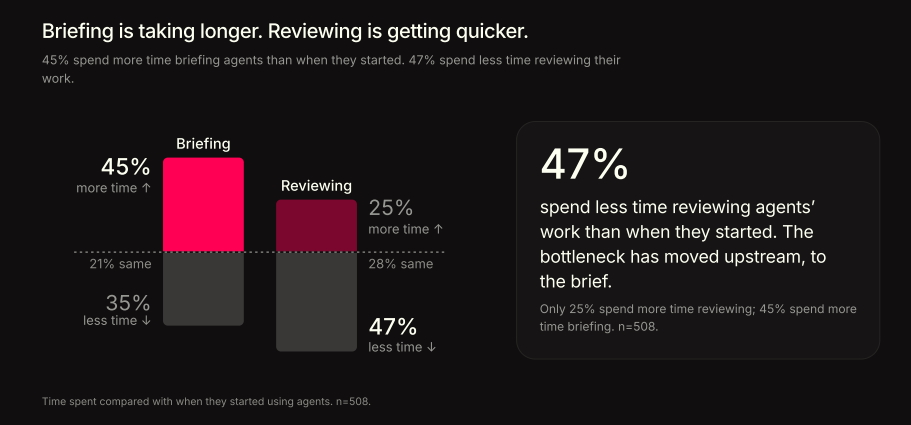
Supercut’s report, Briefing AI Agents: We show people, we tell agents, found that 45% of respondents spend more time briefing agents than when they first started using them. Meanwhile, 47% said they spend less time reviewing what agents return.
That is an important inversion. The output may be getting easier to assess, but the work of setting the agent up has moved upstream. Forty-four percent said a single new task takes five minutes or more to brief, while 72% admitted they had completed a task themselves in the past month because explaining it to an agent took too long.
The report calls this the “handoff tax.” It is a neat term for a rather less neat operational reality: every autonomous action needs context, a clear desired outcome, permissions and someone responsible for the result. The agent may have the stamina of a caffeinated intern; it still cannot read the room – or the Confluence page it was never given access to.
What is the AI agent handoff tax?
The AI agent handoff tax is the time workers spend briefing AI agents, supplying context, following up and reviewing their outputs. Supercut found this takes a median 30% of respondents’ working week.
What are workers struggling to tell AI agents?
The problem is not usually the task steps themselves. Supercut found 55% of respondents said background knowledge – why something matters and what has already been tried – is among the hardest information to convey. Company conventions and rules followed at 40%, while exceptions, edge cases and visual information each sat at 35%.
That distinction matters for enterprise AI leaders. A model can produce a decent draft from a prompt. It is less likely to make a reliable change to a CRM record, customer ticket or business workflow if it does not understand the unwritten rules surrounding that action.
Workers are also briefing agents very differently from colleagues. While 78% said they show colleagues what they mean through an in-person interaction, meeting or recording, just 14% give agents a video. Most type their instructions: 82% do so, and 56% rely on typing alone.
Supercut, which sells a screen-recording product that AI agents can access through an MCP server, understandably sees video as the answer. Three in four respondents who had provided recordings said they were more useful than text alone. But the broader takeaway is not that every agent brief needs a video. It is that enterprises need better ways to capture and pass on organisational context.
What is hardest to explain to an AI agent?
According to Supercut’s survey, background knowledge was the most difficult element to communicate, followed by internal conventions, edge cases and visual context.
What should enterprise leaders do next?
AI agents are becoming workplace co-workers. That makes governance and ownership more important, not less. Organisations should identify which sources of context agents can access, establish approval thresholds for consequential actions and make it clear which human owns an agent’s output.
They should also measure the full cost of deployment. An agent completing a task in two minutes is not necessarily a win if an employee spends 15 minutes assembling the brief, locating the evidence and fixing the result. ROI calculations that count only execution time are missing the bit where the human does all the scene-setting.
The research has limits. Supercut funded and designed the study, respondents were recruited from research panels, and all had already used AI agents to make changes in work applications. The findings therefore describe active agent users rather than the wider workforce. Still, that makes the group especially relevant: these are not AI tourists. They are people already trying to get work done with agents.
As Supercut co-founder David Okuniev put it:
“We brief colleagues by showing them, and we brief agents by writing essays.” The enterprise challenge for 2027 is to make those essays shorter – without making the outcomes less reliable.
The issue is particularly relevant as AI agents move from answering questions to taking action across enterprise workflows – a shift UC Today explored in its look at how enterprise AI is getting serious about action.













Leave a Reply