Washington — President Trump and House conservatives are holding Congress hostage over Senate Republicans’ inability to pass a voting regulations bill known as the SAVE America Act.
Mr. Trump abruptly canceled a signing ceremony Wednesday for a landmark housing affordability bill that has overwhelming bipartisan support in both chambers, seeking once again to use unrelated legislation as political leverage in his push to get Congress to adopt controversial voting requirements, such as showing proof of citizenship and restrictions on mail-in ballots.
The House has passed earlier versions of the bill that aren’t as sweeping, with support from a handful of Democrats. But the president has since requested to add other Republican priorities, like bans on mail-in voting and transgender athletes’ participation in women’s sports. Senate Republican leaders have repeatedly said the bill does not have the support to reach the 60-vote threshold to advance in the upper chamber.
That hasn’t stopped the president from trying. He threatened earlier this year not to sign most other bills until Congress passed the SAVE America Act. Earlier this month, Mr. Trump refused to reauthorize a warrantless surveillance authority that is the source of the bulk of the intelligence in his daily security briefing unless the election bill was attached. It still has not been reauthorized.
And on Wednesday, hours before he was set to sign a bill that marked the first comprehensive housing affordability legislation in decades — a bill that came as the issue is top of mind for many Americans — the president again demanded that the SAVE America Act be prioritized. He said he would not sign the housing legislation into law until lawmakers pass his political pet project.
Backed by conservatives, Mr. Trump has demanded that Senate Majority Leader John Thune find the votes to pass the legislation, or change the Senate’s rules to make it happen. But Thune, a South Dakota Republican, has made it clear that Senate Republicans won’t support that option either. Still, GOP leaders have tried to address interest from conservatives, including by allowing a marathon floor debate on the measure earlier this year aimed at giving members a chance to make their case.
“We’ve made the point a number of times, as you know, that we don’t have the votes. But that’s not a conclusion obviously he would like to see us draw,” Thune said Wednesday.
GOP Sen. Lisa Murkowski of Alaska reiterated the point and argued the president’s insistence is only obstructing his own agenda.
“If he chooses to hold up his own agenda because he wants action on the SAVE Act, that’s, I guess, his call. It is not helpful to him,” she said Wednesday. “It’s not moving the needle. If you don’t have the votes, sir, you don’t have the votes.”
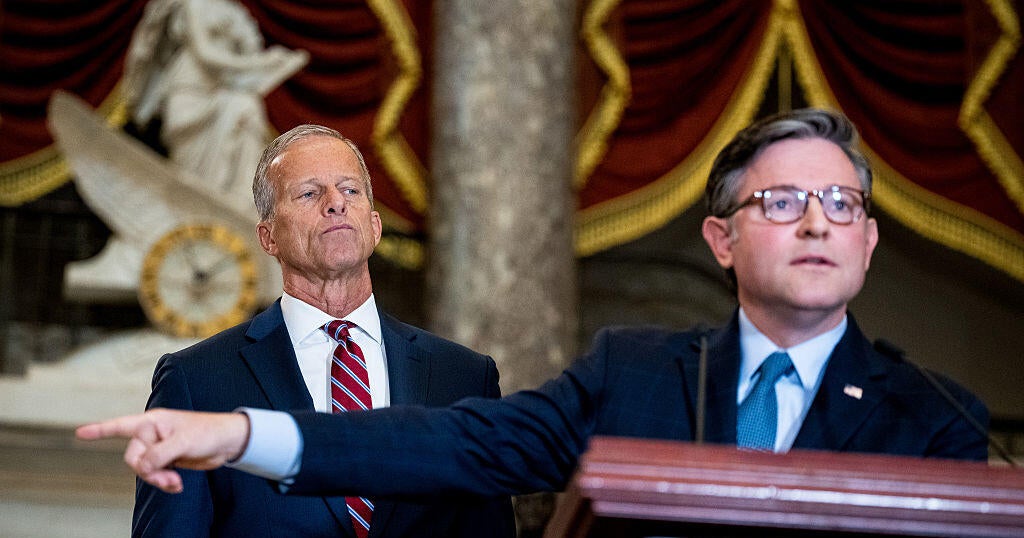
House Speaker Mike Johnson was meeting with Mr. Trump at the White House on Thursday afternoon about the path forward. Before leaving the U.S. Capitol, the Louisiana Republican said he expected a “productive” meeting about “how to get the agenda moving again.”
In a news conference Thursday morning, members of the conservative House Freedom Caucus railed against the Senate for recessing until July 13, instead of staying in Washington to find a path forward on one of Mr. Trump’s top legislative priorities. The Senate was previously scheduled to be off the next two weeks and left a day early for the break.
“The Senate sucks,” said GOP Rep. Byron Donalds of Florida.
GOP Rep. Scott Perry of Pennsylvania demanded that the Senate return to work, saying they would stay in town “and do whatever it takes” to get the legislation to Mr. Trump’s desk.
“We have done our job, but if there’s more to do, God bless it, we will stay and suffer through it,” he said.
Shortly after the remarks, House GOP leadership canceled Friday votes and announced just one vote Thursday afternoon. The House is currently scheduled to be in session for most of next week and then on break from July 3 until July 13.
But conservatives, led by GOP Rep. Anna Paulina Luna of Florida, have effectively shut down legislative action on the House floor until the SAVE America Act passes the Senate. With their narrow majority, House GOP leaders need nearly all of their members to stick together in party-line procedural votes to advance their legislation.
“From my standpoint, I don’t want to vote on anything else until this is passed,” GOP Rep. Ralph Norman of South Carolina said Thursday. “I’m not voting for anything.”
“The fact that they’re trying to say that we can put the SAVE America Act in reconciliation — it cannot be done,” Luna said.
Republicans have used the budget reconciliation process twice in this Congress to approve party-line legislation. The process allows the party in the majority to approve legislation with direct budgetary consequences without support from across the aisle, lowering the Senate’s typical 60-vote threshold to a simple majority to advance. But the process has strict requirements, and a number of Republicans have cast doubt on the ability to use the maneuver to approve the elections legislation.
Luna has urged Johnson instead to attach the voting regulations bill to the National Defense Authorization Act or an extension of a key spy authority known as Section 702 of the Foreign Intelligence Surveillance Act, which Mr. Trump previously suggested.
Johnson said he believes the best path forward for the SAVE America Act is attaching it to a third budget reconciliation bill. On Wednesday, he pitched the creation of a “grant program” tied to reconciliation that states could draw from to implement elections provisions.
GOP Rep. Chip Roy of Texas said he’s not interested in “a watered-down version” and was doubtful that the elections measure would see a different outcome than its current fortune if attached to a party-line spending bill.
“We need the entirety of the SAVE America Act passed,” Roy said.
And the president also seemed to dismiss the idea. Asked Wednesday whether he would be open to provisions of the SAVE America Act in a reconciliation measure, Mr. Trump responded, “Not really, no.”