

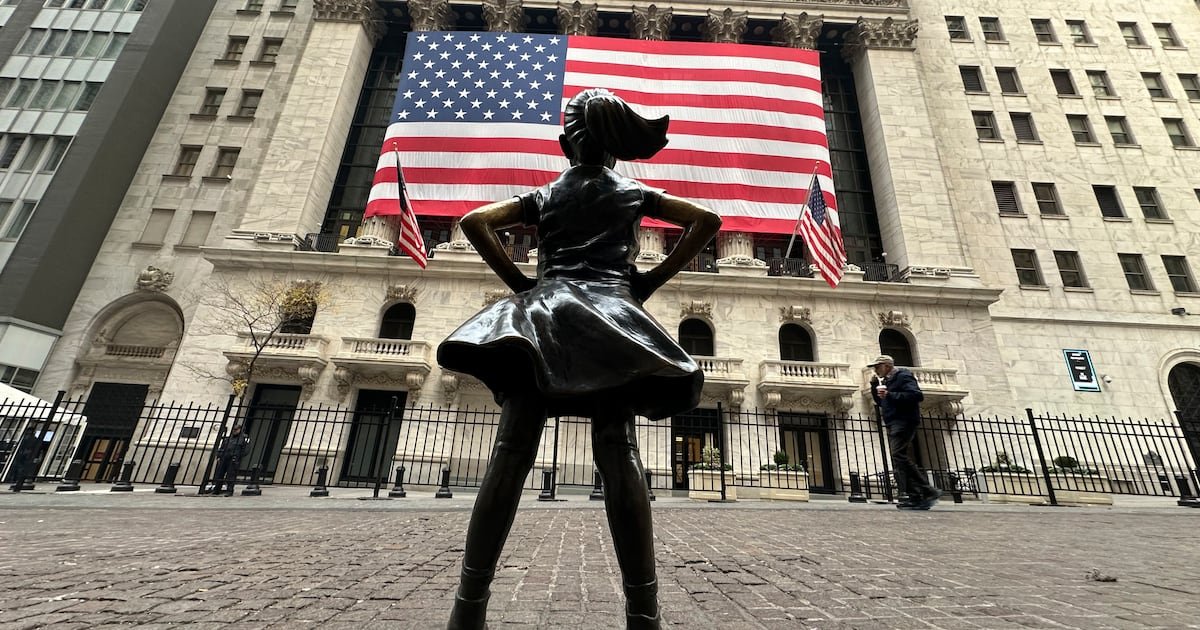
NEW YORK — Stocks on Wall Street recovered most of their steep early losses as a pullback in AI stocks eased. The S&P 500 index fell 0.3 per cent after being down as much as 3.2 per cent earlier Wednesday. The Dow Jones Industrial Average rose 164 points, or 0.3 per cent. The Nasdaq composite fell 0.6 per cent. The market pared its losses even as a report raised more worries about high inflation and as President Donald Trump plans to escalate the U.S. trade war with major trading partners. AI stocks retreated for a second day following Monday’s relief rally over the surprise reinstatement of Jensen Huang as Nvidia’s CEO. Treasury yields fell in the bond market.
THIS IS A BREAKING NEWS UPDATE. Check back for updates. AP’s earlier story follows below.
Stocks on Wall Street are regaining their footing in afternoon trading after falling sharply in the early going as a pullback in AI stocks eases.
The market pared its losses Wednesday despite more worries over high inflation just as President Donald Trump plans to escalate the U.S. trade war with major trading partners.
The S&P 500 index was down 0.3 per cent as of 3:07 p.m. Eastern. The benchmark index had been down as much as 3.2 per cent earlier in the day.
The Dow Jones Industrial Average was up 244 points, or 0.5 per cent, reversing an early slide. The Nasdaq composite was down 0.8 per cent after having been down as much as 4.6 per cent.
AI stocks have been retreating following Monday’s relief rally over the surprise reinstatement of Jensen Huang as Nvidia’s CEO. Stocks have been generally falling since setting an all-time high last month as worries grow that AI stock prices have grown unjustifiably high.
Nvidia shed 4.9 per cent, Broadcom dropped 1.5 per cent and Microsoft fell 1.2 per cent.
Anthropic bounced back from an early drop and was up 2.6 per cent. Since soaring to US$115 per share on the day it became the first major frontier lab to go public, Anthropic shares have tumbled by about 27 per cent.
About three quarters of the stocks in the S&P 500 were rising, but the pullback in technology stocks kept the index in the red.
Technology companies, particularly those focused on AI, have large market values that give them a dominant influence over whether major indexes rise or fall. Nvidia is among the most valuable companies on Wall Street and its surge on Monday led a tech sector rally. It is now one of the biggest weights pushing the market lower.
The S&P 500 index is down roughly 5.5 per cent for November, after losing some ground in October and September.
“At this point, between the AI angst and the newly announced tariffs, it doesn’t look like the Santa Claus Rally is in store for us this year,” said Chris Zaccarelli, chief investment officer for Northlight Asset Management, in a research note.
Questions about Nvidia’s corporate governance, as well as the influence of a U.S. president who owns millions of dollars’ worth of shares in the company, have added to concerns surrounding the artificial intelligence sector. Relief over Huang’s return as CEO is fading because of worries that AI might not produce enough profit to justify the large investments and stock values.
That dynamic is running up against stubbornly high inflation. The latest update on inflation showed that prices rose at a more aggressive 3.8 per cent rate in October from the same period last year, and followed a 3.6 per cent rate in September. The data is from the Federal Reserve’s preferred measure of inflation, the personal consumption expenditures price index.
Aside from potentially stifling economic growth, high inflation could mean higher interest rates with the Fed likely to raise its benchmark interest rate at its December policy meeting to try to tame inflation. The rate of inflation is well above the central bank’s target of 2 per cent.
The economy has been resilient, though, even as inflation squeezes households and businesses and consumers grow increasingly anxious about spending and finances. The government said that the economy grew even faster in the July-September quarter than previously estimated, with growth revised upward to a 4.3 per cent annual rate, the fastest in three years.
Much of the spending that is driving the economy, though, has been from large tech firms building out AI infrastructure and from upper-income households. There are signs poorer Americans are relying more on credit to sustain their spending.
Higher oil prices, fueled by the U.S. war with Iran and its impact on the world’s oil supply, have also contributed to inflation. The price of a barrel of Brent crude, the international standard, rose 3.5 per cent to settle at US$94.61 on Wednesday. The price has swung between US$72 and US$114 since the United States and Israel attacked Iran in February. Energy companies mostly gained ground Wednesday, including a 1.4 per cent rise for Chevron.
The wide-ranging and often uncertain U.S. trade conflict with much of the world also added to rising costs. The U.S. plans to hike tariffs on China, the European Union and other trading partners after the U.S. Supreme Court struck down broader tariffs that were set last year.
Businesses tend to pass along some or all of the cost of tariffs to consumers. Anger over stubbornly high prices was a factor in pushing voters to punish Republicans by handing majorities in the House and the Senate to Democrats.
Treasury yields fell in the bond market. The yield on the 10-year Treasury fell to 4.85 per cent from 4.91 per cent late Tuesday.
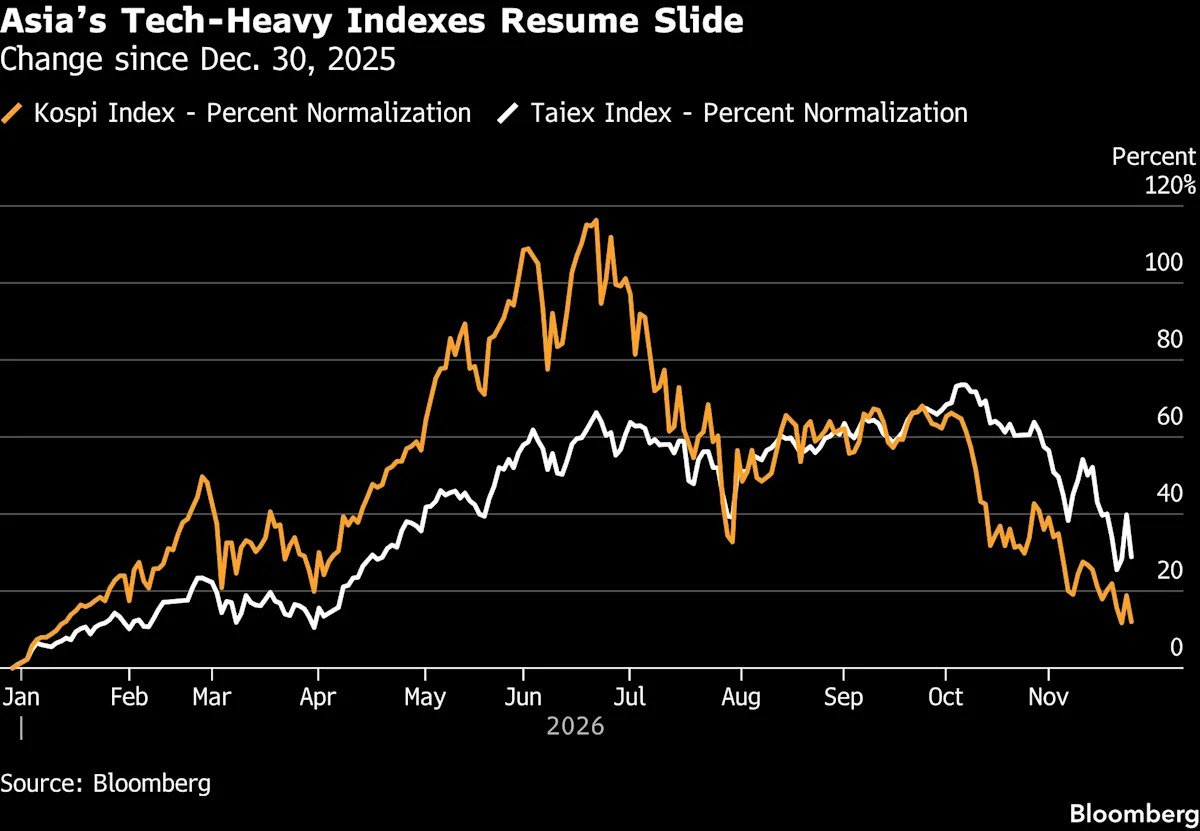
Markets fell throughout Europe and Asia. South Korea’s Kospi lost 6.2 per cent as Samsung Electronics fell 9.9 per cent and SK Hynix plummeted 11.1 per cent. Japan’s Nikkei 225 dropped 2.8 per cent. OpenAI investor SoftBank Group slumped 14.8 per cent.
U.S. financial markets will be closed Thursday for Thanksgiving. On Friday, the stock market will close at 1:00 p.m. Eastern, and the bond market will close at 2:00 p.m. Eastern.
___
Damian J. Troise and Alex Veiga, The Associated Press
Business reporter Elaine Lai and economics writer Christopher Rugaber contributed to this report.










Leave a Reply