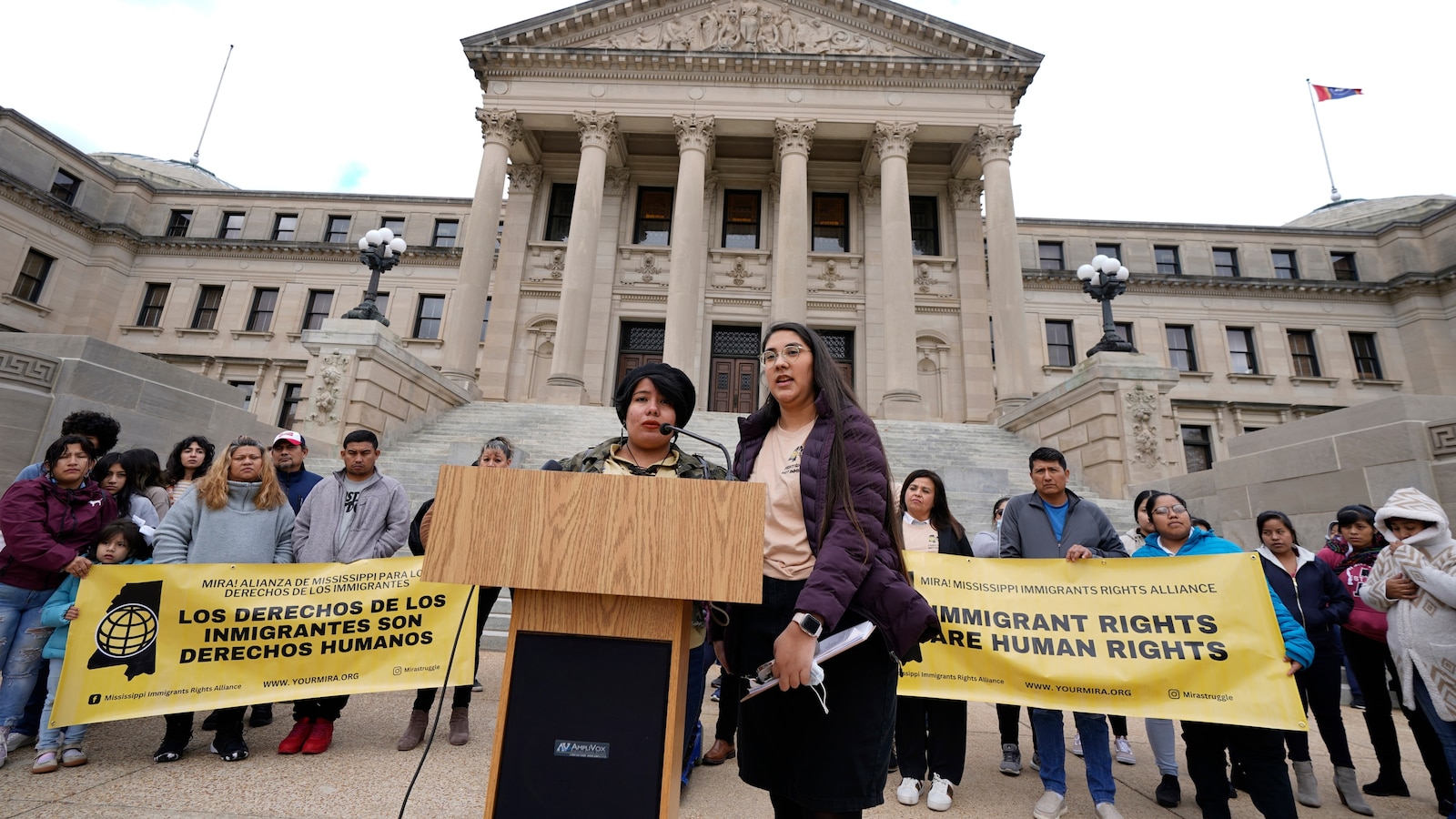
A new Mississippi law will authorize the state’s top law enforcement agency to compile a list of all immigrants illegally living in the state.
What’s to be done with that information is a bit open-ended. But the law set to take effect Wednesday is sparking alarm among immigrant advocates, who fear it could become a new tactic to target immigrants in conjunction with President Donald Trump’s plan to deport millions of people lacking legal approval to live in the U.S.
The law says the state Department of Public Safety “may use all reasonable lawful investigative means available” to determine the number and identities of all “illegal aliens” in Mississippi. That includes collecting their names, addresses, country of origin and whether they are an adult or minor. It also includes noting any criminal history and the date, location and status of deportation proceedings.
The department is directed to share information on those suspected of violating laws with state and local authorities. The measure neither requires nor prohibits the database from being shared with U.S. Immigration and Customs Enforcement.
Republican state Sen. Angela Hill, who sponsored the measure, said states have a right and obligation to assist the U.S. government in discouraging illegal immigration, which she said facilitates crimes such as human and drug trafficking.
The new law “seems like commonsense to me,” Hill said. “In order to address the problems caused by illegal immigration, we need to understand the magnitude of the problem. Identifying the number and identity of illegal aliens in Mississippi is a concrete way to better understand the problem.”
Nationwide, states already have enacted more than 100 immigration-related laws this year, according to an Associated Press tally.
In Republican-led states, those measures generally have aligned with Trump’s agenda by requiring local sheriffs to sign cooperative agreements with ICE, reinforcing eligibility restrictions for public benefits and directing election clerks to check voter rolls against the federal Systematic Alien Verification for Entitlements system in an attempt to flag noncitizens.
Democratic-led states generally have pushed back against Trump with new laws banning cooperative pacts with ICE, forbidding ICE tactics like wearing masks and restricting immigration enforcement actions in schools, hospitals and other sensitive locations without judicial warrants.
The closest thing to Mississippi’s new law appears to be a 2021 executive order by Republican Florida Gov. Ron DeSantis. That measure directed the Florida Department of Law Enforcement to “use all lawful investigative means available” to determine the number and identities of all “illegal aliens” who had been transported from the nation’s southwest border to Florida.
The Florida agency did not respond to an AP request for information about the results of the executive order.
Trump’s administration, meanwhile, has stepped up enforcement of a decades-old federal law that requires noncitizens to register with the U.S. government.
The Mississippi law envisions more than a one-time count. It prescribes an ongoing effort to keep track of immigrants illegally in the state for the next two years. That could get complicated as people overstay visas, apply for new forms of legal status and move into and out the state.
“You can be undocumented today, and then have status tomorrow, and then lose it again next month, and then regain it three months from now,” said Efrén Olivares, vice president of litigation and legal strategy at the National Immigration Law Center, a nonprofit that advocates for low-income immigrants.
“It’s practically unworkable, but it’s also very worrisome, because it’s eerily reminiscent of other countries that have created lists of certain groups of people,” Olivares said.
State officials will need to come up with “a credible and fairly foolproof way of correctly determining someone’s immigration status,” said Jessica Vaughan, director of policy studies at the Center for Immigration Studies, a nonprofit think tank that supports restrictions on immigration.
But Vaughan said the law “makes a lot of sense,” adding that it “raises the likelihood that someone’s illegal presence is going to come to the attention of federal authorities.”
Mississippi has one of the country’s smallest percentages of immigrants illegally residing in the state — fewer than 28,000 people, amounting to less than 1% of its population — according to a report by the American Immigration Council, which used 2023 Census Bureau data.
The new law “is very concerning for a bunch of different reasons,” including the potential to redirect law enforcement resources away from protecting the public to investigating people from foreign countries who may be contributing to the economy, said Victoria Francis, deputy director of state and local initiatives for the American Immigration Council, a nonprofit that advocates on behalf of immigrants.
“A mandate like this invites profiling and turning entire communities into targets,” Francis said.
The law could undermine trust between police and residents, said Lydia Grizzell, policy and advocacy manager for the American Civil Liberties Union of Mississippi.
“That increases the likelihood of individuals not reaching out to law enforcement when it’s needed – and that is opposite of the mission,” she said.