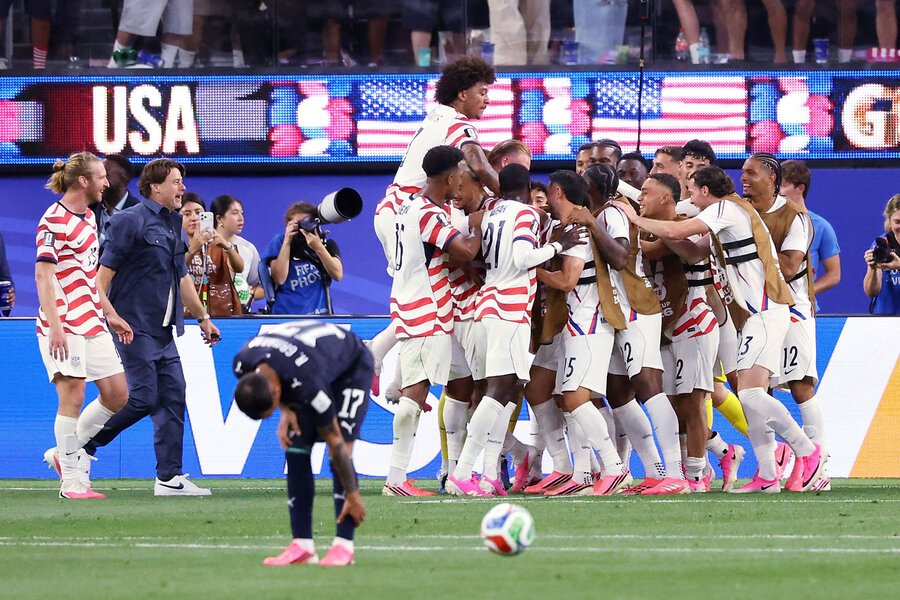
When Coach Mauricio Pochettino coined the rallying cry of the U.S. men’s national soccer team this summer, he perfectly captured the American predicament.
“Why not U.S.?”
On one hand, it is a statement of ambition and belief.
Why We Wrote This
This World Cup could provide the best opportunity for the U.S. men’s national soccer team to overcome its mediocre record in tournaments past and make a deep run – and perhaps even show that this squad really is deserving of being called a “golden generation.”
Precisely no one predicted that the United States would win this summer’s World Cup. But since he took the job in 2024, Mr. Pochettino has been about changing a mindset as much as structure or strategy. The success of those efforts saw the U.S. side win two games in the group stage for the first time since 1930, the first World Cup.
Yet, admittedly, it is a rather ambivalent rallying cry. Tournament favorites France, for example, have so thoroughly taunted and tormented their opponents that anything short of the final would seem an injustice at this point. “Why not us?” would hardly be considered an appropriate statement of their intent. “Why not forfeit?” might be a more apt message to opposing teams.
Ahead of Wednesday’s Round of 32 match against Bosnia-Herzegovina, however, the U.S. finds itself inhabiting that ambivalence with as much audacity as possible. The fact is, a run to the final is unlikely, approaching impossible. Yet history beckons, and in a home World Cup primed for drama, “Why not us?” has given fans and players alike the permission to dream.
The question is: What does that dream look like, if not a World Cup title? The answer is simple and even has a name. The U.S. is desperate for its first true “golden generation.”
Every serious soccer nation has had one – a confluence of young stars all peaking at the right time to take the team to new glories. Norway and Morocco are in the midst of theirs right now, for example. Senegal and Belgium are at the tail ends of theirs, hoping for one last flash of brilliance. France’s unearthly forward line is a once-in-a-generation supernova, and, by this point, everyone agrees that Argentina’s Lionel Messi constitutes a golden generation all by himself.
For the U.S., there has long been the hope that this might be its first golden generation worthy of the name. From Weston McKennie to Sergiño Dest, more American players have had greater success in European leagues than previous waves of American talent. But in the end, it all really came down to Christian Pulisic, the most skilled player the U.S. has ever produced.
Yet those years of expectation turned only to disappointment, with the U.S. failing even to qualify for the 2018 World Cup, then exiting meekly in the first game of the knockout stage in 2022. The sparkly parts never looked anything like a golden whole.
As one of the most coveted coaches in world soccer, Mr. Pochettino was hired to turn that tarnish into luster before North America’s own World Cup. And the first round this year certainly had its shining moments – from demolishing Paraguay to tidily dispatching Australia.
But this is the moment U.S. soccer has been waiting for since … well, forever. The Americans made it to the semifinals of the somewhat half-baked inaugural World Cup in 1930 and then to the quarterfinals in 2002. But neither of those teams had the opportunity that the U.S. has today. Neither had the depth and quality of talent. Neither had a nation of baying, star-spangled fans behind them in the stands. Neither could say they had the honest chance to change the trajectory of the sport in the U.S.
All that begins against Bosnia. So, where does “Why not us?” end, if not in raising the trophy after a win in the finals? The wildest dreams probably look a lot like South Korea in 2002. A decent but hardly dominating host nation, the Koreans rode their fanatic support to the semifinals, beating Italy in extra time and Spain in penalties. At last, they lost to Germany, 1-0.
The Americans have so far done just enough to make supporters think it might be possible. But “Why not us?” can be double-edged. After all, there are plentiful reasons why it won’t be the U.S.

First and most obviously, there is Bosnia, which is the kind of team that is easy to underestimate but difficult to beat.
Part of that is a uniquely deep and Bosnian pride. The player who improbably sent Bosnia to this World Cup with a successful penalty kick grew up in Wisconsin and even played for the U.S. team at lower levels. But Esmir Bajraktarević represents Bosnia in part because four of his uncles and a grandfather were killed in the 1995 genocide at Srebrenica.
Many Bosnian players have similar stories. For them, this team and this World Cup are about more than soccer. They are a statement of resilience, expressed in an almost ferocious commitment to each other and to the defense of their goal.
In fact, it is thoroughly disciplined teams like Bosnia that are often more likely to go on surprising runs through the World Cup. The United States’ swashbuckling intensity is usually a recipe for defeat in the World Cup knockout rounds, when the winner is more often the team that holds its defensive nerve. Just ask Germany, which lost in penalty kicks to a Paraguay team that only occasionally even tried to score.
There is also the fact that Bosnia is European, and the U.S. has failed to beat a European team once in seven attempts under Mr. Pochettino. The stat is not mere geographic coincidence. Playing Europe generally means playing against better players. And visions of Turkey’s Arda Güler repeatedly slicing through the American defense in the final group-stage game suggest old vulnerabilities remain. The U.S. lost, 3-2, on a late goal set up by Mr. Güler’s trickery, which once again left the U.S. defenders looking as though they were frantically searching for their lost car keys.
The U.S. largely played its second string for most of the game, but the trend is clear. Mr. Güler, who plays professionally for Spanish giant Real Madrid, was easily the most skilled player the U.S. faced in the opening round. Now, they will face a succession of them, mounting each game. Belgium potentially lurks in the Round of 16. As recently as March, they beat the U.S., 5-2.
But the Americans do have the talent to win, certainly against Bosnia, and perhaps even against a team like Belgium. This time, progressing deeper into the tournament is not merely a fond hope but a fairly reasonable expectation.
For Mr. Pochettino, “Why not us?” is really a challenge to his players. “Why not you?”
The pieces are in place for the U.S. to finally witness a squad that inspires something more than the hope of competent mediocrity, which has defined it for decades. For the U.S. team’s would-be golden generation, that test starts now.
The U.S. faces Bosnia-Herzegovina July 1, 2026, at 8:00 p.m. ET in Santa Clara, California.