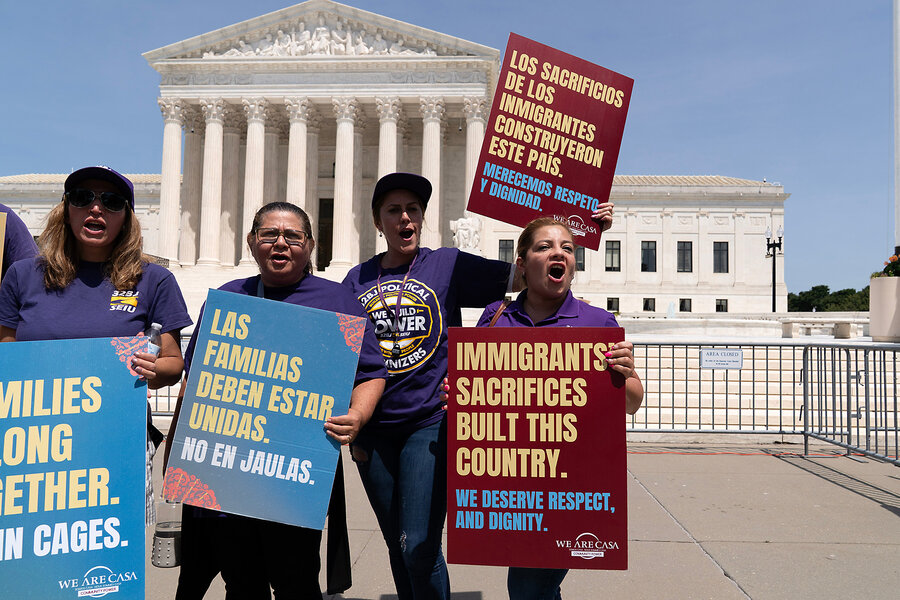
Amid a national reckoning over who belongs in the United States, the nation’s highest court preserved the right to citizenship based on birth. The ruling rebukes part of President Donald Trump’s anti-immigration campaign that could have profoundly altered American identity.
The Supreme Court on Tuesday affirmed that children born to immigrants here – no matter their status – are automatically considered U.S. citizens. The 6-3 decision in Trump v. Barbara upholds birthright citizenship, as written into the Constitution’s 14th Amendment in 1868.
“Citizenship, then and now, was the right to have rights – to freely participate in our political community. The Framers of the Fourteenth Amendment extended that promise to ‘every free-born person in this land,’” Chief Justice John Roberts wrote for the majority. “We keep that promise today.”
Why We Wrote This
The U.S. Supreme Court has rejected President Donald Trump’s order ending birthright citizenship as unconstitutional. The audacious order was linked to the White House’s wider effort to curtail illegal and legal immigration.
Since returning to office, Mr. Trump has pursued a mass deportation agenda targeting unauthorized immigrants – as well as many other immigrants here lawfully. On the last day of the court’s term, the ruling followed two recent immigration victories for the White House that upheld broad enforcement at the border and in the interior.
President Trump called Tuesday’s ruling “too bad,” but something Congress could fix. Birthright citizenship, he said on social media, is “expensive and unfair to our Country.”
The legislature’s power to make such a fix is limited, however. The court’s decision held that Mr. Trump’s executive order reinterpreting birthright citizenship violated the 14th Amendment, though only a slim majority – five justices – agreed on this point. The ruling could render legislative change to birthright citizenship unconstitutional.
“The fact the court ruled on constitutional rather than statutory grounds … narrows the scope for legislative responses,” says Aziz Huq, professor at the University of Chicago Law School. “The ball is now in the White House’s court as to whether to play the issue as a political matter.”
Trump’s attempt to break with tradition
Virtually everyone born in the United States is a U.S. citizen. Children of foreign diplomats are an exception.
Just after the Civil War, the 14th Amendment established U.S. citizenship for formerly enslaved people and their children, dismantling the high court’s notorious Dred Scott decision that denied citizenship to Black people. Three decades later, the court affirmed automatic U.S. citizenship for children born to immigrants here.
On his first day back in office in January 2025, Mr. Trump signed a flurry of executive orders. One order claimed that automatic American citizenship didn’t extend to children born to parents in the U.S. unlawfully or temporarily, such as on a visa. He directed federal agencies to withhold documents recognizing U.S. citizenship from people born under those circumstances.
The order was meant to apply to babies born in the U.S. starting a month after the order’s rollout, but swift litigation halted the policy. Lower courts questioned the constitutionality of the president’s order.
The 14th Amendment begins: “All persons born or naturalized in the United States, and subject to the jurisdiction thereof, are citizens of the United States.” One of the Trump administration’s arguments was that U.S.-born children of immigrants are not under U.S. “jurisdiction” if their parents lack long-term legal status.
Ultimately, the court struck down Mr. Trump’s order on constitutional and statutory grounds – with a twist. One of the six justices in the majority said the order only violates immigration law.
The government argued that allegiance was critical in determining citizenship for children of immigrants. “The trouble is that there is scant evidence for this dramatically revisionist view,” wrote Chief Justice Roberts for the majority.
The ruling came as a huge relief to immigrant advocates.
“The decision is an important rebuke against President Trump, who sought to change this fundamental protection embedded in the Constitution,” said Elora Mukherjee, director of the Immigrants’ Rights Clinic at Columbia Law School, in an email. That “attempted power grab should shock everyone in a constitutional democracy.”
While the issue should be settled, she says, “it’s likely that these fringe and radical efforts to remake who qualifies as an American will continue given modern day politics.”
Justice Brett Kavanaugh, who dissented in part, said Mr. Trump’s order didn’t violate the Constitution, but it did violate immigration law that codified the 14th Amendment. Congress could amend or pass new legislation to create exceptions to birthright citizenship for children of immigrant parents without full lawful status, he wrote.
“The constitutional issue is not straightforward, much as we might want it to be,” wrote Justice Kavanaugh. In his view, “the Court should have decided the case on the narrow and straightforward statutory ground.”
Ilya Shapiro, a senior fellow at the Manhattan Institute, says he agrees with Justice Kavanaugh’s “middle-of-the-road approach.” That would allow Congress to narrow who may be a citizen beyond what the Constitution requires.
The court “would’ve been better off taking Kavanaugh’s off-ramp and leave the issue to the political branches,” he says in an email.
The outcome also disappointed Zack Smith, a senior legal fellow at The Heritage Foundation. A ruling on constitutional grounds makes it a “more difficult, more arduous task to go about overturning this decision,” he says. But as the Trump administration weighs its options, says Mr. Smith, “I think you’ll see continued restrictions on the ability of people to enter the United States.”
In the principal dissent, Justice Clarence Thomas, joined by Justice Neil Gorsuch, argued that “domicile – a person’s legal home – played a key role in both state and national citizenship in America.”
Mr. Trump’s order wasn’t unconstitutional, Justice Thomas wrote, because it applied to children of parents who weren’t “domiciled” in the United States. “The Citizenship Clause was enacted for people who were born in this country and called it home,” including formerly enslaved people, he added.
His argument echoed one by the Trump administration, that the birthright citizenship clause was ratified as a means of neutralizing the court’s Dred Scott decision. In a concurrence for the majority, Justice Ketanji Brown Jackson said it meant much more.
“Freed Blacks did not advocate for a unique set of rules that catered only to their situation,” she wrote. The “alternative account” advanced by Justice Thomas and the Trump administration, she added, pits “Black Americans against immigrants when the advocates who promoted the Fourteenth Amendment did no such thing.”
Controversy set to linger?
Mr. Trump has bashed birthright citizenship for more than a decade. A growing group of Republicans argues that it encourages illegal immigration and “birth tourism.” While the president has falsely claimed that only the U.S. has birthright citizenship, a number of other countries grant that right – including Canada and Mexico.
Critics of Mr. Trump’s order, including child advocates, argued that the executive branch meddled with a long-established right and national tradition, while adding bureaucratic scrutiny to all births in the United States. Some immigrant advocates also warned of the potential expansion of stateless populations.
Most Americans support birthright citizenship. Nearly 7 in 10 voters favored keeping it for people regardless of their parents’ citizenship, according to a June survey from Quinnipiac University. A Reuters-Ipsos poll from April found similar support for birthright citizenship from 64% of U.S. adults.
Looking ahead, Professor Huq says he wouldn’t be shocked if birthright citizenship “became a litmus test for judges or justices this president puts forward.”