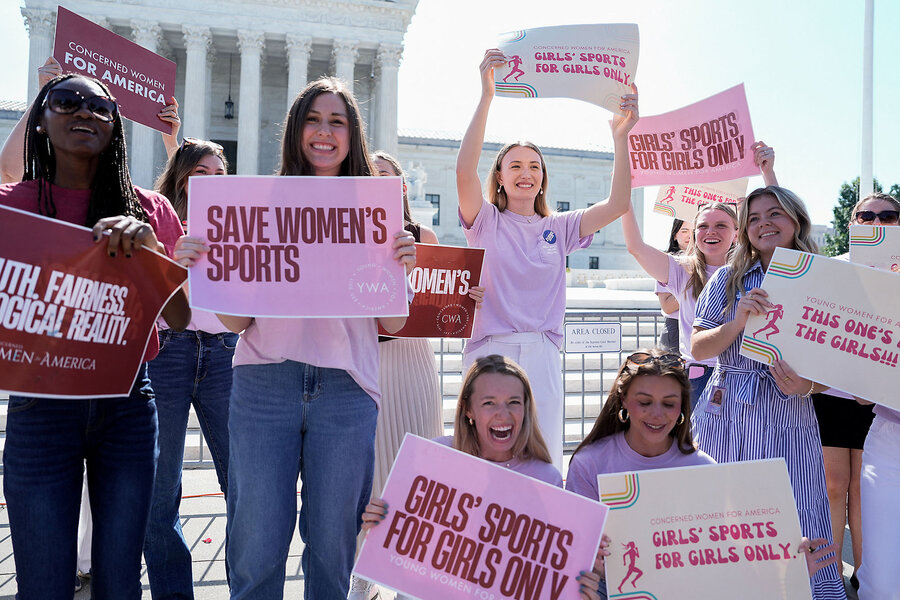
In a setback for transgender rights and a victory for the Trump administration, the U.S. Supreme Court on Tuesday upheld two state laws that ban transgender girls and women from scholastic sports. The sports question has become a political cudgel for Republicans with an eye on growing divisions among Democrats over stances on certain transgender issues that polls show are unpopular with a majority of voters.
In a divided opinion, the court unanimously agreed that laws in West Virginia and Idaho didn’t violate Title IX, which outlaws sex-based discrimination by schools. But it split 6-3 along ideological lines on whether the laws violated the 14th Amendment’s equal protection clause. More than half of states have enacted laws or policies that exclude most transgender students from joining sex-segregated sports teams. Supporters say these laws provide for fair competition and protect girls from potential injury.
The ruling, West Virginia v. B.P.J., doesn’t mandate that all states adopt similar restrictions. Blue states have resisted political and legal pressure from the Trump administration to exclude transgender girls from school sports as part of its rollback of transgender rights in public life. But the ruling will likely empower the Trump administration, which has used Title IX investigations to force schools to fall into line, as well as conservative legal activists who have tried to overturn transgender protections in states like Minnesota. And more states might pass laws similar to those in West Virginia and Idaho.
Why We Wrote This
The Supreme Court’s ruling in a West Virginia case doesn’t mandate that all states adopt similar restrictions on transgender athletes. But it aligns with public concerns about fair competition and the protection of girls from potential injury.
The American Principles Project, a right-wing advocacy group that has helped states draft laws to restrict transgender rights, applauded Tuesday’s ruling. “The Supreme Court has handed down a landmark victory for fairness and sanity by restoring sex-based categories that protect female athletes. Girls deserve their own playing fields and private spaces, free from biological men who seek to invade them,” said APP President Terry Schilling in a statement.
In a statement, Kelly O’Neill, an attorney for Lindsay Hecox, a university student in Idaho who sued the state over its ban on transgender women athletes, criticized the ruling: “It is profoundly unfair to deny a young person the benefits of teamwork and dedication because of who they are.” (Ms. Hecox has since stopped playing college sports and asked the court to declare her lawsuit moot. Her suit was combined with one filed on behalf of a grade school transgender student in West Virginia identified as B.J.P.)
The decision is the latest by the conservative-dominated court to uphold state and federal laws that restrict transgender rights. Last year, the court upheld Tennessee’s ban on gender-transition treatments for minors. Justice Amy Coney Barrett wrote in an opinion in that case that transgender people lack “obvious, immutable or distinguishing characteristics” that would make them a distinct minority protected by the 14th Amendment.
“The court has been completely consistent on constitutional arguments, saying that trans people are not protected by the equal protection clause, and increasingly saying that trans people essentially don’t exist,” says Dara Purvis, a professor of law at Temple University who signed on to an amicus brief in support of B.J.P. She says the ruling, while not unexpected, is troubling for transgender individuals as it weakens their rights as a protected group.
Geoffrey Stone, a law professor at the University of Chicago, says the ruling is fairly narrow and doesn’t go much beyond the question of school athletics. “I think the court is not suggesting that discrimination on the basis of trans [status] is going to be permissible,” he says.
In this case, the Supreme Court stood for the rights of girls and women participating in sex-segregated sports, and found that the state has a “sufficient justification” for excluding transgender women students from certain scholastic sports because of the potential harm to women. “But that will be very different from saying trans people can’t be doctors, can’t be lawyers, or anything like that,” Professor Stone says.
In a partial dissent, Justice Sonia Sotomayor argued that the majority ruling was “inconsistent” in its application of the 14th Amendment. “It credits the West Virginia Legislature’s concern that a class consisting of transgender girls like B. P. J. is large enough to pose an existential threat to girls’ sports, but at the same time holds that this class is too small to be protected by the Equal Protection Clause.”
In 2024, former Massachusetts Gov. Charlie Baker, a Republican who is now president of the NCAA, was asked in a congressional hearing about the number of transgender athletes competing in intercollegiate competitions. He said out of 510,000 athletes, “less than 10” were known to be transgender. In 2025, the NCAA updated its policy to exclude students “assigned male at birth” from competing in women’s sports after the Trump administration issued an executive order against the practice. Similarly, the International Olympic Committee announced this year that women’s sports would be restricted to “biological females,” in part because of the Trump administration’s policy.
Schools and universities now have clarity on how to apply Title IX protections, says Sarah Hartley, a lawyer at Bryan Cave Leighton Paisner. The downside, she adds, is that it will likely lead to the exclusion of transgender students from sports teams that aren’t selective at lower levels.
“The vast majority of kids who play in middle school don’t go on to play in high school,” says Ms. Hartley, who is a former Division I squash player.
The American public generally favors the exclusion of transgender girls and women from competitive sports. In a Reuters/Ipsos poll taken in April, two-thirds of respondents supported bans. Among Democrats, the proportion was 44%, compared with 92% of Republicans.
Ballot questions in Colorado and Washington state about transgender athletics could test the strength of Democratic opposition in November. A ballot initiative in Maine, whose governor, Janet Mills, clashed publicly with President Donald Trump last year over Maine’s transgender school-sports policy, failed to qualify because it didn’t gather enough validated signatures.
Justice Brett Kavanaugh, who wrote the majority opinion in the case, is a sports fan and a father who coached girls’ basketball teams. In oral arguments leading up to Tuesday’s decision, he wrestled with wanting all young children to be able to play sports while also recognizing the “zero-sum game” of who makes a team and who doesn’t.
In his opinion, he expressed dismay that the issue has pitted transgender students who wish to play sports against biological female athletes. Both, he says, are deserving of respect. “No student-athlete on either side of the issue, whether a biological female or transgender, deserves to be ostracized or vilified,” he wrote.
Staff writer Sophie Hills contributed to this report.