Just four years after he signed the Declaration of Independence, but before the colonies would win the war that granted their freedom, Benjamin Franklin was already thinking about the future.
Franklin wrote a letter in 1780 to his close friend Joseph Priestley, the scientist who discovered oxygen, lamenting being born at the beginning of the scientific revolution. He dreamed not just of what the United States and the world would look like in 250 years but 1,000 years.
“The rapid Progress true Science now makes, occasions my Regretting sometimes that I was born so soon. It is impossible to imagine the Height to which may be carried in a 1000 Years the Power of Man over Matter,” Franklin wrote.
Maybe no man in the country’s 250 years was more of a multi-hyphenate than Franklin: politician, diplomat, inventor, journalist, postmaster-general and even the originator of the pros and cons list.
But his predictions of what could happen 1,000 years from when he jotted them down in a letter to a friend showed he was also something of a futurist — even if the term didn’t yet exist.
In the letter, he presaged maglev trains, writing, “We may perhaps learn to deprive large Masses of their Gravity & give them absolute Levity, for the sake of easy Transport.” He also believed all diseases would be “prevented or cured, not excepting even that of Old Age.”
That being said, artificial intelligence, genetically engineered humans and a battle for the control of space were not on his menu like they are now, 250 years into the country Franklin helped form.
Like Franklin over two centuries ago, CBS News spoke to three futurists about what they think the U.S. will look like in the centuries ahead.
But conversations about the future often also discuss the past. It was George Santayana, a teen living in Boston at the time of the American centennial, who later wrote, “Those who cannot remember the past are condemned to repeat it.”
With the U.S. in one of its most fractured time periods in recent memory, it might be easy to use the current climate to portend the future.
“When you live during a time, it makes you feel that this is an extraordinary event in the United States as a nation,” said George Friedman, the founder of Geopolitical Futures and author of “The Next 100 Years” and “The Storm Before the Calm.” “When you look back in history and take a look at the other times, this isn’t anything much worse than Richard Nixon. So yeah, we get strange presidents, but the idea that we are in a uniquely divided position at this point is false.”
Health
Franklin wrote about people living for 1,000 years — specifically, surpassing the ages of Biblical figures like Methuselah and Noah. While that hasn’t come to pass yet (to be fair, we still have 750 years left on Franklin’s timeline), advances in medical technology have come a long way since the 1770s.
The fast development of the COVID-19 vaccine in 2020 is a prime example of that, said Amy Webb, founder of the Future Today Strategy Group and author of “The Genesis Machine: Our Quest to Rewrite Life in the Age of Synthetic Biology.”
“The genetic sequence for the first COVID vaccine was designed on a computer in about two days,” she told CBS News via email. “This was just mindbogglingly incredible. We crossed a threshold – biology was something we had read-edit-write access to, and mRNA worked!”
Despite the promise of mRNA vaccines, they have come under the scrutiny of the current administration and Health and Human Services Secretary Robert F. Kennedy Jr., who canceled about $500 million in grants for research on mRNA vaccines in August 2025. Kennedy said the vaccines caused “more risk than benefits,” an argument not supported by the scientific community.
Jean-François FORT/Hans Lucas/AFP via Getty Images
Regardless, Webb called the promise of the developing blend of technology and healthcare “extraordinary.”
“Imagine a system that detects disease before symptoms appear, where your bathroom doubles as a diagnostic lab, and therapies are tailored to your genome rather than the statistical average,” she said.
Webb described the future of biology as “an engineering discipline.”
“We will grow materials, manufacture drugs, and produce food the way we now write software. Think: programmable, iterative, decentralized,” she said. “That moves whole swaths of business from extraction to cultivation, and it rewrites supply chains that have been stable since the industrial era.”
If you’re thinking this is starting to sound like the genetically engineered future from the 1997 sci-fi film “Gattaca,” you’re not far off.
“One of the things that I’ve been looking at for a long time, which is when the wall between biology and technology begins to fall,” said Brian David Johnson, an author and futurist professor at Arizona State University. “Sometimes we call it synthetic biology, some would call it gene engineering, but it’s that idea of being able to move back and forth between the digital realm and the physical realm with very little friction.”
“What does it mean to model life and then be able to build life?” Johnson asked. “What does it mean from a material standpoint to be able to do that? … I think those moments are things all of a sudden where it really changes how we think about human life and our daily life. And to me, that’s one of those big things and it is coming.”
Space
Founding father John Adams, hardly known for his boundless enthusiasm, famously wrote on the future of America in 1787, saying, “A prospect into futurity in America, is like contemplating the heavens through the telescopes of Herschell. Objects stupendous in their magnitudes and motions strike us from all quarters, and fill us with amazement!”
Adams used astronomer William Herschel’s groundbreaking telescopes, with which he discovered Uranus the same year the colonies won their independence (1781), as a metaphor for just how amazing the future of America could be. Even as an amateur astronomer himself, Adams probably didn’t know how much space would play a role in the country’s future.
The U.S. is currently in a new type of space race, even though it has been happening largely in the background — with thousands of satellites in low Earth orbit.
“You look at 6G (mobile phone technology), you look at edge computing, you look at space-based communications as well,” Johnson said. “And we’re going through and building this out, we’re building a much more robust network.”
Manuel Mazzanti/NurPhoto via Getty Images 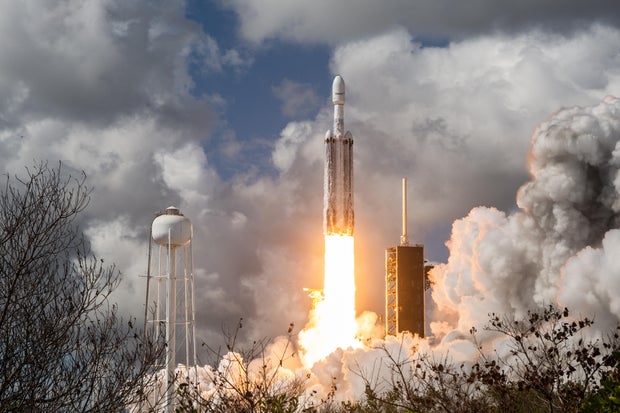
SpaceX currently has more than 10,000 satellites in low Earth orbit, and launches more just about every week. Jeff Bezos’ Amazon Leo operation plans to launch thousands in the coming years and fellow American companies like Planet Labs and Maxar Technologies are doing the same.
“As we start to see the privatization of space with the (low Earth orbit) satellites … that becomes a really really interesting little frontier of what does that mean when we’ve got this sort of 360 (degree) connectivity all around, right?” Johnson said.
It’s also changed warfare, Freidman said.
“The Ukraine war demonstrated that war is not fought as it was in World War II,” he said. “The fundamental basis of all warfare is intelligence, so satellites in low Earth orbit can identify targets, send data down to things like a weapon called (High Mobility Artillery Rocket System) … and trigger an attack. So it used to be the question, ‘Who controlled the oceans?’ Now, it’s the question, ‘Who controls low-Earth orbit?'”
Artificial intelligence
Hardly a day goes by in 2026 when you don’t hear something about artificial intelligence and how it will transform the world. Whether that will be for the good or bad is still a hotly debated topic, but there’s no one left arguing it won’t overmake America in the next several centuries.
“What AI is pushing us to do is to fundamentally revalue how we think about human labor and how we value human labor,” Johnson, who previously worked as a futurist for IBM, said. “And I mean labor in the economic sense, but I also just mean who we are as humans and what we do.”
Johnson and Friedman both believe AI will fundamentally change American society. But they don’t believe it’s anything more than a familiar cycle.
“We’ve done it before. Assembly lines did that, the internet did that … and the impact is quite large,” Johnson said. “I’m an optimist, right? So I’m like, well, let’s value what it means to be human. … Because if the robots and AI can do it, well, let the robots and AI go do it. … Then you sort of reorient around how we value human beings.”
alexsl/Getty Images 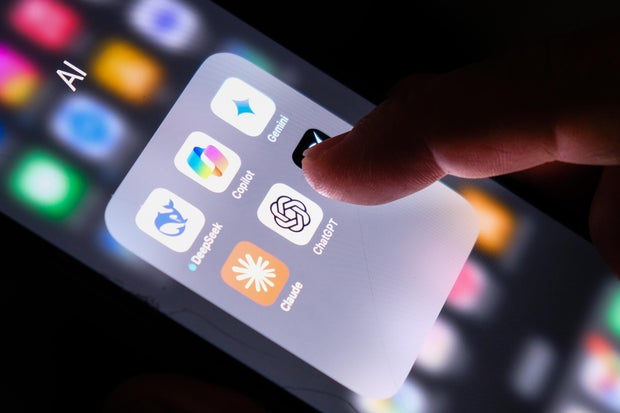
It’s not so simple for Webb, who believes “this cycle doesn’t map cleanly onto the old ones.”
“The comforting story we tell ourselves is that humans always adapt, that every technological revolution looks scary at first and then we all come out better on the other side,” she said. “That’s a cherished belief, and it’s a dangerous one.”
In the year 2276
On the 500th anniversary of the United States, there will at least be a few items that look the same.
That’s because the U.S. government is burying a time capsule under Independence National Historical Park in Philadelphia with items from all 50 states as well as Congress, the Supreme Court and sports leagues like the NFL, NBA and MLB. By order of Congress, it will not be reopened until 2276.
But, the challenge now is preparing for a long-term future in a rapidly changing society, Webb said.
“The core issue in 2026 is that how can a society plan for its next 50, 100, or 250 years when our current leaders plan only 18-24 months out? On a 50-year horizon, that means they are optimizing for a world that will no longer exist,” Webb said.
Friedman says America is in a period of reinventing government, “but our culture does it in ugly ways.”
“First, you bust it down, then you build it up, but that’s it. All layers of our culture, something we do, so when I look at that, I don’t see a crisis going on. I see the norm of the American system,” he said.
Join CBS for “The Great American Block Party 250,” a primetime special on Saturday, July 4, hosted by CBS Evening News anchor Tony Dokoupil and Entertainment Tonight’s Nischelle Turner, featuring live musical performances, celebrations around the country, and the largest fireworks show in history in the skies over the nation’s capital. Tune in July 4 at 8 p.m. ET on CBS and stream it on Paramount+ and CBS News 24/7.