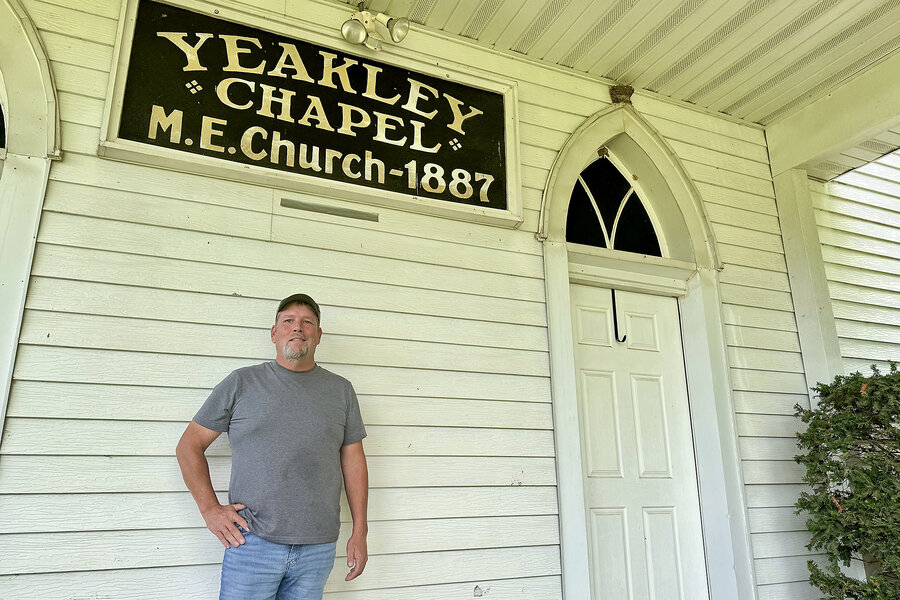
On a cloudy-white Sunday morning in June, Joey Phelps shuffles into the familiar back pew of Yeakley Chapel, the small Methodist church that has been a part of his life for nearly 50 years.
These days only about a dozen people come to attend Sunday services, but Mr. Phelps and his mother are still regulars. He was baptized here as an infant sometime in 1976, the nation’s bicentennial, and he’s lived within five miles of the chapel his entire life.
Yeakley stands along old Route 66 west of Springfield, Missouri, its cemetery stretching behind it. For travelers, the old chapel is a curiosity, a historic church beside America’s most famous highway. But the church was already old when Route 66 was named in Springfield in 1926. Founded in 1865 and rebuilt in 1887, it belongs to an older America of wagon roads, frontier settlements, and rural congregations that gathered long before automobiles began carrying tourists west.
Why We Wrote This
Route 66, developed as a commercial corridor and known for neon signs, has sites that speak to America’s spiritual side as well. In the 1800s, a Methodist congregation pushed across the country’s frontier to Missouri and put down roots that remain today.
America is filled with places like this: small churches and volunteer fire departments, grange halls and veterans posts. They survive not because of institutional strength but because somebody quietly decides they are worth caring for.
But Yeakley is Mr. Phelps’ home. When he was 10 years old, he rode a vintage tractor he rebuilt himself, sitting on the clattering machine as he drove a mile from his house down the road to the white clapboard church. Some fallen branches needed to be moved, and the sanctuary needed some tidying up, he recalls, and he wanted to help.
“It was 1929 Farmall Regular,” says Mr. Phelps, whose father taught him about engines practically from the time he could walk. “It was the first one they made, before they were even red.” Some 40 years later, he’s still “kind of a caretaker” of the nearly 140-year-old church building.

Harry Bruinius/The Christian Science Monitor
“We want to have a sign ministry on Route 66,” says Susan Schmalzbauer, Yeakley’s pastor. “Because we already know people like to stop and take pictures. So we’re going to give them a little message when they stop too. I want them to know that we’re still worshipping here on the route, and we were here before it was the route.”
The Yeakleys came from Greene County, Tennessee — same name, different hills, more than 600 miles east — arriving in Missouri around 1840. They were frontier Methodists, part of a wave of settlers who moved west carrying their faith with them.
John Yeakley organized the Methodist church here in 1865, the year the Civil War ended. He and five other families built the first structure. It burned on Jan. 29, 1883. The current building rose from those ashes in 1887. John’s son, Thomas, donated the land that now holds the chapel and its cemetery.
“They came here in a wagon, not in a convertible on primetime television,” says John Schmalzbauer, the pastor’s husband and the congregation’s pianist. He’s also a religious studies professor and the president of the Greene County Historical Society.

Harry Bruinius/The Christian Science Monitor
Mr. Phelps is kind of a Route 66 throwback. He spent much of his life as a mechanic and machinist, and he’s still a passionate collector of vintage tractors – he’s rebuilt and restored about 20, he says. Today he heads the sewer department for the town of Battlefield.
He also participates in what is called “nostalgia drag racing,” running with the Dirty South Gassers or Nostalgia Gassers, associations that race old vintage cars from the 1950s and 1960s. Mr. Phelps races a red ‘62 Chevy II, which he calls “A Hard Day’s Night.”
For Mr. Phelps, his relationship with the church is much deeper than a pastime, and something harder to describe. “It’s all I know,” he says. “I’ve never been to a different one.” He pauses. “It’s just a piece of you, I guess.”
He’s been struggling with health issues recently, but he still made it to church today.
“I think one of the things that people [do] is failing to honor small things,” says Ms. Schmalzbauer, Yeakley’s pastor. On this Sunday morning, there were eight congregants in attendance, including a guest. “Because small things that look small can be a very big thing to people.”
“It’s the church’s responsibility to take care of Joey,” she says. “And everyone who is in here.”