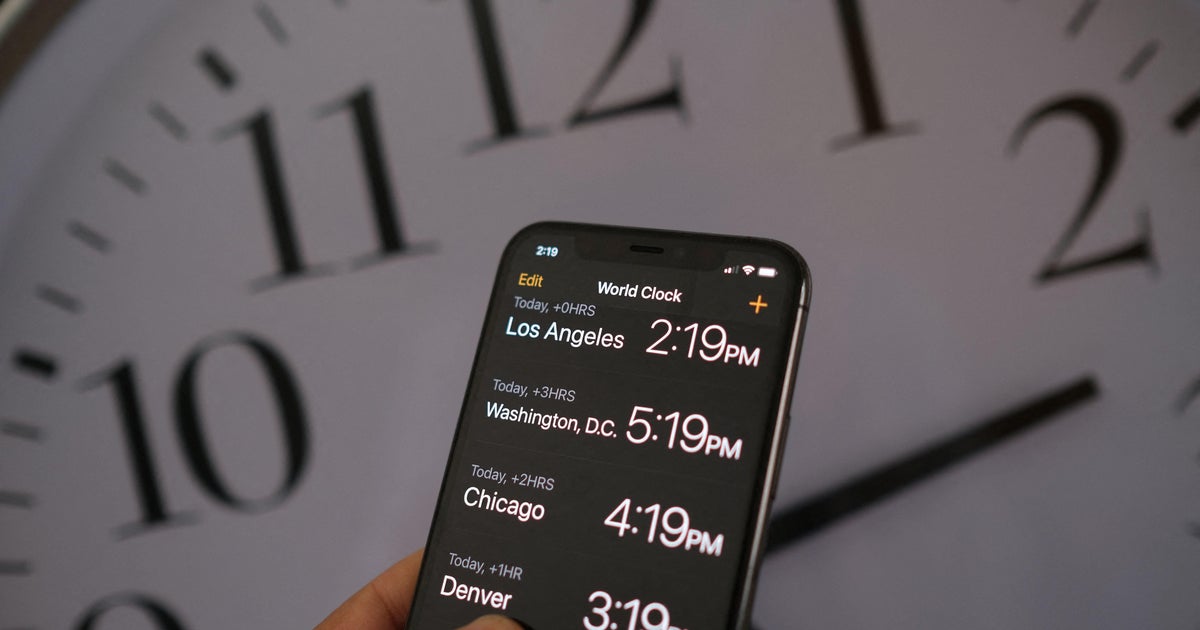
As daylight saving time gets closer and Americans get ready for clocks to “spring forward” for 2026, the time change will affect most of the U.S. — but there are two states and several territories that do not observe daylight saving time.
Come Sunday, March 8, people across the country will move clocks forward an hour and lose an hour of sleep. Daylight saving time ends again, with clocks moving back an hour, on Nov. 1, later this year. The twice-annual change isn’t observed everywhere in the U.S.
Full list of states, territories that don’t do daylight saving
According to the Department of Transportation, which oversees the nation’s time zones, there are two states and five U.S. territories that do not observe daylight saving time.
- Arizona (with the exception of the Navajo Nation)
- Hawaii
- American Samoa
- Guam
- Northern Mariana Islands
- Puerto Rico
- U.S. Virgin Islands
Indiana only adopted daylight saving time beginning in 2006.
Why doesn’t every state have daylight saving time?
Daylight saving time was enacted as a legal requirement by the Uniform Time Act of 1966, according to the Bureau of Transportation Statistics. Under the act, states can exempt themselves from daylight saving time. They do not require permission from the Department of Transportation to opt out of daylight saving time. While states can opt out of observing daylight saving time, they cannot choose to be on permanent daylight saving time.
States also cannot independently change time zones or the length of daylight saving time, which is determined by the federal government.
The states and territories that have chosen to opt out of daylight saving have done so for a variety of reasons.
Arizona
Arizona made the decision not to observe daylight saving time in 1968, according to the state library.
The state made the decision based on the hotter temperatures and desert climate in Arizona, CBS affiliate KOLD reported.
When the clocks “spring forward,” sunset is an hour later. That would keep people in the state out in the sun later during hot months.
It also affects energy costs, KOLD reported.
“The reason for this is the longer the sun was up at night when everyone was home, the more energy households would use during the hot summers,” according to KOLD.
Arizona Rep. Debbie Lesko addressed the issue in a 2022 congressional hearing.
“In Arizona, it is very hot in the summer. In fact, a lot of our workers that work on rooftops, doing new roofs, or on the highways, they actually work in the middle of the night, because it is just too hot,” Lesko said. “And so any time you change anything to Arizona, Arizonans are going to be upset, and it will have consequences that may, that people from the East Coast may not think about.”
The Navajo Nation, which spans parts of Arizona, Utah and New Mexico, does follow daylight saving time.
Hawaii
According to CBS affiliate KGMB, Hawaii’s officials in 1967 determined that the state didn’t need to disrupt its schedules to account for changes in daylight. Hawaii’s proximity to the equator means it gets enough sunlight through the day, regardless of the time of year.
Fighting to end clock changes
A 2022 CBS News/YouGov poll found that nearly 80% of Americans supported changing the current system. The idea of permanently shifting an hour of daylight from the morning to the evening appealed to 46% of Americans while 33% wanted the clock to run out on daylight saving time.
Given the dislike of time changes, several states across the U.S. have tried to end daylight saving or adopt it permanently.
Colorado in 2022 passed a law calling for year-round daylight saving, but the text of the bill states that daylight saving time would only become adopted year-round if Congress enacted a federal law allowing states to remain on daylight saving time all year.
In Massachusetts, state officials in 2023 heard testimony on two bills: one that aimed to make daylight saving time permanent and another that would end daylight saving time and restore standard time year-round.
There have also been federal efforts around changing daylight saving. Under a bill that passed the Senate in 2022 but stalled in the House, daylight saving time would have been made permanent. The bill was reintroduced in 2023 and again in 2025 with the latest version still in committee.
President Trump, before his return to office for his second term, said he’d push to eliminate daylight saving time.
“The Republican Party will use its best efforts to eliminate Daylight Saving Time, which has a small but strong constituency, but shouldn’t! Daylight Saving Time is inconvenient, and very costly to our Nation,” he wrote on Truth Social in December 2024.
While his 2024 comment calls for the elimination of daylight saving time, Mr. Trump has, in the past, called for daylight saving, that is, keeping clocks shifted one hour ahead, to be permanent.
Last year, Rep. Mike Rogers, a Republican from Alabama, reintroduced a bill in the House of Representatives to give states the choice to remain on daylight saving time year-round.
“Changing our clocks twice a year is unnecessary and an outdated nuisance, furthermore, remaining on Daylight Saving Time could have tremendous benefits for the economy and people’s health,” he said in a statement. “The people of Alabama have spoken, and they want to stay on Daylight Saving Time year-round. My legislation allows our state and many more to do just that.”