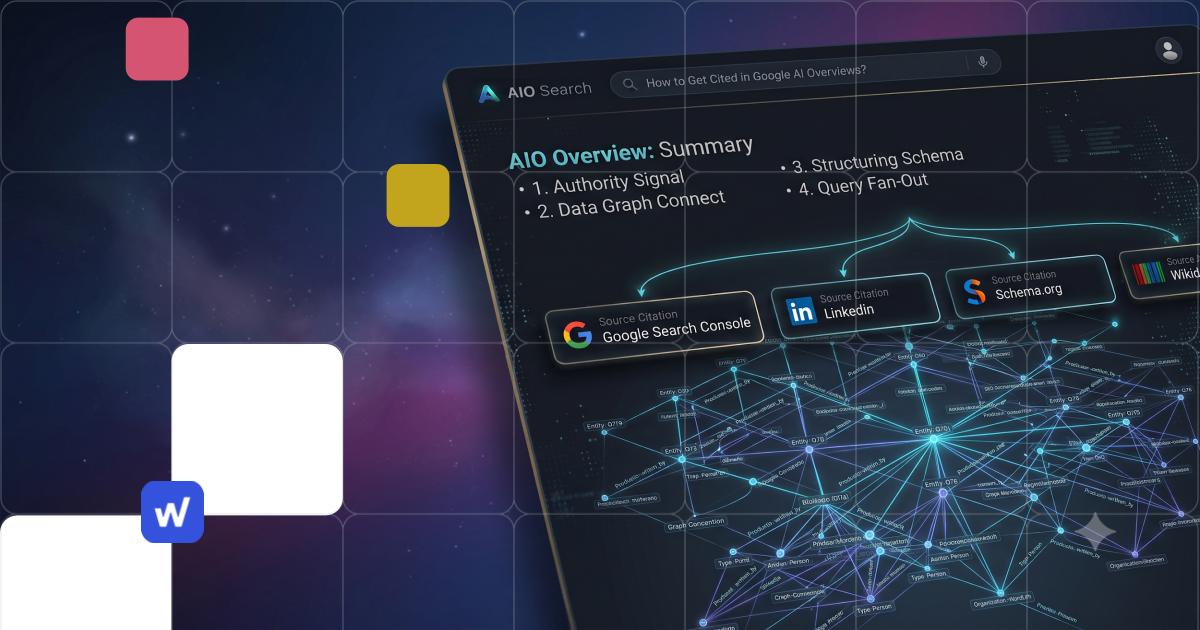
If your Search Console dashboard looks like impressions are climbing while clicks are quietly sliding, you’re not imagining it, and you’re not doing anything wrong. You’re looking at the signature of a search engine that no longer hands out ten blue links — it hands out one synthesised answer, built from three to five cited sources. The brands inside that citation set compound. The brands outside it don’t rank lower; they disappear from the conversation entirely.
This is the operational playbook for landing inside that citation set. It’s built on the mechanics Google has published, the research WordLift has run across BFSI, retail, publishing, and travel deployments, and a four-step framework you can start executing this quarter.
Why AI Overviews Broke the Old SEO Playbook
For three decades, the deal with search was simple: rank, get clicked, get traffic. That deal changed the moment Google started answering substantive questions directly. AI Overviews handles the straightforward ones; AI Mode handles the complex, comparative ones. Both produce the same shape of result — a synthesised paragraph citing a handful of sources, sitting above the classic organic list. Most users read the answer and stop there.
Perplexity, Copilot, ChatGPT search, and every other AI-first interface run the same mechanic: one answer, a small citation set, no ranked list to scroll through.
That’s what produces the pattern confusing so many teams: impressions rising, CTR falling, total clicks flat. Read that pattern correctly. Your URL showing up as the citation behind an AI answer counts as an impression — you were surfaced. The user just didn’t need to click, because the answer already satisfied them. That’s not a failing page. That’s a page participating in the AI answer.
The metric worth tracking going forward isn’t click-through rate. It’s citation rate — are you the source AI engines choose when someone in your category asks a question? We’ll come back to how to measure that. For now, the strategic point is this: becoming citable is editorial and structural work that compounds once it’s done. Recovering from invisibility, once an AI has learned to answer your category without you, takes considerably longer. Waiting to see if AI Overviews are “here to stay” is what turns a solvable content problem into a compounding brand-visibility one.
What Google’s AI Actually Looks For
Google’s E-E-A-T framework hasn’t gone away — but the signals behind each letter have changed shape. Classic SEO checked whether your page mentioned expertise. AI retrieval checks whether it can resolve that expertise against a known entity.
- Authority used to mean backlinks. Now it’s verifiable entity identity — your organisation resolved against Wikidata, LinkedIn, and Google’s own Knowledge Graph.
- Expertise used to mean an author byline. Now it’s Person schema with structured affiliations, prior works, and sameAs links that prove the byline is a real, checkable person.
- Trust used to mean HTTPS and a contact page. Now it’s internal consistency — the AI cross-checks your schema against your content and your entity graph, looking for contradictions.
- Experience used to mean first-person language. Now it’s original entities — products, data, events — that the AI can extract and find nowhere else.
Three entity types decide whether you get cited
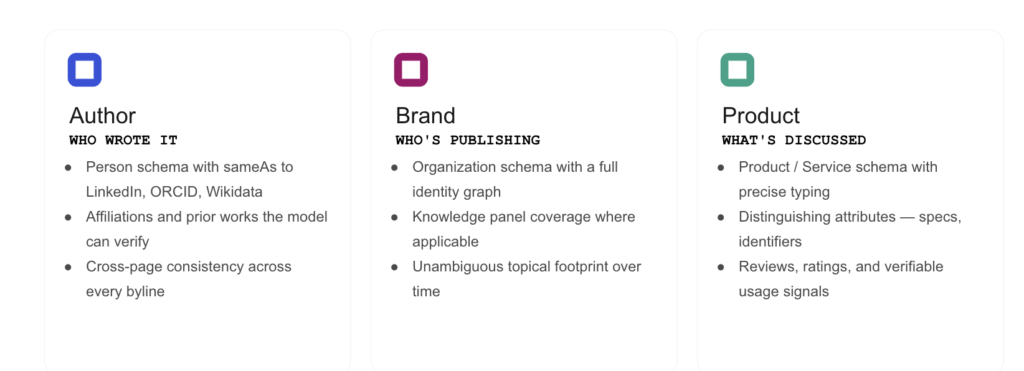
Three entity types decide whether you get cited: Author (who wrote it, resolved via Person schema), Brand (who’s publishing, resolved via Organization schema with logo, founder, and funding data), and Product/Service (what’s being discussed, resolved via Product schema with distinguishing attributes). Author and Brand entities carry the most citation weight; Product entities are what let a citation turn into an agentic commerce action. This is exactly the ground covered in our piece on structured data for personal branding and E-E-A-T and its product-side counterpart, Product Knowledge Graph and E-E-A-T.
Schema.org is how you make that identity legible to a machine. It’s no longer a rich-snippet nicety — it’s the API your site exposes to language models. There’s an economic reason it matters beyond semantics, too. Every LLM inference has a compute-bound “prefill” phase where it reads the entire input context in one pass. That phase has a finite budget per query. Structured, well-typed content is cheap to parse; unstructured prose burns that budget before the model even starts reasoning — and gets dropped from the context window before it has a chance to be cited. Cheap-to-read content wins the budget. Expensive-to-parse content doesn’t get read at all.
It’s worth being precise about what schema alone can and can’t do. WordLift’s own research — testing three retrieval configurations across 2,443 queries and four verticals — found that JSON-LD by itself produces only marginal lift in standard retrieval. The gain shows up once something can traverse the graph: an agent following a Product’s brand to an Organization page, then to that organisation’s Person-schema author. Schema is necessary. It pays off when there’s a connected graph for an agent to follow — which is precisely the architecture we describe in how knowledge graphs power AI SEO.
The Four-Step Framework to Earn AI Citations
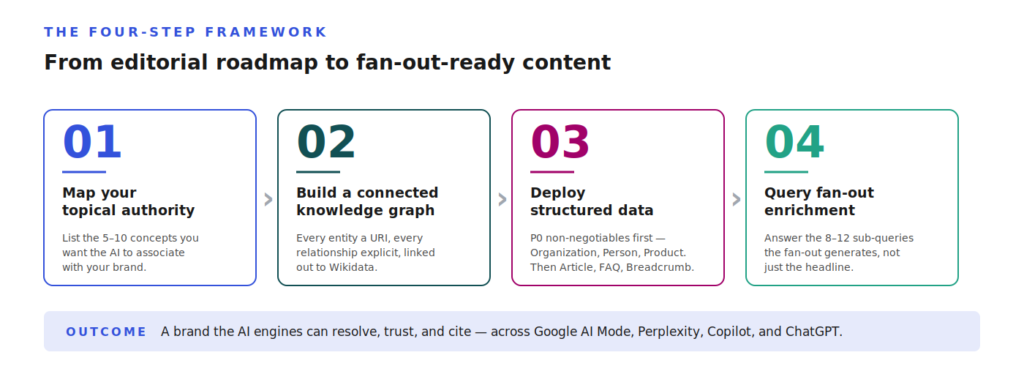
Step 1: Map Your Topical Authority
Before deploying a single schema type, decide what your brand should be known for. List the five to ten concepts you want AI engines to associate with your brand, map each to its corresponding Wikidata or Schema.org entity, and note which ones you already own with content and markup versus which are gaps. Those gaps are your editorial roadmap. Most teams skip this step and go straight to schema — don’t. Our guide to building topical authority through entity analytics walks through the exercise in more depth.
Step 2: Build a Connected Knowledge Graph
Give every entity a stable URI, and make the relationships between them explicit: author writes article, article covers topic, brand sells product. A pile of well-marked-up pages that don’t reference each other is a stack of business cards. A connected graph is queryable infrastructure — and it’s the only version an AI engine can actually use. Extend those connections outward, too, cross-referencing your entities to Wikidata, LinkedIn, and ORCID via sameAs links. An entity the AI can resolve against a known reference is an entity it can cite with confidence.
Step 3: Deploy Structured Data, in Priority Order
Not all schema carries equal weight. Deploy in this order:
- P0 (non-negotiable): Organization schema, Person schema for verifiable authors, Product/Service schema.
- P1 (high leverage): Article schema with author and topic linkage, FAQPage schema for Q&A blocks the AI can lift directly.
- P2 (hygiene): BreadcrumbList for site hierarchy.
Validate every deployment against Google’s Rich Results Test and the Schema.org validator, then monitor monthly for drift. In practice, most sites we audit have this backwards — Article and BreadcrumbList are solid, Organization is missing or incomplete, which is the one schema type carrying the most brand-authority weight. Structured data automation is what makes maintaining this at scale realistic for an editorial team rather than a one-off technical project.
Step 4: Enrich for Query Fan-Out
This is the step most competitors skip entirely, which makes it the highest-leverage one available. When AI Mode processes a substantive question, it doesn’t answer it directly — it decomposes it into eight to twelve parallel sub-queries, each hitting a different sub-intent: a definition, a comparison, a constraint check, an alternative. Your content isn’t competing to answer one headline keyword. It’s competing to answer whichever of those eight to twelve sub-queries it covers best.
For each priority page, generate the sub-query map an AI Mode fan-out would produce for your category, then audit your existing content against it: which sub-queries are already answered, and which are missing? The gaps become your enrichment roadmap — turning a thin product page into a fan-out-ready one by adding structured answers to the specific questions your buyers are actually asking, not just the one you optimised the title around.
For E-commerce: The Agentic Commerce Layer
If your content touches products, there’s a layer beneath Schema.org worth prioritising now, while almost nobody else has: the GS1 Web Vocabulary, and specifically GS1 Digital Link. The GTIN is the only global primary key for physical goods, and both Google’s Universal Commerce Protocol and OpenAI’s Agentic Commerce Protocol enforce it as the canonical identifier. Without a sameAs link to https://id.gs1.org/01/{GTIN}, your product on your own site and your product on a marketplace are unresolvable as the same entity to a shopping agent — which makes you invisible to any agent transacting across retailers.
Pair that identifier with Schema.org’s potentialAction property — attach BuyAction, ReserveAction, or SubscribeAction to a Product or Organization, and you’ve declared something an agent can actually execute, not just read about. Fewer than 100 domains globally have implemented BuyAction properly, which makes it one of the more asymmetric opportunities available to any brand with a product catalogue. For the full picture on identifier strategy, see GS1 Digital Link and our strategic roadmap for GS1 Digital Link adoption.
Measuring What Works: From CTR to Citation Rate
A healthy trend in the AI-search era doesn’t look like a healthy trend in the old one. Here’s what to expect, and what to actually monitor:
- Impressions rising — your URLs are being surfaced inside AI answers.
- CTR falling — expected user behaviour for the AI-answer format, not a content failure.
- Total clicks flat or slightly down — consistent with the shift, not a red flag on its own.
- Third-party citations rising — the leading indicator. Track your presence in Perplexity, Copilot, and ChatGPT; a rise there tends to precede a rise in Google AI Mode citations.
Monthly, segment Search Console impressions by query type (fact, comparison, how-to), and run your top twenty category queries through the major AI engines to see who’s being cited and whether your position holds. The moment genuinely worth worrying about is impressions staying flat and citations failing to appear anywhere — that combination is invisibility taking hold, not the normal shape of AI participation.
Key Takeaways
- AI search returns one synthesised answer, not ten blue links — cited brands compound across engines, uncited brands vanish.
- Impressions up, CTR down is the new normal — it signals citation, not decline.
- Entity clarity beats keyword density as the primary AI signal.
- Schema.org is your API to language models, not a ranking trick.
- AI Mode runs query fan-out across 8–12 sub-queries per question — write for the sub-queries, not just the headline.
- Structured, cheap-to-prefill content wins the model’s limited context budget.
- Schema alone isn’t enough — the winning architecture is schema → entity pages → dereferenceable URIs → graph traversal.
- The agentic vocabulary (BuyAction and friends) is barely deployed — an open opportunity for anyone who moves now.
- GS1 Digital Link is the emerging global primary key for physical goods across agentic commerce protocols.
- The framework: map topical authority → build a connected knowledge graph → deploy structured data → enrich for query fan-out.
Frequently Asked Questions
Does this work for e-commerce specifically?
Yes, and the returns tend to be higher there. Product entity clarity, GS1 Digital Link on every SKU, and verified availability and pricing are the specific enablers that let AI shopping agents recommend and transact against your inventory rather than a competitor’s — the technical lift is the same as for editorial content, but the path to ROI is more direct.
How long until results show up?
Structural changes — schema deployment, entity graphs, sameAs links — tend to show as citation shifts within 4–8 weeks in third-party engines and 8–16 weeks in Google AI Mode. Query fan-out enrichment often moves faster, sometimes in 2–4 weeks, since it’s answering gaps that already exist in your content. The compounding effect takes longer to build: a knowledge graph that’s been running for two years earns citations at a rate a freshly deployed one doesn’t yet match.
Is llms.txt worth implementing?
It’s not a formally supported standard from Google or the major AI engines as of this writing. Some engines treat it as a soft signal; none treats it as authoritative the way robots.txt is. It’s fine to deploy if you want the option, but it isn’t a substitute for schema and entity work — it operates at the wrong layer of the stack to move citation on its own.
Where to Go From Here
None of this is theoretical for WordLift’s own clients. The same entity-and-graph approach behind this framework is how EssilorLuxottica trains its AI with WordLift to keep its content briefs grounded in a real knowledge graph rather than guesswork.
If you want to see where your own brand currently stands, book a free AI Visibility Audit — we’ll run your top 20 category queries through Google AI Mode, Perplexity, Copilot, and ChatGPT, and show you exactly where you’re cited, where a competitor is cited instead, and which structural changes would move you into the citation set.
Or, if you’d rather put the framework into motion directly, see how Agent WordLift builds and maintains your knowledge graph — from entity mapping through schema deployment to ongoing query fan-out enrichment.