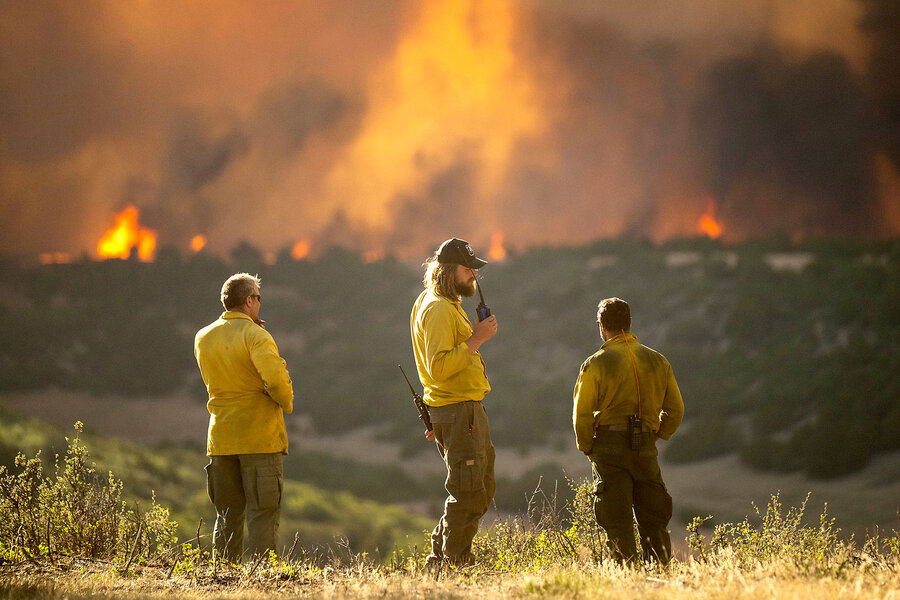
It’s a dark déjà vu for Twyla Petersen. She’s fled wildfires before, like the one that burned her house down in Wetmore, Colorado, in 2012.
Last week, after packing family photos, she fled Wetmore again. She left open gates on her property in case neighboring livestock end up on her side.
“I wanted to, as best as I could, provide a way of escape,” says Ms. Petersen. She sought fire updates Monday at a help center in Pueblo, northeast from the scorched earth.
Why We Wrote This
A large wildfire in southern Colorado has forced thousands of residents from their homes. Government officials, local volunteers, and others are offering support to people and their livestock.
Firefighters are battling 36 large uncontained fires across the United States, according to the National Interagency Fire Center. Fires have so far burned more than 3.3 million acres across the country this year, compared with about 2.1 million acres by this time in 2025. So far, this year marks the second-highest total acres burned during the past decade.
Several wildfires are raging across Colorado and souring skies with smoke. Heat, drought, and wind have helped them grow. In late June, three wildland firefighters died while responding to a western Colorado blaze.
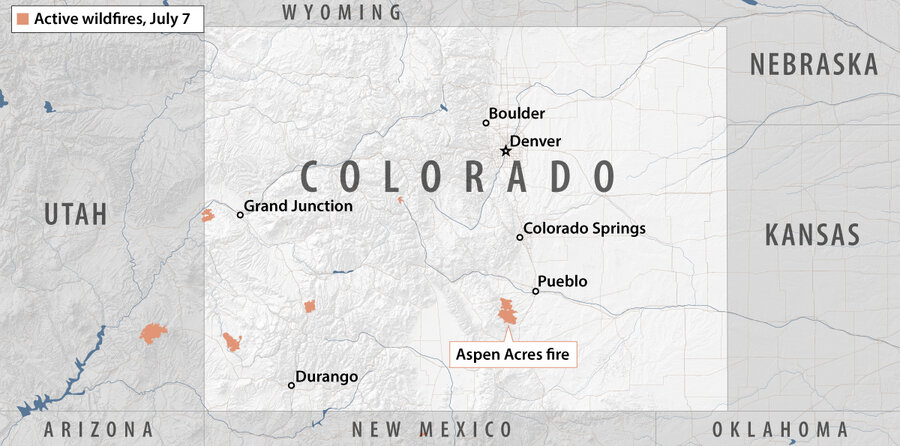
The largest, the Aspen Acres fire, now spans more than 93,600 acres in the state’s rural south – equal to some 146 square miles. Authorities say the fire was human-caused, but details are scarce and under investigation. Thousands of residents from several communities have had to leave their homes. Though no deaths are reported so far, some 260 homes have burned.
First reported June 29, the inferno shows no sign of ending soon. That’s what Coloradans heard at a community meeting at a Pueblo high school Monday night.
“This fire is a monster,” Jim Pitts, an agency administrator at the U.S. Forest Service, tells the crowd. “This thing is absolutely doing what it wants to do.”
The Aspen Acres fire will last long, he says. All summer.
“The forest, we will deal with it when the time comes,” Mr. Pitts says. “Right now, our focus is: How do we support our communities? How do we support our neighbors?”
Help arrives
Led by an incident management team from Alaska, the firefight has pulled in personnel from across the country. Locals have donated goods for each other and hay for livestock.
Outside a disaster assistance center in Pueblo, where she just received food, Traci Reeves munches on a red apple. “The hard part is not knowing when we can go back,” says Ms. Reeves, an evacuee from Rye. She wishes she’d been more prepared.
“I would do it all different next time. … I’d make a list,” she says. “I did grab birth certificates and I did grab passports. But there’s so much I left behind.”
Nearby, the Pueblo Community Animal Response Team has sheltered more than 1,300 evacuated animals – including cattle – at a fairground. Around 1,000 volunteers have raised their hands to help the animals, says James Pritchett, vice president for engagement and extension at Colorado State University, which leads the effort.

Sarah Matusek/The Christian Science Monitor
There are also mental health professionals on hand to connect ranchers to resources, he says.
“That’s a really difficult time,” says Mr. Pritchett. “Both the intensity of trying to save your animals, and then watching the fire in your review mirror.”
“Contained”
In the summer heat of drought-parched Colorado, both the atmosphere above and vegetation below are dangerously dry.
“We know with the way climate change impacts local weather conditions that droughts and heat waves are going to be longer-lived, more extreme,” says Paul Schlatter, a meteorologist with the National Weather Service in Boulder.
National Interagency Fire Center
|
Jacob Turcotte/Staff
The Aspen Acres fire has conquered tough terrain. That includes steep slopes, which can complicate firefighting and aid the rapid spread of flames, says Mr. Schlatter. Plus, he says, “Any amount of wind, in this environment, will keep that fire going.”
As the Pueblo sky glazes over in haze Tuesday morning, authorities say the fire is 15% contained, referring to its perimeter. Mr. Pitts, at the U.S. Forest Service, says to think of a catcher’s mitt.
“You’ve caught the fire there. But just like in baseball … you drop the ball once in a while,” he says. “Just because it’s contained doesn’t mean it’s controlled.”
Another nuance: If the fire grows in size, the percentage of containment could shrink.
After the meeting, fire officials welcome questions one-on-one in front of large maps of the region, overlaid by the rumpled edges of the fire. Ms. Petersen joins others scanning a map.
Colorado should start to see “monsoonal moisture” roll in within a week or so, says Mr. Schlatter, the meteorologist. But that relief remains up in the air.