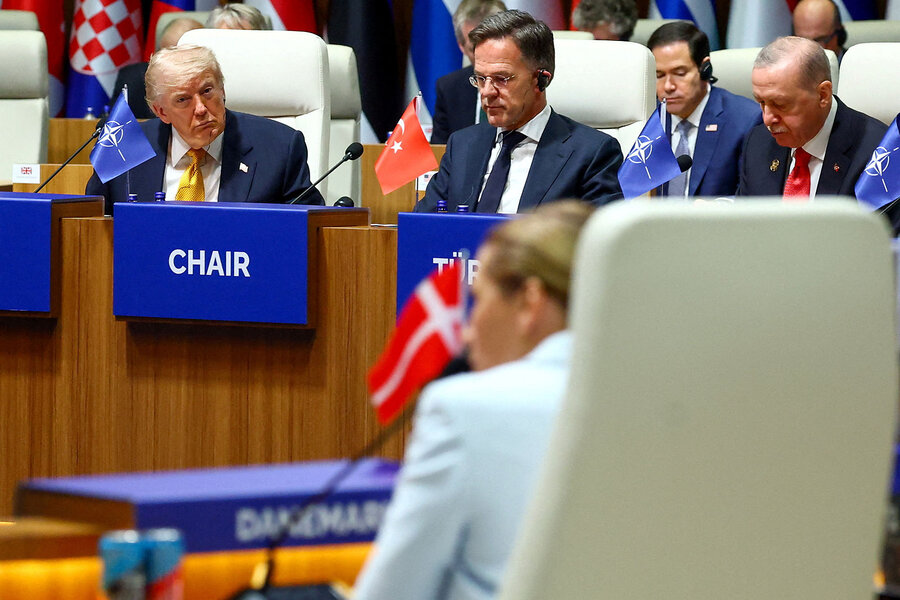
As top leaders gathered this week for the annual NATO summit, the focus – until U.S. President Donald Trump said that any ceasefire with Iran was likely “over” – had been on “burden shifting.”
Beyond calling into question the fragile ceasefire by saying the United States might hit Iran with a new wave of strikes Wednesday evening, Mr. Trump’s threat complicates ongoing discussions among European partners here on how they can take on more of the alliance’s defense and financial costs.
By Wednesday evening, he had backtracked to say, of the war in Iran, “I don’t think it’s going to start again,” and that any further strikes “will be over very quickly.”
Why We Wrote This
The back-and-forth talk of strikes and ceasefires in the Iran conflict at the NATO summit this week risks straining the alliance’s renewed efforts at partnership and unity, a cornerstone of Western defense for decades.
In a wrap-up news conference on Wednesday, NATO Secretary-General Mark Rutte said he thought President Trump “was totally right” to strike Iran. But he also tried to turn the conversation back to the alliance and what “NATO 3.0” – as the capability shifts have been dubbed – might look like as he spoke of equalizing defense spending between Europe and the U.S.
Mr. Rutte described the effort as a move from an “unhealthy co-dependence” to a “healthy partnership.” He also said on Wednesday that the alliance “warmly welcomed” President Trump’s leadership on this front.
Mr. Rutte has been both derided and lauded as the “Trump whisperer” for his good-cop role in NATO’s dealings with the American president. He publicly supported Mr. Trump’s decision to strike Iran again this week for what officials described as violations of the ceasefire, even as the prospect of renewed war threatens to reignite Mr. Trump’s resentments about Europe not doing more to help fight the regime in Tehran.
Whither the ceasefire?
Speaking to reporters in Turkey, alongside Ukrainian President Volodymyr Zelenskyy, President Trump said the U.S. would probably hit Iran with a deluge of strikes again on Wednesday evening.
“I’ll give them a little warning; we’re going to hit them hard again tonight,” he said, adding that the ceasefire was likely over, though negotiations could continue.
Meanwhile, other NATO officials are warily eyeing another potential move: the Trump administration’s announcement last month of a review of U.S. military forces on the continent. The U.S. has strongly hinted that such cuts hinge on Europe making good on its pledge – made this time last year at The Hague – to step up security spending.
“This is the ‘Show Me the Money’ summit,” Bradley Bowman, senior director at the Foundation for Defense of Democracies, said last week during a roundtable discussion for journalists. “The time for some of our NATO allies to say ‘the check is in the mail’ on defense spending is over.”
Europe’s new plan
Europe is stepping up, analysts say. Germany sent an armored brigade of 5,000 soldiers to Lithuania to shore up NATO’s eastern flank, for example, marking the first permanent overseas deployment of German forces since World War II. Allies are also investing in ammunition production and other defense-industrial capacities.
The U.S. would have had a difficult time prosecuting the war in Iran without the use of European bases, NATO officials privately note. NATO member nations have hosted some 5,000 U.S. military sorties during the conflict, Mr. Rutte added on Wednesday.
Mr. Trump’s oscillating grudges, however, have fueled concerns that the troop cuts and the removal of other U.S. military resources from the continent will outpace Europeans’ ability to carry that burden themselves.

In the background, there is also the looming matter of Greenland, on which Mr. Trump still appears to have designs. “Denmark doesn’t spend money or really help Greenland,” but it’s “important” for the U.S., President Trump said shortly after arriving in Ankara.
Save the drama
The hope in making this summit a brief gathering was, like a fraught family dinner, to keep drama to a minimum, said Max Bergmann, director of the Europe, Russia, and Eurasia Program at the Center for Strategic and International Studies (CSIS), during a roundtable discussion last week.
“There’s maybe some passive-aggressive or rude comments thrown around here or there,” he added, “but nothing explodes into an actual sort of fight.”
Holding the NATO gathering in Ankara was seen by many as a move to make sure Mr. Trump, out of respect for authoritarian Turkish President Recep Tayyip Erdoğan, would show up.
Still, there is speculation that, to minimize the potential for clashes, future high-profile meetups, such as the big NATO meeting scheduled for next year in Albania, might be canceled. That could make this the last summit of Mr. Trump’s presidency.
When diplomacy matters
U.S. Defense Secretary Pete Hegseth brought the drama to a pre-summit meeting of top NATO officials last month, berating allies – in front of the media, many of them noted – for letting the U.S. down in Iran after some refused to grant U.S. forces base access for operations.

This did not go down well in much of Europe. Still, a Pew Research Center survey of citizens in 13 member states released this month found that two-thirds of European respondents view NATO favorably. In the U.S., just over half of respondents say they do.
There are plenty of bread-and-butter concerns, however, among European citizens, who have been watching their governments cut social programs in favor of military spending.
In a nod to these concerns, and under provisions agreed to at last year’s NATO summit to increase defense spending to 3.5% for traditional military hardware, and another 1.5% for more open-ended defense-related expenditures, member states are also investing in civilian infrastructure such as bridges, ports, rail networks, and roads.
They are integrating the lessons of Ukraine as well when it comes to drones, electronic warfare, and artificial intelligence. At the summit, NATO pledged some $80 billion in military equipment assistance for Ukraine for 2027, matching the amount pledged this year.
In the meantime, the alliance is using a mechanism it calls the NATO Force Model to map out how Europe can shoulder more of the alliance’s conventional capabilities that could be needed in the event of a wider war.
Give and take
Still, a number of capabilities – or “strategic enablers,’’ in military parlance – that Europe relies on for its defense remain overwhelmingly American.
This includes intelligence and surveillance assets as well as long-range bombers, air-to-air refueling, and, ultimately, NATO’s nuclear deterrence.
For now, the U.S. still pays the bulk of the NATO tab. In 2024, U.S. spending represented 52% of NATO’s combined gross domestic product but covered 64% of the alliance’s expenditures, according to an Atlantic Council report. In 2025, even after The Hague pledged to extend NATO member spending to 5% of GDP, the U.S. still covered roughly 62% of the costs.
Yet, as this gap decreases, so, too, could U.S. influence on the continent, say analysts who note that historically, the U.S. didn’t help Europe solely out of the goodness of its heart. The hefty contributions have given America strategic leverage on the continent.
For the past 77 years, “That’s how we have wanted it – that is how we have insisted on NATO being structured,” Mr. Bergmann of CSIS said.
With the moves underway to step back from NATO, American influence could wane.
What is less clear is how Europe will forge its defense policy, he added, “in a world where they’re not going to be turning to the United States for leadership.”