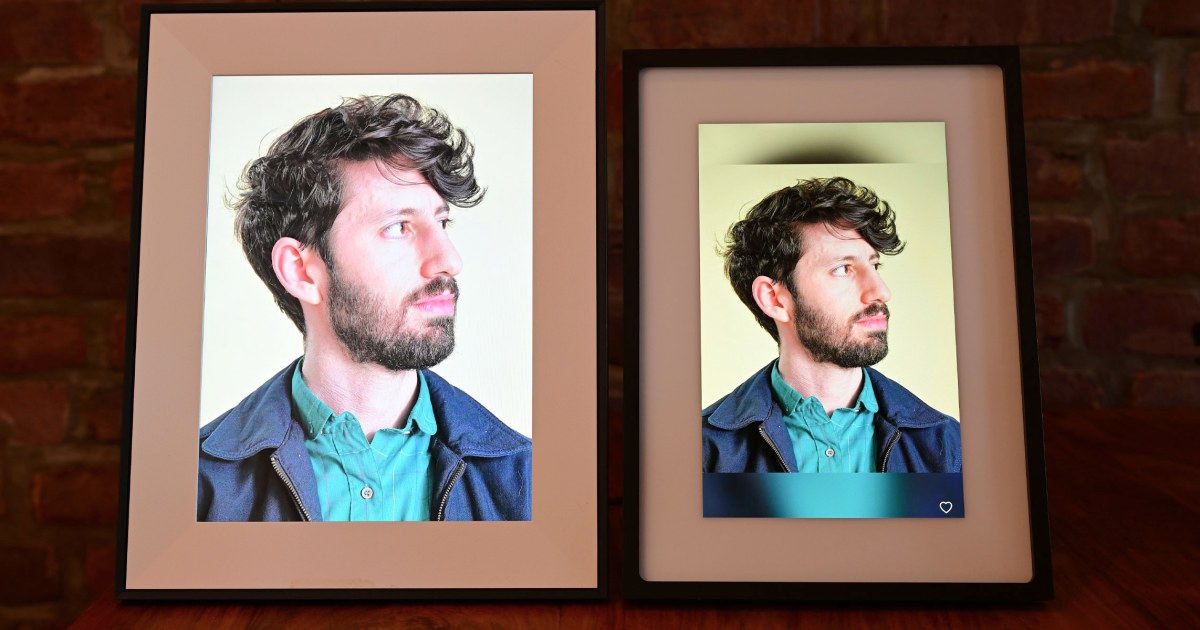
Aura Frame and Skylight are two of the best digital photo frame brands on the market, and choosing between the two on paper is challenging. That’s why I tried them side-by-side for more than a month, to get real-life experience that goes beyond the spec sheet, because digital photo frames are for everyone, not just your grandparents.
These frames make it easy to enjoy your favorite photos without having to scroll through your phone’s messy camera roll. Plus, they have other standout features that make them a great gift for any home. Read on to find out which brand earned my recommendation.
How I tried Aura and Skylight frames

Aura and Skylight sell a few digital photo frames. I tested the Aura Aspen and Skylight Frame 2 — they are the most similar in size, price and functionality. I put both frames in my home for about a month, comparing the setup, interface, design and picture quality of each.
I also recruited former NBC Select commerce editor Lindsay Schneider and NBC Select social editorial assistant Caitlin Cusack for testing — Schneider tried out the Skylight and Cusack tested the Aura.
Want more from NBC Select? Sign up for our newsletter, The Selection, and shop smarter.
Our experience with Aura and Skylight
The Aura and Skylight frames are excellent digital photo frames. Both are easy to use, and have been great additions to our homes. Which one is best for you will depend on a few key differences. We ended up preferring the Aura frame, but there are a few situations where the Skylight frame might be the better pick. Keep reading to learn more.
Setup
Aura
The Aura Aspen is very easy to set up — it took us less than five minutes from start to finish. Setup is done entirely through your phone — you download the Aura app, pair your frame, connect it to Wi-Fi and upload photos. If you are gifting an Aura frame, you can set it up virtually or by scanning the QR printed on the packaging under a peel-away sticker. I love the QR-code option, especially if I am giving a frame to a non-techy person.
Skylight
The Skylight Frame 2 also has a simple setup process — I’m confident almost anyone could do it with little issue. However, it’s slightly more involved than Aura. You download the Skylight app and interact with both the app and the Frame 2 touchscreen during setup. For example, I had to input my Wi-Fi password by typing on the frame — Aura automatically synced my Wi-Fi network through my phone. You also have to set up an email address option for sharing photos — Aura has this too, but it does not force you to do this during setup.
If you are gifting a Skylight Frame, you can set it up virtually and share a gift code with your recipient once they unbox the Frame 2.
Winner: Aura. Both frames are quick and easy to set up, but Aura is slightly simpler — Skylight has a few extra steps by comparison.
Design
Aura
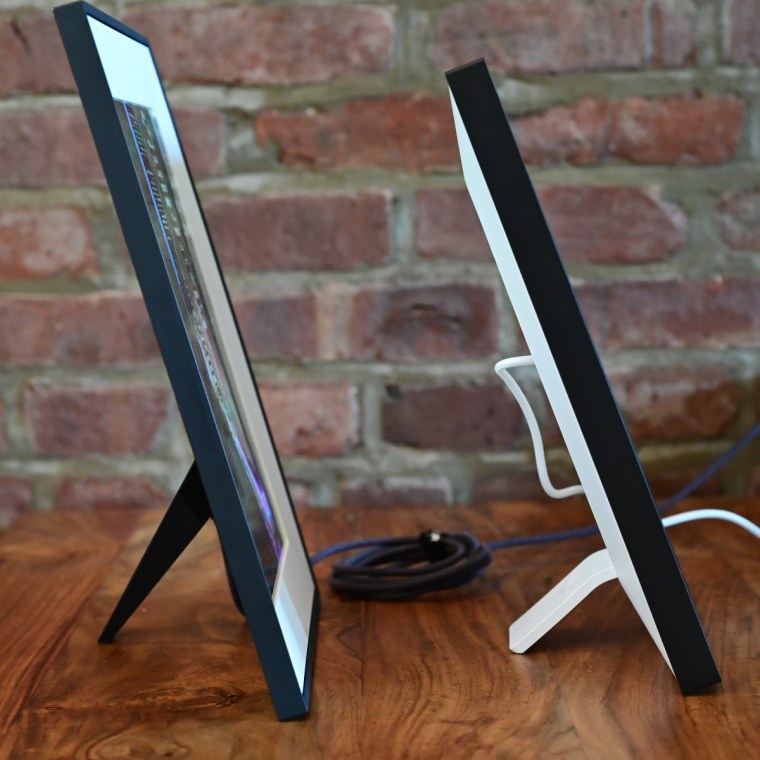
The Aura Aspen is sleek, subtle and convincingly analog looking. It easily blends into most home decor. It has touch bars on the frame’s sides you can use to swipe through photos or tap to control settings and even turn the frame off. I enjoyed using the swipe touch bar, but it took some getting used to. Cusack found it overly sensitive, and would have preferred button controls instead.
The Aspen is available in one style and two colors. The power supply is blocky and has a built-in power cord — I was expecting something sleeker, or at least something with USB-C, like all my other gadgets.
Skylight
The Skylight Frame 2 is similarly sleek and attractive. You can pick from 10 styles and colors, including options with a faux frame mat, making it easier to match to specific decor than the Aura Aspen.
The Frame 2 is a touchscreen — you tap and swipe the screen to look through photos, albums and change settings. The touchscreen is intuitive but invites fingerprints, and because certain settings are only located on the frame (unless you subscribe to Skylight Plus), the screen ends up with a lot of fingerprints, says Schneider.
The power supply is blocky and has a built-in power cord, just like the Aura Aspen. But the power cord is shorter — Schneider wanted to put her Frame 2 on a high shelf, but couldn’t because of the power cord’s length.
Winner: Draw. This one’s a toss-up. I prefer the Aura Aspen’s subtle design and swipe controls. Others preferred the Skylight Frame 2’s touchscreen controls (despite it being a fingerprint-magnet). Both are sleek and easy to put unobtrusively into your space.
Ease of use

Aura
Aura frames are exceedingly easy to use. Everything is controlled through the Aura app — uploading photos, inviting friends and family to share photos, changing each photo’s framing, picking slideshow settings and more. Cusack sent her family a link to add photos, and she started seeing new photos and videos instantly. I’m a fan of this app-first approach: after all, you don’t adjust settings on a real photo frame.
Skylight
Skylight is also easy to use, but slightly less so. Tasks like uploading photos usually have one extra step compared to Aura. The Skylight app feels a little busier than Aura’s, with more menus and submenus. Plus, settings are split: some are controlled via the Skylight app, others via the touchscreen on the Frame 2 itself.
Ease of use is complicated by Skylight’s optional subscription service, Skylight Plus. It lets you view and download photos to other devices, change frame settings from your phone, create and edit photo albums and more. It’s $39 a year and covers all Skylight frames in your account, but feels like a strange addition for a device where simplicity is key.
One advantage Skylight has over Aura is built-in storage. After you upload your photos to the Skylight, it does not need to be connected to Wi-Fi to display those photos — they are stored locally in the frame. This makes the Frame 2 the obvious choice for off-the-grid living or Wi-Fi dead zones.
Winner: Aura. The Aura is slightly easier to use than the Skylight. Its app is more intuitive and controls everything easily while Skylight splits functions between its frame and its app (unless you have a Skylight Plus subscription).
But if you want to mess around with connectivity, the Skylight Frame 2 has more options. It has local storage built-in, making it the better option if you plan to display your frame somewhere without the need for Wi-Fi.
Picture quality
Aura
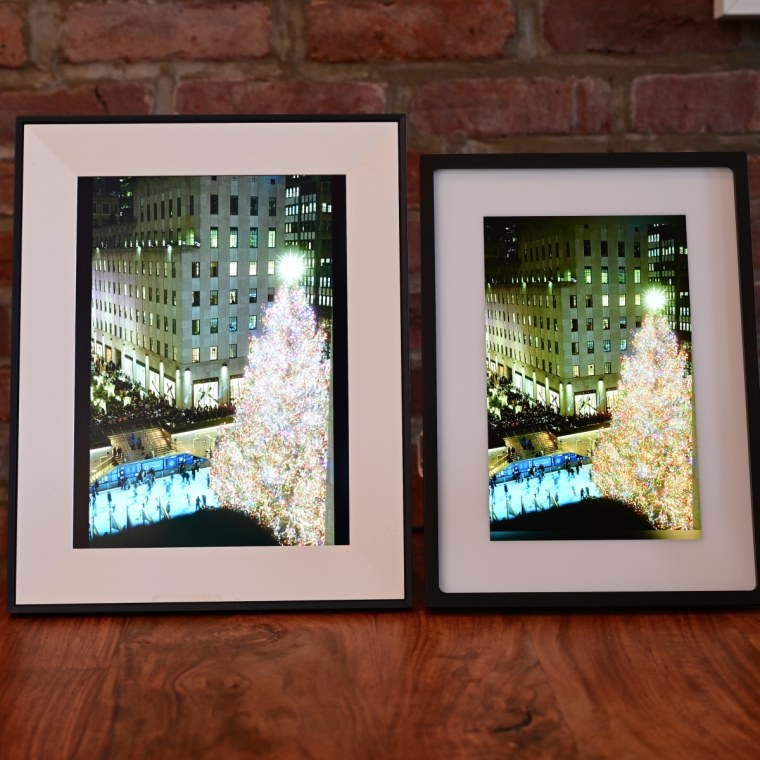
Pictures on the Aura Aspen look surprisingly good. I wasn’t expecting much out of the frame’s 1600-by-1200-pixel resolution, but photos looked true to life and never felt overly digital. The Aspen has a 4:3 aspect ratio, matching that of your smartphone camera. That means that most of my smartphone photos filled the entire frame, without any crop or black borders.
You cannot change the brightness of the Aura Aspen though — it automatically adjusts to match your room’s ambient lighting. I took issue with this at first, but the more I tested the frame, the more I got over it — the brightness is good enough to see photos clearly, but not turned up so high that it’s obvious the frame is digital.
Skylight
Pictures on the Skylight Frame 2 also look good, especially with its higher screen resolution, but more of them are cropped or have black borders than with the Aura Aspen. That’s because the Frame 2 has a 16:9 aspect ratio. Most smartphone cameras default to a 4:3 ratio — fitting into 16:9 naturally leads to more borders.
You can change the brightness on the Skylight Frame 2, but I turned the brightness down a bit — out of the box, the screen looked too bright next to my real photo frames.
Winner: Aura. I think Aura has the edge when it comes to picture quality, but you may not notice the difference. The main advantage is the Aspen’s 4:3 aspect ratio, which matches that of most smartphone photos compared to the Skylight Frame 2’s 16:9.
Aura vs Skylight: The final verdict
In the end, I prefer the Aura Aspen because it feels more like a picture frame. It’s simpler and arguably has less features than the Skylight Frame 2, but that works in its favor — I want my digital photo frame to act like a photo frame, not a tablet.
While I think Aura is better for most people, Skylight has a few advantages I mentioned that may sway you in its direction, namely that it can still work when disconnected from Wi-Fi.
Why trust NBC Select?
I am a reporter at NBC Select who covers technology, fitness and the outdoors, including recent stories on fitness trackers, wireless earbuds and bikepacking. I also write frequently about point-and-shoot cameras, film cameras, camcorders and other photography topics. For this piece, I tested the Aura Aspen and Skylight Frame 2 for about a month alongside two other NBC Select staffers.
Catch up on NBC Select’s in-depth coverage of tech and tools, wellness and more, and follow us on Facebook, Instagram, Twitter and TikTok to stay up to date.