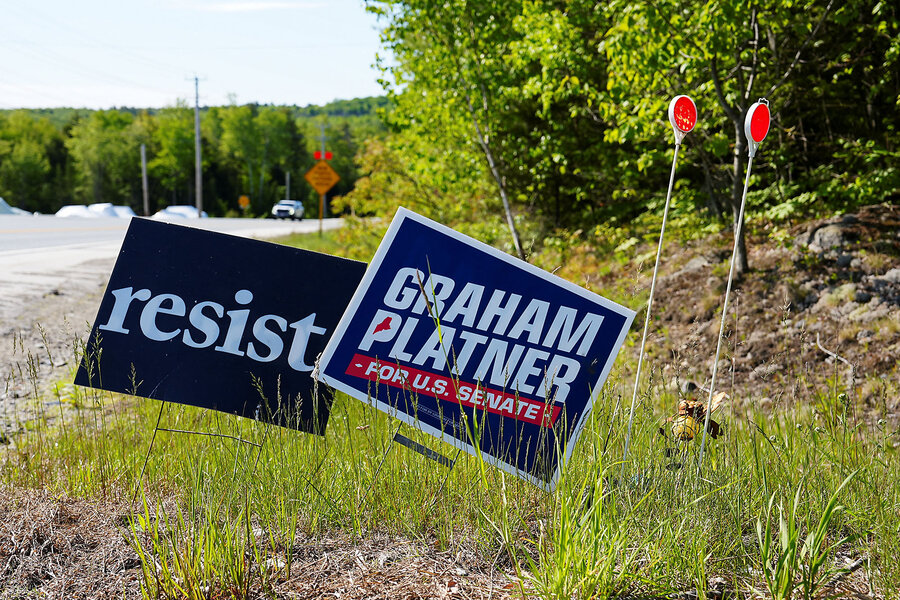
In a bayside community garden in this coastal city, Wendy Chapkis sprays water across a raised bed planted with tomatoes, beans, and squash. Gardening offers a respite from the political tumult that Maine Democrats like Ms. Chapkis are facing amid the implosion of Graham Platner’s candidacy for the U.S. Senate.
On Wednesday night, Mr. Platner announced he was suspending his campaign two days after Politico reported that a woman he had dated accused him of drunkenly assaulting her at home in 2021. He has denied the accusation. His decision has set off a furious scramble for Democrats to nominate another candidate to face five-term Republican Sen. Susan Collins in November.
Ms. Chapkis, a retired sociology professor, voted in a June primary for Mr. Platner, a former Marine who farmed oysters, and she praises him as “a generational talent. That’s why this is heartbreaking,” she says. “The overwhelming sentiment among [Democrats] I know is grief.” But they also agree that he should step aside, she adds.
Why We Wrote This
The collapse of Graham Platner’s Senate campaign in Maine has state Democrats wrestling with questions over candidate vetting and whether the next nominee should come from the party’s moderate or progressive wing.
The messy derailment of a neophyte candidate backed by Vermont Sen. Bernie Sanders and other prominent progressives has reignited tensions within the party over the selection of nominees and how far left they should lean. Mr. Platner defeated the Democratic establishment’s preferred candidate, Gov. Janet Mills, who stopped campaigning before last month’s primary. Now, questions are being asked about candidate vetting and whether progressives overlooked flaws surfaced earlier in Mr. Platner’s campaign, in search of authenticity to advance their agenda in Maine.
Ms. Collins is the only GOP senator up for reelection whose state voted for Kamala Harris in 2024; not flipping Maine could sink Democrats’ hopes to regain the majority. That electoral math substantially raises the stakes for Democrats in this largely rural state of 1.4 million people.
Mr. Platner has until Monday to formally withdraw as the nominee. Democrats then have until July 27 to name a new candidate; several have already come forward, many of whom ran in congressional and gubernatorial primaries in June and have name recognition.
Democrats in Maine have promised a transparent nomination process, mindful of the blowback to Ms. Harris’s coronation in 2024 after President Joe Biden pulled out of the election. But the challenge is daunting, says Michael Brennan, a Democratic state legislator and former mayor of Portland. “There’s no defined process. We’re in uncharted territory,” he says. (The state Democratic Party plans to hold a convention, but how delegates will be chosen and whether they will be pledged to support a particular candidate is unclear.)
For now, perhaps the biggest question is whether Mr. Platner’s replacement will come from the wing of the party that he represented. In a video posted on Wednesday night, he accused Democrats in Washington of meddling in the process and of undermining progressives. He struck an overall defiant tone, one that has been a hallmark of his insurgent campaign.

Graham Platner for Senate/Reuters
To his backers, Mr. Platner’s unconventional style and personal journey are what made him the man for this political moment. Daniel Moraff, a left-wing consultant, insisted during a June interview with The Wall Street Journal that voters had grown tired of bland, on-message Democrats. “Part of our thesis here is that people do not want their candidates grown in vats. They want people who are real human beings.”
During high school in Bangor, Mr. Platner was voted “most likely to start a revolution.” He served four combat tours as a Marine, then worked as a security contractor, before returning to Maine to start over. Along the way, he left a trail of controversies that dogged his campaign to the point at which some Democrats had written off his chances in November. He had a chest tattoo that is a known Nazi symbol, wrote provocative social media posts and called himself an “antifa supersoldier,” and reportedly sexted with other women while married.
But his supporters stuck with him, and his events drew large, enthusiastic crowds. “He did something that was real. Our politics is a little boring up here,” says David Farmer, a longtime Democratic consultant in Maine. “That energy was real. It was easy to understand why people thought he was different and might be able to survive the scandals.”
Erin Oldham, a real estate entrepreneur, hosted a fundraiser in Portland for Mr. Platner. Now, she’s feeling “very disappointed and frustrated” at Mr. Platner because he gambled that his personal history wouldn’t be fully revealed in a high-stakes election. A tattoo is one thing, she says. “Violence towards women is a totally different thing.”
Like other progressive Democrats, she saw Mr. Platner as a bold candidate who spoke truth to power. “We’re looking for somebody with a clear message, and he does have a clear message. But he’s not a clear messenger,” she says.
This focus on finding an authentic messenger speaks to the broader challenge for Democrats who have lost their way with blue-collar voters, says Joan Williams, author of “Outclassed: How the Left Lost the Working Class and How to Win Them Back.” The rush to embrace Mr. Platner, and to explain away his brash ways, parallels the 2022 campaign of Sen. John Fetterman of Pennsylvania, who married progressive policies with a working-class image.
Democrats need to find ways to connect with non-college-educated voters who make up the majority, says Professor Williams, an emerita law professor at the University of California, San Francisco. But this doesn’t necessarily mean a working-class candidate. Sen. Jon Ossoff of Georgia, for example, strikes populist chords about affordability and corruption. “He does that in a very different way by giving us facts. He doesn’t go all blue-collar about it,” she says.
Recent polling in Maine showed Mr. Platner trailing by nearly 30 points to Ms. Collins among white men without college degrees. His biggest support base is in cities such as Portland, where around half the voters have college degrees.
His exit might offer a lifeline for Democrats if they can unite around an alternative. Progressives are wary of being steamrolled by Democrats who want to move to the center. “Graham Platner motivated people to vote,” says Ms. Chapkis. “You need a candidate that’s going to do that if you really want both registered Democrats and independents.”
Don Hogg, a retired government contractor out walking his dog in Portland on Wednesday, is glad to see the back of Mr. Platner, whom he never trusted. He wants a mainstream Democrat on the ballot who can beat Ms. Collins. “We can’t take a chance” on another Sanders-style progressive, he says.