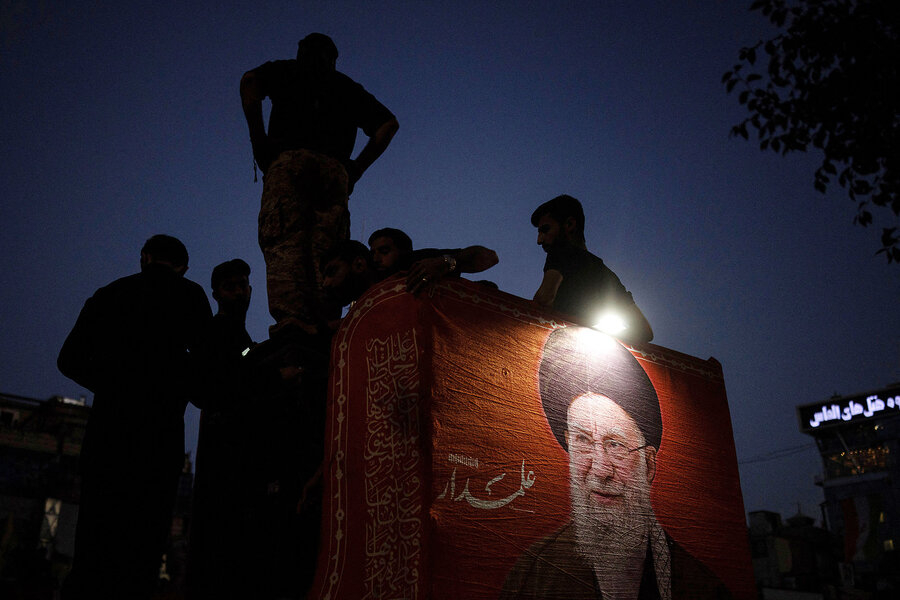
Top U.S. intelligence officials warned for years – through both Republican and Democratic administrations – about the possibility of an Iranian terrorist attack on American soil.
These warnings grew louder in the wake of the U.S. strikes on Iranian nuclear facilities a year ago, and again this past February with the start of the U.S.-Israel war with Iran. The U.S. Counterterrorism Strategy released in May by the Trump administration called Iran and its proxies “the greatest threat to the United States emanating from the Middle East.”
This week, Israel allegedly told the U.S. that Iran is considering a plan to assassinate President Donald Trump, according to news reports. “They want to take out the U.S. leader – me,” Mr. Trump said Wednesday at a summit of NATO leaders in Ankara, Turkey.
Why We Wrote This
Experts say counterterrorism works. Yet new cuts to U.S. intelligence operations are happening just as officials debate whether it is vigilance — or Iranian restraint — that has been key to keeping America safe from serious threats.
Still, analysts are finding it mysterious that anticipated – and threatened – attacks against the U.S. have not materialized, particularly when the Iranian regime appeared to have little to lose as it fought to survive.
Waging a terrorist attack on American soil, for one thing, is tough to do, analysts say. It takes coordination, money, and the ability to evade extensive U.S. surveillance networks. These networks often include tight-knit immigrant communities who don’t want violence or the increased law enforcement attention that comes with it.
The absence of such attacks also points to Tehran’s political pragmatism: The regime might be deliberately avoiding provocations that could unite the American public behind a generally unpopular war.
Iranian leaders follow U.S. politics, says Daniel Byman, director of the Warfare, Irregular Threats, and Terrorism Program at the Center for Strategic and International Studies. “They didn’t want to create justification for a war that, for many Americans, was lacking.”
What remains to be seen, analysts say, is how personnel cuts last month at the Office of the Director of National Intelligence, which critics argue had become too bloated and bureaucratic since the terrorist attacks of Sept. 11, 2001, affect future counterterrorism operations. The administration’s plan to downsize intelligence agencies’ staffing levels between 25% and 40% has lawmakers from both parties warning that such a move could undermine national security.
A foiled 2011 plot
The U.S. foiled an Iranian attempt to carry out an attack on U.S. soil in 2011. U.S. agents charged Manssor Arbabsiar, an Iranian car salesman living in Texas, with terrorism, alongside suspected members of Iran’s Quds Force – the special operations branch of the Islamic Revolutionary Guard Corps.
The alleged plot, which involved planting a bomb at a Washington restaurant to kill Saudi Arabia’s ambassador to the U.S., was “conceived, sponsored, and directed from Iran,” said then-Attorney General Eric Holder. Mr. Arbabsiar later pleaded guilty and was sentenced to 25 years in federal prison, while the alleged Quds Force co-conspirators remained at large.
Retired Marine Gen. James Mattis, then the top commander of U.S. military operations in the Middle East, lamented that the U.S. had not responded “forcefully” enough to the plot.
“I anticipated that [the Iranians] would feel emboldened to challenge us more in the future,” he wrote in his 2019 memoir, “Call Sign Chaos: Learning to Lead.” Gen. Mattis went on to serve as defense secretary during Mr. Trump’s first term, but resigned after two years over disagreements with White House foreign policy.
Even in the midst of then-ongoing U.S. wars in Iraq and Afghanistan, “The first three things I asked my briefers about when I woke every morning,” he said in 2013, “were Iran, Iran, and Iran.”
The challenge of attacking on U.S. soil
Developing sleeper cells, however, involves long-term investment.
Iran has indeed long made these investments in Europe, where such attacks are easier to carry out than in the U.S., says Adrian Shtuni, an associate fellow at the International Centre for Counter-Terrorism in The Hague, Netherlands.
But that doesn’t mean these networks are robust. They tend to involve low-level criminals and are rife with “significant” capability gaps, he says. Rather than pointing to “the existence of deep-cover armies waiting to strike in Europe or the U.S.,” Mr. Shtuni adds, recruits carry out primarily symbolic operations that officials can easily deny.
Iran’s restraint is also highly calculated, Dr. Byman says. Even after the war was launched against them, Iranian leaders recognized that attacking the U.S. homeland could trigger a “rally ’round the flag” effect, he adds, boosting public support for an unpopular war.
When counterterrorism works
The lack of Iranian attacks on U.S. soil is also a testament to effective U.S. counterterrorism efforts, analysts say.
This became evident, they add, when U.S. authorities in May charged Mohammed Baqer Saad Dawood al-Saadi, an international operative and coordinator of the Iranian-backed militia Kataib Hezbollah, with plotting to wage attacks against synagogues in Los Angeles, Arizona, and New York City.
Mr. al-Saadi allegedly conspired with Iran’s Quds Force, unknowingly working with an FBI informant who then reported the information to the bureau, according to the indictment.
This charge offers a window into U.S. counterterrorism operations that have increasingly made attacks more difficult to carry out, Dr. Byman says.
“You need to coordinate things overseas,’’ he says. “You need to send operatives. You need to send money. You need to infiltrate the United States, to do surveillance, to stay low before doing the attack. And with each step, there is the possibility of a mistake.”
There is, too, the apparent U.S. and Israeli penetration of Iranian intelligence services.
“No layer is perfect,” he adds, “but when you combine it, it’s very powerful.”
Similar schemes carried out against synagogues in Europe by less-sophisticated criminal recruits connected to Mr. al-Saadi’s terrorist organization also appear designed to minimize casualties, since they were carried out at night, Mr. Shtuni notes.
“The goal is to generate fear and political pressure,” he says. “This reflects rational self-preservation, not ideological suicide.”
When communities offer warnings
It is the Pulse nightclub attack in Orlando, Florida, a decade ago, in which 49 people were fatally shot, that remains the deadliest terrorist attack on U.S. soil since 9/11. The perpetrator, Omar Mateen, was born in New York to Afghan immigrant parents and had pledged his loyalty to the Islamic State. Mr. Mateen was killed by law enforcement during the attack.

Phelan M. Ebenhack/AP/File
There had been multiple warnings about Mr. Mateen’s terrorist aspirations. The alarming statements his co-workers reported prompted the FBI to interview him twice. A gun store owner also contacted the bureau about Mr. Mateen’s suspicious questions regarding body armor and ammunition, but officials concluded that Mr. Mateen posed no threat.
These are warnings that federal law enforcement is more inclined to heed today. These run-ins also illustrate another reality of perpetrating attacks on U.S. soil, Dr. Byman says: While immigrant communities in many European countries are less likely to work with their governments to foil plots, that is not as true in the United States.
Yet the cuts of dozens of staffers made by Bill Pulte after being appointed acting director of national intelligence in early June are raising concerns within the ODNI, created after 9/11 to coordinate the sharing of intelligence among federal agencies.
For now, Iranian operations have been “a clear example’’ of federal law enforcement’s increased effectiveness, Mr. Shtuni says. “Counterterrorism professionals have done an outstanding job in this high-tension period.”