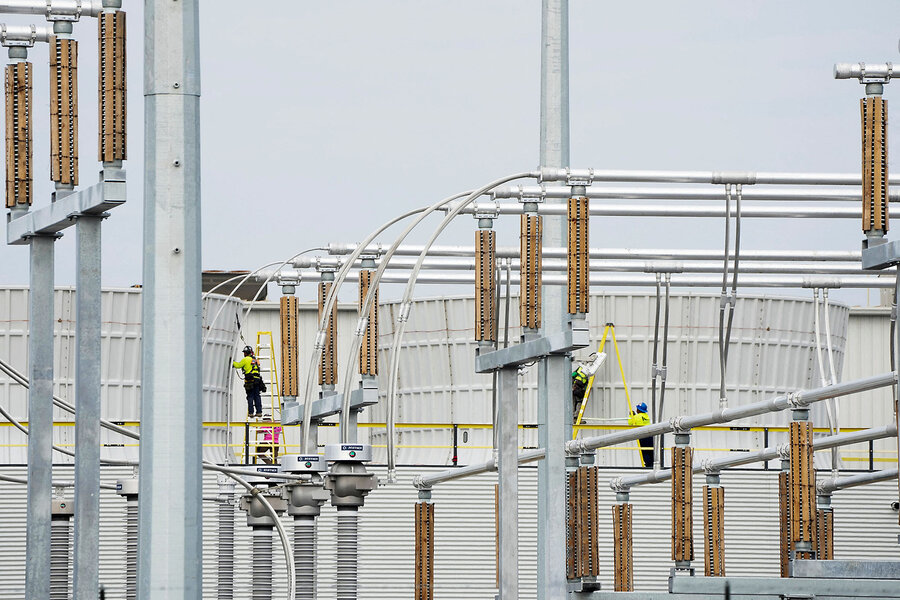
On the edge of dense woods here, an area once inhabited by the Chickasaw Nation, lies a grotto now ringed by barbed wire that protects a new artificial intelligence data center, dubbed “Colossus 1” by its creator, tech mogul Elon Musk.
Just a short crow’s flight away, on the other side of the thicket but close enough to smell acrid fumes wafting from the facility, sits a historic village called Boxtown. Here, narrow paths connect modest homes. White-tailed deer strut across front yards. And while a power plant hums nearby, the area is generally quiet. On porches, where residents are used to spending long, hot summers telling stories, they are now bouncing between a state of wonder and concern about their unlikely new neighbor.
Driven by the AI boom, tech companies have opened nearly 1,200 new data centers in the United States in the past five years. This marks a staggering leap from the 1940s, when the military’s Electronic Numerical Integrator and Computer (ENIAC) debuted at the University of Pennsylvania as one of the world’s first modern computing facilities. The new data centers, which use vast amounts of power and water, have become a national focal point for concerns about the impacts of generative AI on human ethics, the economy, and those communities chosen as hosts.
Why We Wrote This
Artificial intelligence promises economic transformation. In a neighborhood called Boxtown, Tennessee, residents, who once used innovation to build their own community, are weighing challenges as needed resources are redirected to power an AI data center.
“When you put all this money on that machine, you ought to either help people with their electric bill or something,” says Boxtown resident Lemoyne Payton.
As he notes, how tech affects how people treat each other is one thing. How it is reshaping the global economy by redirecting resources – capital, electricity, water – to turbocharge AI is another. And here in Memphis, where reinvention and reimagining ordinary life have long fueled innovation, AI’s physical infrastructure appears to be on a crash course with human lives lived in historic and natural spaces.
Promises made and broken
“Elon Musk gets a bad play in Memphis, but he’s not the problem,” says Donal Harris, director of the Marcus Orr Center for the Humanities at the University of Memphis. “It’s that places like Boxtown are seen as places where you can externalize the risk and environmental degradation so that people in other places can benefit.”
That phenomenon has been at play in Boxtown since its beginnings in 1863. Not long after Emancipation Day, formerly enslaved people noticed the area’s rich soil and its proximity to the Mississippi River and, with permission from the local railroad, built a community there, using decommissioned boxcars and old crates to construct homes.
In the 1960s, annexation by the city of Memphis promised Boxtowners upgraded services and suburban amenities. But even years after the city began collecting household taxes, little had changed: Most roads were still dirt, and many houses, with beams still bearing railroad insignia, lacked indoor plumbing or electricity, making it less suburb than frontier village.
“As late as 1975, the promised services never arrived … The neighborhood faced official neglect,” wrote Aubrey Ford, Phoebe Weinman, and Walker Weinman in a 2019 article for StoryBoard Memphis, an online publication that bridges the city’s past with its future.
Despite those hardships, Boxtown grew and prospered. Success in Boxtown came to be defined by self-sufficiency, civic pride, and generational land ownership. Its expanding middle class, fueled by pioneering entrepreneurs and storekeepers, grew wealthier and sent children to college.
“We’re a family,” says lifelong resident Greg Kinsey. And the power of that family, he says, is that it has always faced the future and injustice united.

Patrik Jonsson/The Christian Science Monitor
But will community fortitude be enough to take on Colossus 1?
That’s a question now being posed by Boxtown local Justin Pearson, a state lawmaker who has challenged the mostly white power structure in Nashville with protests against a recent gerrymander of the city’s congressional district. By “cracking” Memphis’s majority-Black population into three separate districts, the new redistricting dilutes the neighborhood’s voting power, locals say.
Mr. Pearson, who has fought for stricter gun laws in Memphis, has also been challenging Colossus 1 since its inception.
“We’re being told by … everybody who’s just greenlighting this project like it’s the best thing in the world, that this is okay for us to be mistreated,” he said at a community meeting in Memphis last year.
Mr. Pearson’s concerns are rooted in a hard lesson learned long ago in Boxtown: Official promises are easily made, but even easier to break. He fears that toxic air pollution and regulatory neglect will devastate this low-income community already burdened by industrial hazards. These are concerns that strike at the heart of AI’s future – a technology that, even its proponents concede, threatens to accelerate inequality and dim human agency.

Saul Brown, the Memphis Press-Scimitar newspaper morgue/Special Collections Department, University of Memphis Libraries (http://www.memphis.edu/libraries/special-collections/)
When industry surges ahead
A Memphis Press-Scimitar photograph from 1961 shows two Boxtown men atop a horse-drawn cart stacked with firewood – in front of a power plant.
The image, says Dr. Harris, “perfectly encapsulates the paradox of modern Memphis: Two old guys collecting firewood who live in the shadow of a power plant and don’t have electricity.”
Now, Colossus 1, a massive supercomputer and data center that will be used to train Grok, an artificial intelligence chatbot, is posing the same quandary as that coal plant did a half-century ago.
But the change is already coming faster than defenses can muster. Mr. Musk reconfigured an old appliance factory in about four months, installing portable natural gas generators to fuel the 300-megawatt processing facility. Those generators produce exhaust that some say poses a threat to human health.
Last month, Mr. Musk’s SpaceX corporation leased the facility to AI competitor Anthropic to power its fast-growing Claude chatbot at an estimated $1.25 billion per month for computing power at the Colossus 1 and Colossus 2 data centers in Memphis.
So Grok is out. Claude is in.

Patrik Jonsson/The Christian Science Monitor
Risk, reward, and innovation
To some, the new tenant suggests Memphis, long known for its entrepreneurial streak, could play a significant role in the evolution of this latest, powerful technology. The river city, known for its penchant for risky innovation, has helped revolutionize shopping (Piggly Wiggly, founded by Memphian Clarence Saunders, the first self-service grocery), global commerce (FedEx, started by native son Fred Smith), and music (Elvis Presley, Al Green, Otis Redding, Justin Timberlake, Sun Studios, and Stax Records), among other things.
Anthropic “describes itself as a Public Benefit Corporation with a single purpose: the responsible development of advanced AI for the long-term benefit of humanity, with accountability to the public good embedded in its corporate DNA,” Memphis Mayor Paul Young said in a statement posted on the social platform X in May. “They built their tech with guardrails that the world can learn from. And now they’ve chosen Memphis to grow their capacity.”
Amid several AI players, Anthropic has arguably become the most powerful, recently hedging on releasing its latest chatbot, Mythos, amid fears that criminal enterprises could exploit it. Anthropic is expected to go public this year with what is anticipated to be a massive initial public offering.
Until recently, Mr. Musk was an Anthropic antagonist, once dubbing the company “Mis-Anthropic.” But with Anthropic’s lease now in hand, he has changed his tune. “So long as they engage in critical self-examination, Claude will probably be good.”
Meanwhile, resistance has steadily built in the U.S. against AI data centers: 71% of Americans oppose having a data center built “next door,’’ or near them, according to a May Gallup poll. More philosophically, a May Politico/Public First poll found that 43% of Americans believe AI’s risks outweigh its benefits, compared with 33% who say the opposite.
In few places are those tensions as tangible as they are in Boxtown.
In his 50s, Mr. Kinsey feels a deep sense of nostalgia for the community of his childhood. Much was gained with electricity and plumbing. But much was also lost, he says, including a forest of fruit trees, pristine air quality, and a sense of safety.
As for Claude, now moving in down the street, he says the new technology holds both peril and potential. There are “so many questions, but not enough answers, as to what’s going on,” he says.
Still, change is part of life, he adds, and like most Memphians, he embraces the city’s love of betting big on bold ideas. “Might as well get ready for the ride. But don’t blink – or you’ll miss it.”