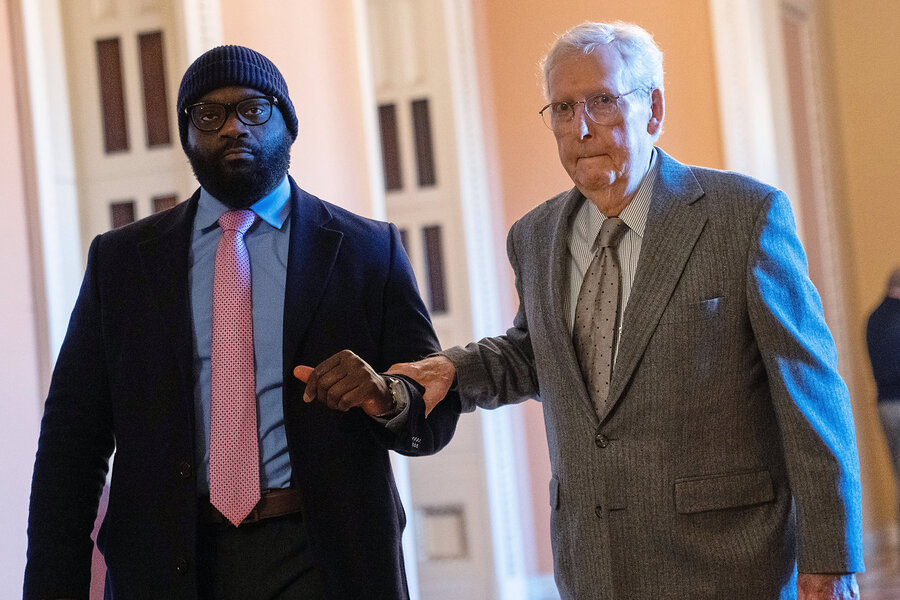
On June 14, Republican Sen. Mitch McConnell of Kentucky was rushed to the hospital. But for nearly a month, there was no official word on his condition or the reason for his hospitalization, even as questions and conspiracy theories mounted.
On Sunday, Senator McConnell released a statement saying he “took a fall” at his Washington, D.C., home and “was briefly unconscious.” He then developed pneumonia while in the hospital. Doctors say the senator and former majority leader is recovering. But his ongoing absence, and the lack of information related to it, raised the question: What happens if a sitting U.S. senator becomes incapacitated but does not step down?
The answer is not clear, and it differs from state to state. Neither the Constitution nor any state provides a mechanism for declaring a senator incapacitated. In 45 states, the governor is allowed to make a temporary appointment to fill a vacant Senate seat until a special election can be held, but only if a senator dies or resigns voluntarily.
Why We Wrote This
Sen. Mitch McConnell’s absence from the Senate, unexplained for nearly a month, prompted speculation on what had happened to him. His ongoing recovery could keep him away at a time Republicans need all the votes they can get.
In South Carolina this week, Republican Gov. Henry McMaster named a temporary replacement for GOP Sen. Lindsey Graham, who died over the weekend; Mr. Graham’s sister, Darline Graham Nordone, was sworn in on Tuesday.
But there is no clear mechanism to replace a senator who is alive, if not well.
“It’s not clear that there is an ideal system to fit this situation,” says Michael Thorning, director of the Bipartisan Policy Center’s Structural Democracy Project.
In the recent past, there have been several senators who have stepped back from their roles for medical reasons. Sen. Tim Johnson of South Dakota in 2006 and Sen. Mark Kirk of Illinois in 2012 were each incapacitated for the better part of a year, but both returned to office. Democratic Sen. Dianne Feinstein of California refused to step down even after some colleagues believed she was not mentally fit to serve. She died in office in September 2023, one day after casting her final vote to prevent a government shutdown.
“The real challenge here is that the Congress is not like the presidency, where you have two elected officials on the same ticket with the same theoretical electoral legitimacy,” says Mr. Thorning. “There’s no easy passing off of someone’s electoral mandate to an individual temporarily, as the 25th Amendment imagines for the president and the vice president.”
Senators have a vital “advice and consent” role within the legislative branch, confirming presidential appointees, and approving or rejecting treaties with a two-thirds majority. And when one party has a narrow margin of power – Republicans currently have a 53-47 majority – every vote counts.
Narrow margins
As vexing as this appears today, the framers of the Constitution would never have imagined that legislative branch members would be present for every vote.
Looking back, Mr. Thorning says, “You would find that absences were quite common.” As a result, majority votes were unpredictable. “Nowadays, just given the political moment we’re in, combined with very slim majorities, it’s much more important that they have as full attendance as they possibly can, and so that makes those votes much more critical.”

Aaron Schwartz/Sipa USA/AP/File
The system for electing senators differs greatly from what the founders envisioned. Until 1912, senators were selected by state legislatures because they technically were representing the state and ensuring a level playing field among states, regardless of population. In 1912, Congress passed the 17th Amendment, which enabled the direct election of senators, though the Senate’s role remains less populist than that of the House of Representatives.
In the absence of news about Mr. McConnell’s condition, Kentucky Democratic Gov. Andy Beshear asked the hospitalized senator to disclose his medical condition. Later, the governor hinted that he would challenge the state’s 2024 law that allows him to call a special election to fill a vacant seat, but forbids him from naming a replacement should there be a vacancy.
The senator explained his weekslong silence in his July 12 statement: “You all know how folks of my generation often hesitate to share the vulnerability that comes with growing older. Even in the public eye, I feel that same instinct – I can’t help it.”
Mr. McConnell, who announced in February of last year that he would retire at the end of his current term in January, added that he has “every intention of finishing the job that you elected me to do.”
Stephen Voss, a political scientist at the University of Kentucky, says that Mr. McConnell’s period of silence was in keeping with the senator’s habit of pushing back against popular pressure.
“Senator McConnell’s resistance to the 24-hour news cycle is on brand. He’s not going to be giving out information automatically; he’s going to do it when he thinks it’s best,” Professor Voss says. For Mr. McConnell, Kentucky’s longest serving senator, the Senate is “a deliberative body which has an elite role to play. It is designed to resist a mob mentality.”