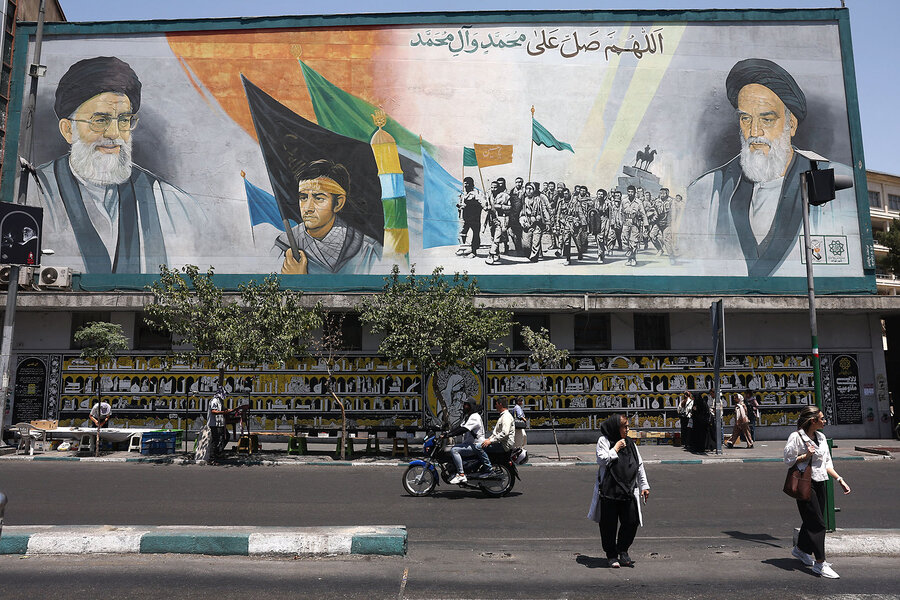
Over the months since the first bombs fell in late February in the U.S.-Israeli war on Iran, the world has witnessed the confrontation of two very different approaches to war and diplomacy.
From Washington, President Donald Trump has sought to conduct a war he chose to launch from the perspective of his instinctive preference for transactional initiatives and quick resolutions – with little thought for strategic end goals.
From Tehran, on the other hand, an otherwise divided and factionalized leadership has conducted a war that was imposed on it from an ideological footing and with an eye to a postwar future that – beyond just the survival of the Islamic Republic – could leave Iran in a stronger position in a transformed Middle East.
Why We Wrote This
Each side in the U.S.-Iran war is internally divided on the way forward, making resolution of the conflict problematic. And President Donald Trump’s transactional approach doesn’t resonate with Iran, which is playing more of a long game.
The collision of these two very different approaches is just one reason why, analysts say, a war that Mr. Trump had said would last no longer than four or five weeks is now approaching its sixth month – with no end in sight.
“The president’s transactional approach can only take him so far, especially when you are in the depths of a complex strategic problem that requires a very different way of thinking and both clarity and steadfastness on your objectives,” says Mona Yacoubian, director of the Middle East Program at the Center for Strategic and International Studies in Washington.
“We’re seeing the transactional bump up against the strategic,” she adds, noting that on the other side, the Iranians “are playing the long game.” While their first order of business is survival, some elements of the Iranian regime are also focused on exploiting “their new instruments of power in exerting control over the Strait [of Hormuz]” and “how they can strengthen their position in the Middle East that comes out of this war transformed.”
Calling this a “hinge moment” in the Middle East marked by “the collapse” of the old order, Ms. Yacoubian says “such a complicated historic moment really demands strategic thinking and not transactional approaches.” The latter fails to “bring in the range of elements and influences that will determine where the region is headed,” she adds.
In this context, President Trump’s preferred approach is not just coming up short, but is becoming counterproductive to U.S. interests, others say.
“If there was a moment in the span of the two Trump presidencies when his transactional approach of the businessman came crashing down, it’s the Iran war,” says Alex Vatanka, a senior fellow with a focus on Iran at the Middle East Institute in Washington.
Yet despite growing criticism of his approach – even from some Republicans – Mr. Trump appears to be doubling down on his preference for gut-prompted action.
Responding to Iranian attacks on ships in the strait, he declared the 14-point memorandum of understanding (MoU) reached with Tehran last month “over.” He then returned to both a blockade of Iranian ports and to air strikes, continuing the tit-for-tat dynamic that is putting the two antagonists back on the escalatory ladder.
Impact of bombing campaign?
On Wednesday – the fifth consecutive day of renewed air strikes – Mr. Trump declared that the United States would start hitting more civilian infrastructure, like power plants. He warned in a Fox News interview that next week “we’re going to knock out all of their bridges unless they get to the table and negotiate.”
The president also announced that he would replace his plan for monetizing the U.S. presence in the Strait of Hormuz – charging a toll to ships passing through under U.S. protection – with a “better idea” from Gulf leaders. Their pledge, Mr. Trump said, was to make substantial investments in the U.S. in exchange for the American role in the strait.

White House officials argue privately that the renewed bombing will put the U.S. in a position of strength when the Iranians agree to return to negotiations.
But others say the return to widespread bombing – as well as renewed demonizing of the Iranian leadership and threats of Iran’s annihilation – will only pump up the regime’s hard-liners and make the way of moderates who want more negotiations more arduous.
“It would take time and quiet diplomacy and an end to the name-calling and threats of annihilation, but I think President Trump can get a deal if he acts in ways to help the people inside Iran who can basically give him what he wants: a Strait of Hormuz that is open, and no Iranian nuclear weapon,” says Mr. Vatanka.
“But he’s not going to get that,” he adds, “if he just calls them all ‘scum’ and reinforces the elements in the regime that see the U.S. as an imperialist power that will never satisfy its appetite for domination.”
The crux of the problem Mr. Vatanka sees is that Mr. Trump still hasn’t decided if he wants to get a modest deal that gives him an off-ramp, or if he wants to be the president who puts an end to the Islamic Republic.
Internal divisions on both sides
Much has been said about the divisions within the Iranian regime and how that complicates negotiations for a lasting deal. Former Trump White House national security adviser John Bolton says that as a result of the U.S.-Israeli war’s early decimation of senior leadership, Iran is left with various “heads of authority” who compete with one another.

But there is also a stark divide in the White House among senior national security advisers that is one source of Mr. Trump’s volatility on the war, some say – and one reason it has dragged on longer than the president predicted.
“This is a president who likes to move fast based on his own gut, but he still hears from those around him who see this war and military intervention generally from very different perspectives,” says Ms. Yacoubian of the Center for Strategic and International Studies.
She contrasts Vice President JD Vance, who is “far more skeptical of military intervention” – and whom Mr. Trump tasked with negotiating the ill-fated MoU – with Secretary of State Marco Rubio, “who is far more hawkish, especially with Iran.”
Some analysts point to two distinct three-man camps: Camp Vance, which includes special presidential adviser Steve Witkoff and son-in-law Jared Kushner; and Camp Rubio, with Defense Secretary Pete Hegseth and CIA Director John Ratcliffe among the hawks.
As one example of how the clash of these two groups has upended the diplomatic process and arguably extended the war, Ms. Yacoubian cites Secretary Rubio’s “redoing” of the MoU’s provision on Lebanon during a trip to Israel just days after the MoU was concluded.
“When Rubio came in with something aimed at boxing Iran out of Lebanon, it looked like a ‘corrective’ to the MoU,” she says.
“But it also cast doubts among the Iranians about what had been negotiated,” she adds, “and ultimately reinforced the hard-liners who say the Americans can’t be trusted.”