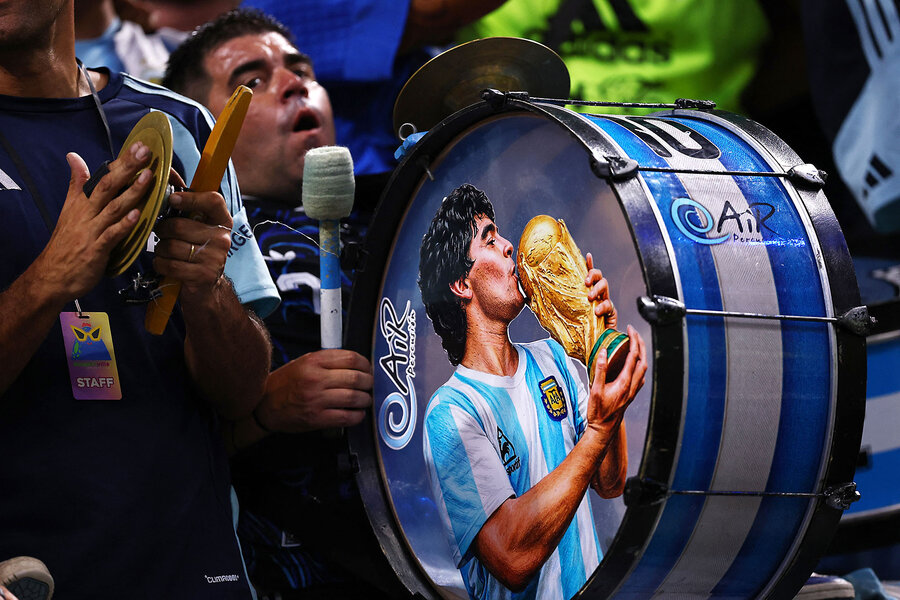
Carrying his sticks and snare drum through the pale-blue-and-white-jerseyed crowd of Argentina fans, Eduardo Subelza is part maestro, part mood-shifter, and all beat-setter.
An American of Argentine heritage, Mr. Subelza, a stay-at-home father from New York, says that he began reconnecting with his Latin roots during the 2022 World Cup. With his dad’s help and a passion for zealous snare drumming, he now follows Argentina’s national football team across the United States to help rally fans. Argentina now hopes to repeat that 2022 win when it plays Spain in the World Cup finals in New Jersey on Sunday.
The chants and beats “encapsulate what it means to be Argentinian – this idea of love and family, and we can succeed together,” says Mr. Subelza.
Why We Wrote This
Group singing seems to be having a resurgence. At World Cup matches, fans say the shared anthems help build unity and national bonds.
The star-studded World Cup pitch play might be galvanizing American fandom. But the competition has enveloped Americans in another trend as well: the rising sound of organic, communal singing and music-making, which seems increasingly visible in other parts of society, too.
From living rooms to public squares to stadiums, experts say, spontaneous singing and music-making appears to be gaining in popularity across the U.S. It’s a shift, they say, driven in part by the desire to overcome pandemic- and social media-induced isolation. Studies show that shared rhythms and singing promote a sense of well-being and belonging.
Some 54 million Americans were participating in choirs and community choruses before the pandemic, according to a 2019 choral impact study. Since then, new grassroots movements ranging from casual “one-day choirs” to “singing resistance” groups have popped up across the country. And at the World Cup, Americans who traditionally used rhythmic chants like “U-S-A!” are leaning in to more European-style chants and songs.
FIFA, meanwhile, made an intentional shift over the past decade, from a few standard songs to curated, event-driven playlists, in part to muffle rougher fan chants and songs, in part to make games more live-concert-type experiences. The result is that game music – and fan involvement – now feel more like a pop concert sing-along.
“You have the emotive transmissions of sound when you’re singing,” says Eduardo Herrera, an ethnomusicologist at Indiana University Bloomington, who has watched anthem singing take hold. Fans bond by singing the same words, tunes, and rhythms together, swaying, waving or pumping fists in unison.
The result is a music-assisted sense of “belonging” that has been on full display during the World Cup matches.
The Americans got into it with John Denver’s “Take Me Home, Country Roads,” giving the U.S. coach, as he told reporters, serious goose bumps. The English belted out “Wonderwall” by the British band Oasis, then the Beatles’ “Hey, Jude,” to serenade their star midfielder, Jude Bellingham. Japanese fans sang “Vamos Nippon” to the tune of “Pop Goes the World” by the Canadian band Men Without Hats.
And on Wednesday, here in Atlanta, the Argentines turned a tourist attraction called Underground Atlanta into Underground Argentina, reveling with drums, chants, and dancing after beating England, 2-1, to earn a place in the championship game.
From Buenos Aires to Atlanta, fans sang an old stadium song that goes “por esta camiseta, ganar o morir,” meaning, “for this shirt, win or die.”
The chants “make them have more strength, hyping them up basically,” says Seridne Pele, an Argentina fan who had traveled from Charlotte, North Carolina, to Atlanta for the game.
Piped-in team anthems and spontaneous sing-alongs have long defined fútbol, especially at the club level. But since the pandemic, there’s been even more focus on fan spontaneity and unity. Research showed that without fans, home-field advantage withered.
“We are sponges; we are porous”
As the World Cup has shown, thousands of voices, trombones, horns, and drums not only strengthen national bonds but can also, as fans say happened Wednesday, possibly change the trajectory of matches.
“This is how people touch players,” says Professor Herrera. “We are sponges; we are porous. And when you hear big drums, it’s not just your ears listening – it’s your entire body. When 70,000 people are chanting, it changes the atmosphere. The leaders of these chants are masters of modulation, changing the atmosphere of the stadium and getting it where it needs to be at that moment. The instrument is your stadium and setting the mood for the game.”
Mr. Herrera starts singing a rough translation of one chant, “La Cuarto Estrella” – “The Fourth Star” – over a WhatsApp call from Buenos Aires:
“I am a fan of the team / I support it with my heart / We won the third star, and we want to be champions once again / 32 years later, we’re going to win what was stolen from us / The cup was robbed from us, and we will bring it back home.” Then the chorus: “I want to have our four stars.”
When Americans sang “O Canada”
The world got an early taste of stadium singing when the rockabilly-esque “El Rock del Mundial” became a hit during the 1962 World Cup in Chile. Now Algeria, Spain, Japan, and England all have solid traditions.
The U.S. has long been known for “batter, batter” chants at baseball games. American sports stadiums then began introducing more piped-in entertainment.
That might be changing.
When the Carolina Hurricanes hockey team played this spring, a spontaneous chant of “Olé, olé, olé, olé!” arose. (The Canes had used that chant to troll the Montreal Canadiens, who used the same chant when they were winning.) And when they celebrated in Raleigh, North Carolina, after winning the Stanley Cup in June, 180,000 Hurricane fans filled the streets for a parade, then erupted into Neil Diamond’s “Sweet Caroline,” a staple anthem for North Carolina sports and the Boston Red Sox.
Near the Canadian border, the Buffalo Sabres are among several American teams that sing both “The Star-Spangled Banner” and “O Canada” before the puck drop. Despite political tensions between the two nations, when a singer’s mic fizzed out before a game this spring, the mostly American crowd stepped up to finish “O Canada.”
Maradona and Messi
For the Argentines, there’s been a lot to sing about during this World Cup.
Mixed into the passion on Wednesday were decades of history: lingering bitterness over the 1982 Falklands War, the memory of player Diego Maradona’s dramatic career, and the legacy of Lionel Messi, who is possibly playing in his final World Cup matches.
There are also videos of the Argentine team chanting in the dressing room. Two players, Luis Díaz and Juan Fernando Quintero, sing on Ryan Castro’s 2024 hit “El Ritmo Que Nos Une” (“The Rhythm That Unites Us”).
Emotions embodied in the chants and singing fold into a collective experience that encompasses not just love but also heartbreak and tragedy, says fan Alex Baiardi-Peralta.
“The Argentine tradition has been established perhaps the longest,” adds Professor Herrera, who studies the intersection of sports and music. “It’s a way of participating not as a spectator but as part of the game.”
The music is simple to learn. Many anthems take familiar melodies and stud them with fresh lyrics.

Patrik Jonsson/The Christian Science Monitor
Fan Javier Luna recalls an “amazing” atmosphere Wednesday in Atlanta, with the chants growing more passionate as Argentina converted two goals in the last minutes to win.
“The chants are not very complicated to learn,” he says. “But they’re very powerful and catchy and very straight to the point.”
For Mr. Subelza, his drum kit has channeled a passion that has only grown as Argentina faces Spain on Sunday. The music, he says, makes all the difference. “Even when they are losing,” he says, “that’s when we cheer them up the most.”