Maybe it was the heat, which scotched some celebrations. Or the divisive political rhetoric. Or the setup itself: a congressional commemorative commission clashing with the president’s Freedom 250 group.
For whatever reason, America celebrated its 250th birthday with far less sustained verve than its 200th. As soon as the fireworks ended, the nation’s focus snapped back to the war with Iran, the upcoming midterm elections, and World Cup soccer. Or so it seemed to me.
Is America losing its patriotism? Is it really more divided than it was in 1976, when President Gerald Ford tried to rally a nation roiled by the Vietnam War and the Watergate scandal?
Why We Wrote This
Behind today’s bitter political division that has eroded civility in many regions, everyday Americans are still searching for hope and connection as they reflect on what it means to be a loyal American.
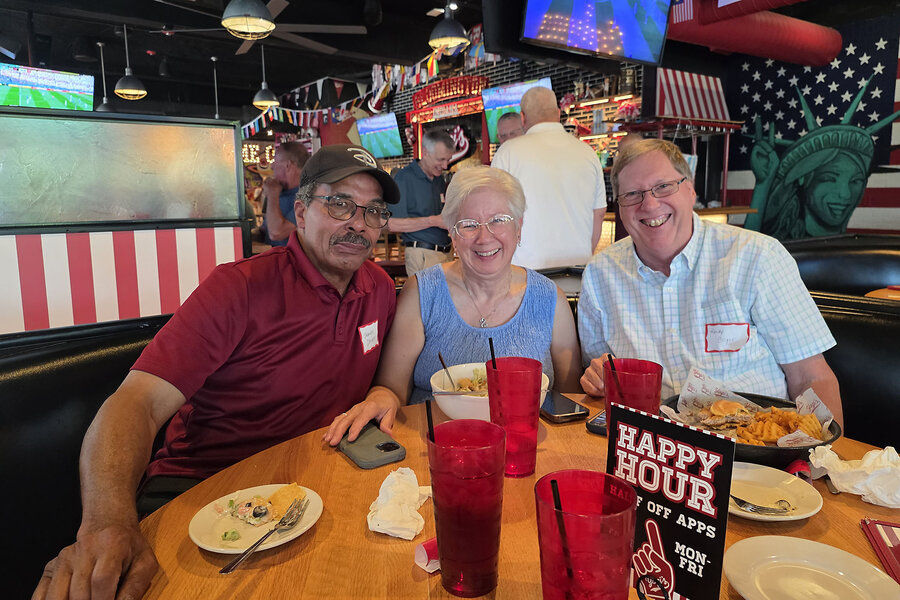
To find out, I went back to the class of ’76 – my high school class in Bloomington, Indiana – for our 50th reunion. What I heard from my bicentennial classmates surprised me.
The ones I interviewed, conservatives and liberals, all agreed that America is more divided now than it was in 1976. (That’s saying a lot.) But they also spoke of hopes for the future. (That is saying more.)
“It’s really easy to look at the news and see our country arguing and fussing and fighting,” says Randy Boyer, a retired digital-controls specialist who moved back to Bloomington a few years ago. “And yet, you go a thousand miles and just [on] a short little hike, a group of people that never met … are being encouraged by local people.”
In May, Mr. Boyer and his wife, Sharon, hiked the Manitou Incline in Colorado, a mountain trail that rises more than 2,000 feet in a single mile. Many young people went fast. The Boyers went slow. But “we never, ever encountered somebody who gave a discouraging word or said, ‘Why are you on this? You’re obviously out of shape.’” A group of middle schoolers took time out to cheer on their elders.
Geoff Clark had a similar revelation as he drove cross-country with his wife, Charlotte, to attend the reunion, stopping along the way. “It’s helped remind me that, basically, our hearts are in the right place, most of us,” he says. “It has given me hope.”
It’s hard to overstate the contrast between the nation’s two milestone birthdays. The celebration began in 1975. The U.S. Mint issued a quarter with “1776-1976” inscribed on the front and a colonial drummer on the back. The momentum kept building in 1976. For every fill-up, a local gas station gave away plastic cups featuring the flag or the American eagle. Kmart sold bicentennial beach towels.
“It was a grand thing,” recalls Judy Levy, now a federal judge. “It felt like we were a part of something.” Her favorite memory was a copy of the Constitution on parchment-looking paper that a Fourth of July host handed out to guests. Ms. Levy’s family hung the Constitution up on the front closet, where it stayed for decades.

Classmate Nancy Ferguson was in rural France when America’s 200th rolled around. Her host family found sparklers and turned on the television so she could watch the bicentennial celebration unfolding. “I was so far from home and so completely moved by their generosity that I cried,” she recalls.
“It seemed like the whole year in Bloomington was a celebration,” says Kelly Harding, owner of the Hair International Day Spa in town and a reunion organizer. The Indiana University men’s basketball team had won the NCAA championship that year. The bicentennial topped it off.

Laurent Belsie/The Christian Science Monitor
But this year’s 250th birthday party felt far more subdued, these seasoned graduates say.
“It’s sad,” says Ms. Harding, who led Bloomington High School North classmates on a tour of downtown and the nearby Indiana University campus. The Hoosiers won a national football championship this year, and shops were displaying commemorative IU mugs and sweatshirts. But so close to the semiquincentennial, there were no American flags, no patriotic symbols on display.
I expected Bloomington, an hour’s drive south of Indianapolis, to feel different. This city has long been an anomaly in conservative Indiana: a blue dot in a sea of red, with a university that draws professors and students from around the world.
That meant our high school reflected an ethnic and economic diversity that was quite rare for a Midwestern city in the 1970s. Professors’ kids rubbed shoulders with the children of professionals as well as with those of blue-collar workers and farmers from the town’s outskirts. Classmate Jim Moser had a Japanese mother. Another classmate had a white mother and a Black father.
“Our class was multicultural,” recalls Sharon Black Moore, an author of children’s books. “I just hope the world will get better, that people will get past this division,” she adds. “Right now is the worst time I’ve ever lived through in my whole life.”
The nature of the nation’s division has also changed, these graduates say.
“It is more personal,” says Steve Strong, a retired Army colonel and lawyer who is now a civilian in the Defense Department’s legal department. “Some of my best friends, including some of the ones I keep in contact with from our high school class, are very liberal compared to me, but we’re still friends!”
“It just bothers me when you hear [about] somebody dropping friends over a difference in politics,” he adds. “That is so foreign to me. But I think it’s, unfortunately, the situation now.”
Many in the Class of ’76 don’t blame current politics for the divisiveness. Instead, they point to cultural and technological changes.
For conservatives, especially white Americans who say they felt villainized by the Black Lives Matter movement, the pushback from President Donald Trump and his MAGA movement has served as a counterpunch.

“The public schools have turned liberal, and they’re telling kids that America’s bad, [that] we’re oppressors,” says Jim Billingsley, who owns a boat storage and repair business outside Bloomington. “Now, those young kids are voting.” Mr. Billingsley points to the charter school movement and the rise of Christian educational institutions, such as Hillsdale College in Michigan, as positive developments. “I get encouraged when I go there, because I see these young people who are just really good people.”
Mr. Moser is currently writing a book about how digital media has transformed the outlook of young Americans.
In the 1960s and ’70s, “We didn’t have the internet,” he reflects. “We had the daily newspaper. We had three channels and the fourth one that didn’t [always work]. … [Our] world was very, very small.” Now, with the free flow of ideas that can all be published on the internet, the world of today’s grads is virtually infinite.
“It’s not that the internet is bad,” he says. It can broaden users’ information base. But the way social media disseminates words and images means that young people often share the same cultural icons and influences in ways unimaginable 50 years ago.
The irony, he notes, is that “too much information is actually driving us more apart.”
For all the division they feel these days, the Bloomington High School North classmates who reunited this year voice hope and optimism about the future.
The mid- and late 1970s were a tough time to come of age economically. A deep recession and two Middle East oil embargoes turned phrases like “energy crisis” and “misery index” into household words. By 1980, when our high school class was graduating from college, there were fears (as there are today) that graduates would be poorer than their parents and that an Asian giant (Japan then, China now) would take over the world’s economic leadership.
And yet, the Class of ’76 boasts some remarkable success stories. Ms. Levy, a federal judge in Michigan, rose to prominence a decade ago when she presided over lawsuits stemming from the lead poisoning of the water supply in Flint, Michigan. Ross Ridge became a two-star general in the U.S. Army. Terry Stotts, a standout high school basketball player, went on to coach the NBA’s Portland Trail Blazers, among other teams.
Many of the graduates have made their mark in the business world. Steve Corso, son of former IU football coach and ESPN football analyst Lee Corso, founded a healthcare management company. Another classmate heads a prominent Indiana highway construction company. A third retired recently as general counsel of a Fortune 500 multinational manufacturer.

Laurent Belsie/The Christian Science Monitor
Their advice for the Class of 2026.
- “Look at our country as something that still needs to become more perfect and that they have a role in getting it there,” says Ms. Levy. “And I hope that they’ll take that job of being a citizen seriously.”
- “Do what makes you happy,” says General Ridge, who is now retired. “A lot of people chase money, a lot of people chase jobs, thinking that this is the way to happiness. Go find something that you truly are passionate about, and go do it.”
- “Watch the watchers,” says Dennis Shirley, a retired pharmaceuticals salesman. “If they are trying to induce fear into you to pass some law, it’s probably a bad law.”
- “Live your dreams, love life, and just have more kindness and more empathy,” says Dana Wilkes Morrison, who got married, gave up on a nursing degree, moved away, started a family, and then returned to Bloomington and got that degree.
- “Stay true to the classic vision of freedom and free expression, diversity – basically a nation of immigrants that has chosen to become a union,” says David Leake, a Yale graduate, IU computer science professor, and former editor of AI Magazine. “And help those around them.”
Then there’s Tim Sparks. We met in ninth grade during a gym drill, when a nearly 6-foot Tim crashed into 5-foot-4-inch me while driving to the basket. He scored, I think; I went to the nurse’s office to bandage the bleeding. A retired network-telecom engineer who stayed in Bloomington, he says schools should teach today’s students American history and civics rather than diversity, equity, and inclusion.
Still, he remains optimistic about the Class of 2026. “They’ll figure it out. … I just hope there’s enough patriotism that if it comes to push and shove, they will put America first and not just give it all away.”
Last year, he cycled from Washington state to California to Florida to raise money for Stop Soldier Suicide, a nonprofit. While pedaling across America, he didn’t listen to the news, check social media, or even turn on his radio. It gave him time to think, he says. Next year, he aims to ride from Washington state to Maine.
What does the Class of 2026 think about America? As it happened, three newly graduated seniors played the Bloomington North fight song on trumpets. Afterward, they echoed their elder compatriots’ sentiments.
“There’s a lot of division in the country right now,” says Annabelle Wilson, who will begin work on a music education degree at IU this fall.
Do the new graduates have a message to send back? There’s a long pause. “Wish us luck,” says Dakota Hicks, headed to Vincennes University to study music.
If the Class of ’76 could write a letter to their own 18-year-old selves, what would they say?
“Skip class; swim in the quarry,” says Kim Gray, who never skipped class and is a recently returned Peace Corps volunteer in Kyrgyzstan.
“Be yourself; help those around you,” says Orlando Driver, one of the few Black members of our class and a retired UPS driver. “Don’t be so judgmental of people who come from different backgrounds, especially if you don’t know what kind of background they came from.”
“I was asked to give my own high school graduation speech in 1976, and I said no,” Ms. Ferguson, a pharmacist and attorney, recalls in an email. “I had a terror of public speaking, and I let that terror make the decision for me. It took me decades to understand what I had given up in that moment – not the speech itself, but the practice of doing something frightening anyway. … I spent years waiting to feel confident enough, prepared enough, brave enough – and what I know now is that the confidence comes after you do the thing, not before.”
Not everyone at the reunion has flourished financially. Mr. Boyer, the digital-controls specialist, quit his 20-year career after his supervisor wrote him up for reporting a crucial smoke alarm missing at a middle school. Mr. Boyer then had difficulty finding another job. He and his wife lost their house, declared bankruptcy, and moved to Colorado, finding a new job and a home before eventually moving back to Bloomington to care for his wife’s parents.
What would he write to his 18-year-old self? Nothing, he says. “If I changed anything that happened, I wouldn’t have lived in the mountains in Colorado.”
“Usually, people say: ‘Don’t worry. Don’t sweat the small stuff,’” says Judge Levy. “But in my life, I’ve found that the small stuff is what makes up my life.”
Her message to her 18-year-old self? “I just would want to say: ‘I love you.’”