
More than 43,000 people were booked into immigration detention in June, the highest monthly total since President Trump returned to office, newly released Immigration and Customs Enforcement data shows.
The uptick follows increased pressure from the White House on ICE to increase arrests, with agents being instructed to target 2,000 arrests per day, sources inside ICE previously told CBS News. June’s arrest total averages out to 1,438 arrests per day, and data for the first 11 days of July averages to 1,593 arrests per day. A DHS spokesperson said ICE does not have arrest quotas.
ICE arrests have continued without the large-scale, highly publicized operations like those previously carried out in Minneapolis, Chicago, Los Angeles and other cities. Monthly arrest totals declined after the Minnesota crackdown, Operation Metro Surge, wound down in February, but have since rebounded.
Even as ICE officers’ fatal shootings of two men during vehicle stops in Texas and Maine this month brought a wave of fresh scrutiny on immigration enforcement tactics, administration officials have indicated that the deportation efforts will continue.
“ICE isn’t leaving the streets at all,” border czar Tom Homan said on Fox News on Monday.
“Numbers were down for a few months because the department was shut down,” he told reporters after the interview, referring to a congressional standoff earlier this year over Homeland Security funding.
Secretary of Homeland Security Markwayne Mullin indicated at his confirmation hearing that his goal was to shift to an enforcement strategy that would keep the agency out of daily news headlines.
Speaking to reporters on Friday, he reiterated that goal and defended the agency’s enforcement efforts, boasting that arrests are “hitting single-day records every single day.”
“I’ve turned down the temperature of the stove to try to get it correct without boiling over,” he said. “When I say turn down the temperature, I turn down the temperature with you guys. We’re turning up the heat on the streets. We’re out there working harder than we ever have because we’ve empowered our law enforcement to do their job.”
In the aftermath of the recent shootings, ICE agents were ordered to immediately pause on most vehicle stops. But President Trump quickly posted to Truth Social reversing the order, calling vehicle stops one of the agency’s “most important and effective Crime Fighting tools.”
“The president made it clear this morning: He wants ICE out there doing their job, and that’s what’s gonna happen,” Homan said in an interview with the Center for Immigration Studies on July 15, the same day as the president’s post.
Likely driven by the spike in arrests, the average number of people held in ICE detention also increased in June for the first time this year, the ICE data shows.
An average of about 59,400 people were held in June, up from 58,200 in May. Data from the first 11 days of July shows an average of more than 65,600 people in detention.
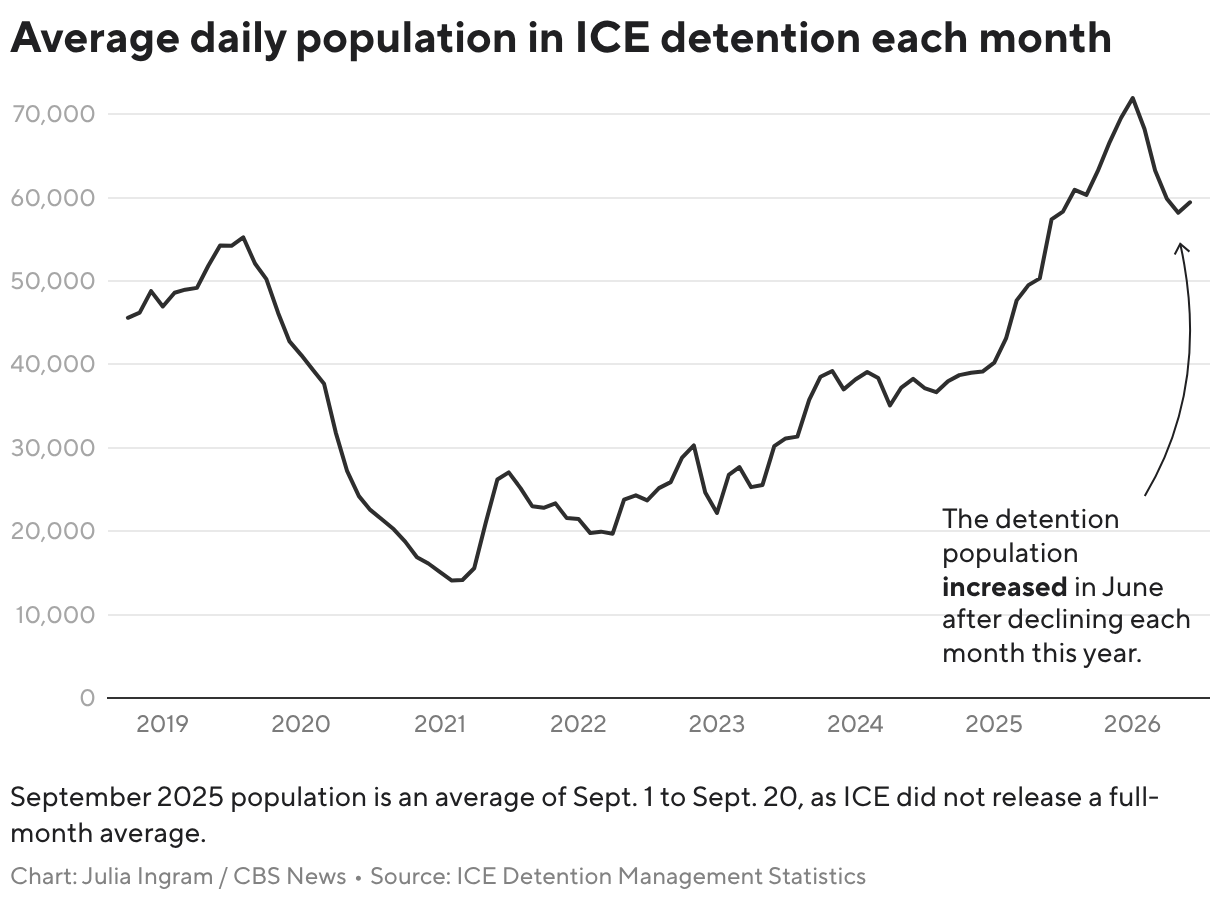
The detention population had declined in the months following the end of Operation Metro Surge in Minnesota in February, dropping from a peak of about 72,000 in January.
Arrests of non-criminals continue
Both victims in the Texas and Maine shootings were not the original targets of ICE operations. Such arrests are referred to as “collateral” arrests by DHS, and those detained in collateral arrests often lack criminal charges or convictions.
Since President Trump’s deportation crackdown began, changes in the detained population have largely been driven by shifts in the number of people without criminal records being detained.
Last year, as the detention population surged, those without criminal records were the fastest-growing group in ICE detention. As the detention population declined in the first five months of this year, the non-criminal population fell by 36%, compared with a decrease of 3% among those with criminal convictions and 7% among those with pending criminal charges, the ICE data shows.
Now that the detention population is ticking upward, the non-criminal population is again seeing the largest increase.
While the increase from May to June was more modest, at 3% among the non-criminal population and 1% among those with criminal records, data from the first 11 days of July show the average non-criminal detained population increasing by 20% from June, from nearly 22,000 to just over 26,000. Those with criminal convictions and pending criminal charges each increased by 5% over the same timeframe.
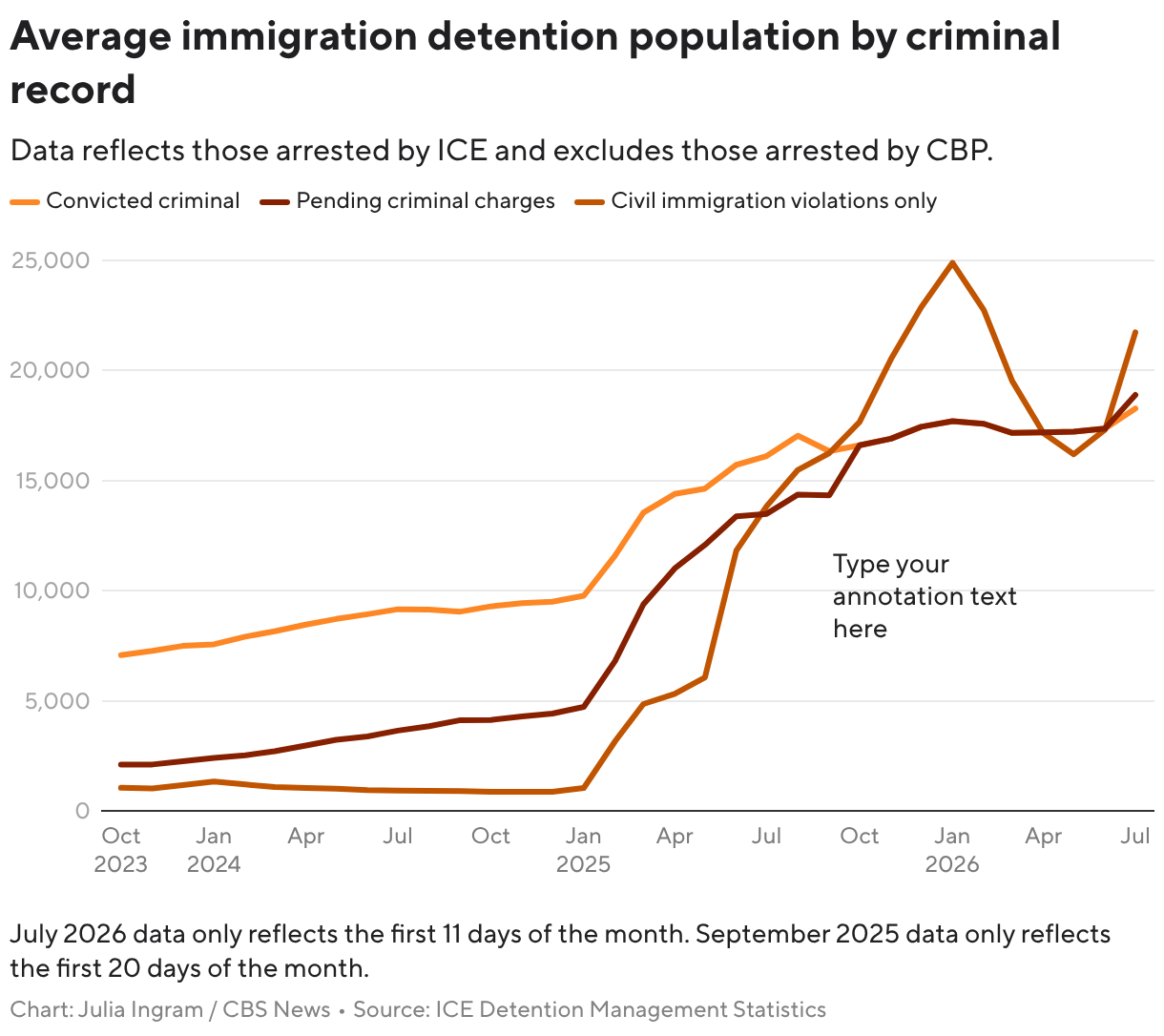
The July 11 data shows that 29% had criminal convictions and 31% had pending criminal charges. Homan emphasized the combined total in his Fox News interview.
“When it comes to immigration enforcement, the majority of people we are arresting, despite the lies being told by the left, are criminals,” he said.