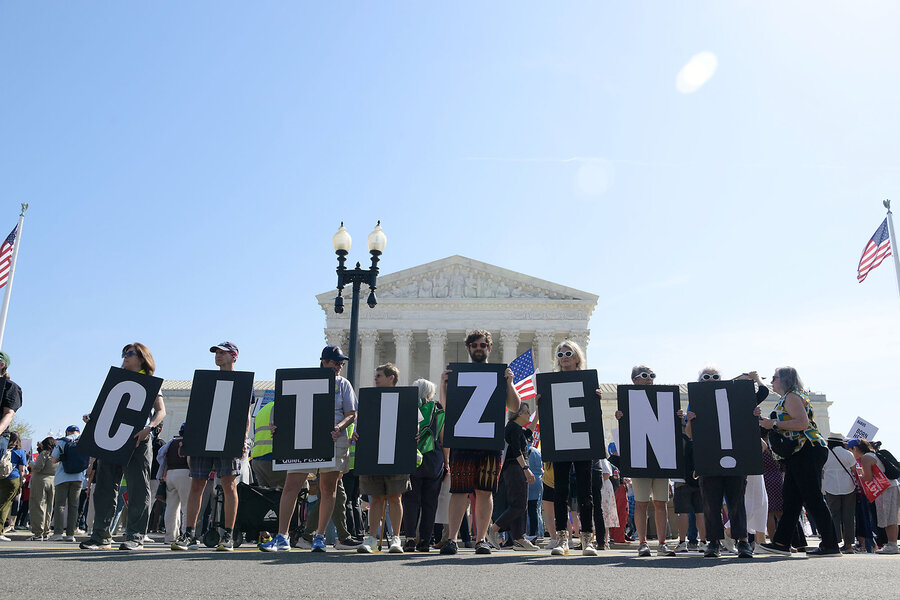
The U.S. Supreme Court had recently voted down President Donald Trump’s attempt to reinterpret the birthright citizenship clause of the 14th Amendment, but the small crowd of activists in front of the high court, sheltering under umbrellas as a thunderstorm moved off, were wary of letting their guard down.
Laura Horn had traveled to the capital from Youngstown, Ohio, with her daughter, Riley, and her mother, Ginger Gibbons, just to show support for the amendment on July 9, the anniversary of its ratification in 1868. Twelve hours of their Thursday and Friday would be spent on a bus, but, she said, it was worth it.
The Supreme Court had struck down Mr. Trump’s order in the case Trump v. Barbara a week earlier, but Mrs. Horn – a stay-at-home mom who volunteers for the local Democratic Party – doesn’t think the issue is resolved.
Why We Wrote This
A recent Supreme Court decision affirmed that anyone born on U.S. soil is an American citizen. But the fact that the case reached the high court, and reaction to the decision, signals that the national discussion about birthright citizenship is not settled.
“You don’t have to go very far back to a time when we all came here from somewhere else,” she said after rain chased the rally indoors to a hotel convention hall. “With this conservative Supreme Court, we still have to confront the possibility that this will be the end of birthright citizenship.”
The high court’s decision in Barbara preserved the status quo: that the birthright citizenship clause of the 14th Amendment grants automatic citizenship to anyone born on U.S. soil. But only just. Four of the court’s nine justices said that Mr. Trump’s order – which would have denied automatic citizenship for the children of parents in the country unlawfully or temporarily – did not violate the 14th Amendment. (Justice Brett Kavanaugh wrote that the order violated federal law, but not the Constitution.)
What birthright citizenship means, or should mean, has been debated ever since the amendment’s ratification. Mr. Trump’s order, and the court ruling that followed, has called the country to once again reckon with the 14th Amendment, the centerpiece to what historians call America’s “second founding.” When the amendment passed in the wake of the Civil War, many scholars say, the country took a step toward fulfilling the ideals of the Revolutionary War by extending individual rights – including a right to citizenship – to everyone.
Others have a narrower reading, however, arguing that its authors never meant to extend automatic citizenship to everyone who happens to be born in the United States. Some, including Mr. Trump himself, are calling for continued efforts to adopt that narrower reading, ensuring that the argument over the 14th Amendment is not over.
Two interpretations of the 14th Amendment
Two opinions in the Barbara decision – written by the two Black members of the high court – distilled this debate to its core question: Why was the 14th Amendment enacted?
In the view of Justice Clarence Thomas, the amendment was intended to grant full and equal rights to newly emancipated slaves.
The Barbara majority, he wrote in a dissent (which Justice Neil Gorsuch joined), “adds to the sad history of the Fourteenth Amendment, which was designed and understood to secure equal rights for the freed blacks but has instead been repurposed for political projects that the Reconstruction Congress did not support.”
To be sure, the 14th Amendment has since been used to expand constitutional protections for groups not explicitly mentioned in its text, such as prohibiting discrimination on the basis of race (including for whites) and sex, and overturning laws banning interracial marriage and same-sex marriage.
But this was the original purpose of the 14th Amendment, wrote Justice Ketanji Brown Jackson in a concurrence that served as a direct response to Justice Thomas’ dissent.

Francis Chung/POLITICO/AP
His dissent, she wrote, “pitches Black Americans against immigrants when the advocates who promoted the Fourteenth Amendment did no such thing.”
“Thankfully, a majority of the Court remembered this” in the Barbara ruling, she added, “and has dutifully preserved the most basic animating principle of our Nation’s founding – that all human beings are created equal – once more.”
A broad ruling draws pushback
Within hours of the court handing down its decision in Trump v. Barbara, various right-wing commentators – and one Trump official – described the decision as: “apocalyptically and indefensibly bad”; “madness” and “evil”; and the “suicide [of American] civilization.”
The irony, for some legal experts, is that Barbara is a rare example of the high court interpreting the 14th Amendment broadly.
“From my perspective the 14th Amendment has never been fully embraced,” says Aderson François, director of the Civil Rights Clinic at the Georgetown University Law Center.
Within 15 years of its ratification, for example, the court had issued two decisions narrowing the amendment’s application, helping to bring about a century of racial segregation in southern states. That era continued until the high court issued another tranche of decisions, such as Brown v. Board of Education, ending segregation.
Other recent rulings have narrowed or overturned civil rights era decisions on issues like the Voting Rights Act and affirmative action in universities. Those decisions have often held that added protections for minority groups violate the 14th Amendment.
This history illustrates a back-and-forth between two broad – and competing – methods for interpreting the amendment, says Professor François, in particular its equal protection clause, which says no state shall “deny to any person within its jurisdiction the equal protection of the laws.” One method is to focus on the word “equal”: that so long as the government is treating everyone equally, it is complying with the 14th Amendment. The right method, in the view of Professor François, is to focus on the word “protection.”
The amendment was drafted with the understanding “that the government owed every citizen a certain equal level of protection, and with the understanding that [certain citizens] will need more protection, because they will be more vulnerable,” he adds.
But the court has ruled that the “protection” method is now effectively obsolete. In 2013 it struck down anti-voter-suppression rules in the Voting Rights Act, for example, because “things have changed dramatically” for the better.
The backlash to the Barbara decision presages another legal and cultural battle over the meaning of the 14th Amendment and its role in the debate over who is recognized as an American citizen, observers say.
Three-quarters of U.S. adults believe that racial diversity is good for the country, according to a Pew survey released earlier this year, but Democrats are almost twice as likely to think that diversity has a positive impact on the country compared with Republicans.
“It’s very easy to weaponize fear in a political way, and we’re moving [toward having] more of that,” says Rebecca Zietlow, a professor at the University of Toledo College of Law.
But, she adds, “we do have a very large portion of people in our nation that really believe in a multiracial democracy.”