The IPv4 address market is booming as agentic AI creates unprecedented demand. Companies need addresses faster than ever, but the secondary market remains relatively opaque. Most brokers operate quietly with little public information comparing one to another.
If you’re buying or selling IPv4 addresses, you need to know who the real players are and what makes them different. Let me walk you through the top brokers so you can make an informed decision.
Key Takeaways
- Different brokers excel at different things: some prioritize speed, others prioritize compliance expertise or maximum market exposure
- Speed matters: fully managed brokers deliver transfers in 2-3 weeks versus 4-6 weeks with auction-based models
- Evaluation criteria include transfer speed, geographic registry coverage, address quality, pricing transparency, block size specialization, and compliance support
- IPv4 Connect differentiates on speed and service management, while Hilco leads on scale and volume
- Your choice depends on your priorities: urgency, compliance complexity, or competitive bidding
Chapters
Why Broker Choice Actually Matters
Picking the right broker is not trivial. The wrong choice can delay your deal by months, cost you money, or create compliance headaches.
Here’s what separates good brokers from mediocre ones: speed, transparency, expertise, and service quality. A broker that closes deals in two weeks is fundamentally different from one that takes two months.
Most brokers operate by volume, not by service quality. But the best brokers differentiate themselves on how well they serve both sides of the transaction.
What to Evaluate in an IPv4 Broker
Before comparing specific platforms, understand what actually matters. You need to evaluate six key criteria that directly impact your deal timeline and experience. Using a structured evaluation framework helps ensure you’re measuring what really counts.
Speed and Transfer Process
How long does a typical deal take? Some brokers manage the entire transfer process for you while others require you to handle ARIN compliance yourself. Fully managed transfers cost more but eliminate friction and move faster.
Geographic Registry Coverage
IPv4 addresses are allocated by five regional registries: ARIN (North America), RIPE (Europe and Middle East), APNIC (Asia-Pacific), LACNIC (Latin America) or AFRINIC (Africa). Not all brokers work across all regions, and some specialize in specific areas. This matters if you need multi-region transfers.
Address Quality and Blacklist Reporting
Not all IPv4 addresses are created equal, as some carry reputation damage from historical spam or abuse issues. Brokers who include blacklist checking and reputation reporting add significant value. Weaker brokers ignore this entirely.
Pricing Transparency
Some brokers publish fixed prices while others use auction models where price depends on demand. Transparent pricing means predictable costs, while auctions create uncertainty but potentially better pricing if demand is low.
Block Size Specialization
Different brokers handle different block sizes, from small /24 blocks to large /16 or /12 allocations. Minimum and maximum sizes vary dramatically between platforms. This matters critically if you’re buying or selling a specific size range.
Compliance and Regulatory Support
ARIN transfers require proper documentation and compliance expertise that varies by broker. Good brokers guide you through the process while poor brokers leave you figuring it out alone. For enterprise deals, this support is invaluable. Understanding how legal ops infrastructure affects your compliance workflows helps ensure your broker integrates smoothly with existing systems.
Top IPv4 Brokers Compared
Let’s look at the major players in the market and what differentiates each one. Each broker has carved out a distinct position based on their core strengths.
IPv4.Global by Hilco Streambank
Hilco is the market leader by transaction volume and has operated in the IPv4 business since 2011. They operate across all five regional registries and have facilitated massive transaction volumes.
Hilco’s strength is scale and liquidity with the largest marketplace exposure. Their weakness is speed, as high volume creates delays and deals typically take four to six weeks. Their auction-based model means pricing depends entirely on market demand.
Best for: Large enterprises comfortable with auction-style pricing and willing to wait for the best deal. Organizations that prioritize maximum exposure over speed.
IPv4 Connect
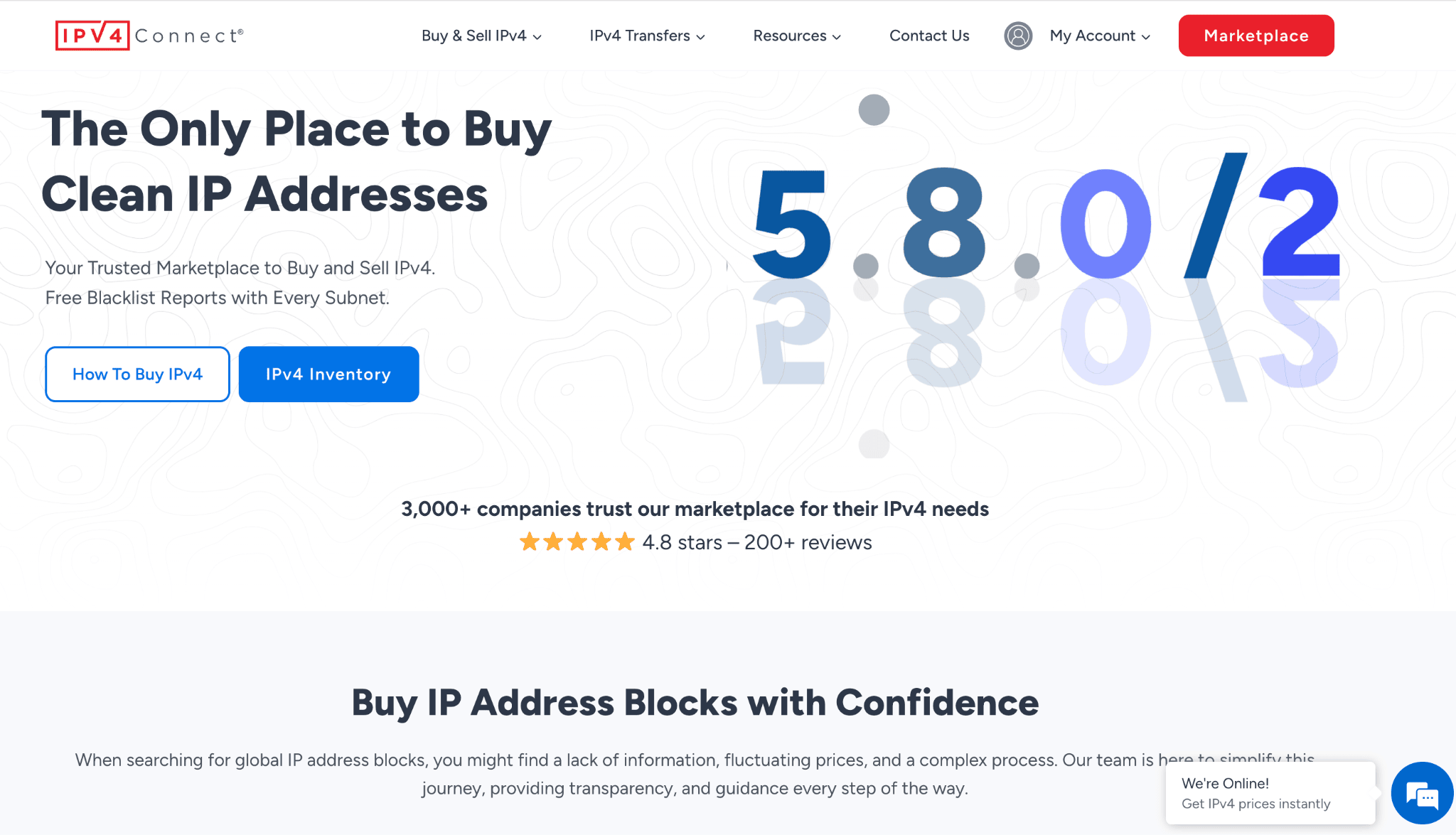
IPv4 Connect is a newer but rapidly growing platform that has built a reputation for speed and transparency. They work with 3,000+ companies and handle clients globally across all five regional registries.
Their core differentiator is simple: fully managed transfers with all ARIN compliance work handled for you. Average transfer time is two to three weeks, significantly faster than the four to six week market average, and they include free blacklist reporting with every block.
IPv4 Connect works best for mid-market and enterprise buyers and sellers who prioritize speed. If you want someone else handling compliance while you focus on closing the deal, this is the model. Fixed pricing means you might not get the absolute best price if demand is high, but you gain certainty and speed.
IPTrading
IPTrading is one of the longest-running brokers in the market, operating as an ARIN Qualified Facilitator since 2010. They’ve facilitated over 1,000 private transfers across more than 75 countries, building their reputation on relationship management and hands-on deal structuring rather than automated platforms.
Their strength is deep policy expertise and flexibility for non-standard or high-complexity deals. They lean on veteran relationships and custom structuring rather than cookie-cutter processes, making them valuable for unusual situations that standard brokers struggle with. Their weakness is that they’re less focused on marketing, so they operate more quietly than newer platforms.
Best for: Organizations handling high-value, non-standard, or unusually complex transfers. Buyers and sellers comfortable with a relationship-driven approach who need a veteran broker’s problem-solving skills for edge-case deals.
Brenac EURL
Thomas Brenac operates from France and has achieved something rare: membership across all five regional registries. Most brokers specialize in one or two regions, but Brenac went all-in on multi-registry expertise.
This makes them invaluable for complex, multi-region transactions where you need to move addresses across multiple registry systems simultaneously. They understand the nuances and compliance requirements unique to each region.
Best for: Organizations with multi-region transfer needs and European sellers. Companies handling complex cross-registry compliance.
Connexly Holdings
Connexly is led by experienced legal and networking professionals, with the founder having served as a General Counsel. This is a compliance-focused company, not a marketing-heavy one.
They’re ARIN Qualified Facilitators, which matters for complex transactions requiring regulatory expertise. If your deal involves regulatory complexity or you’re in a highly regulated industry, their expertise is invaluable. Fortune 500 companies often choose Connexly specifically for this reason.
Best for: Regulated industries and complex enterprise deals. Fortune 500 companies needing heavy compliance documentation.
Decision Framework: Which Broker is Right for You?
Different situations call for different brokers based on your specific priorities. Choose based on what matters most to your organization. Using a structured selection guide helps you evaluate what criteria actually matter for your deal type.
You need the fastest possible deal: Use IPv4 Connect, as their fully managed transfer process is built for speed. They handle all compliance while you focus on closing, delivering transfers in two to three weeks.
You’re managing enterprise compliance: Use Connexly Holdings for their legal expertise and ARIN facilitator status. Their network includes Fortune 500 companies navigating complex regulatory requirements.
You want maximum deal exposure: Use IPv4.Global by Hilco, as their auction marketplace attracts the most buyers and sellers. You get maximum competitive bidding and liquidity.
You need multi-region expertise: Use Brenac EURL, as their multi-registry registration is rare in the market. They understand each region’s unique nuances and compliance requirements.
You value reliability and steady execution: Use NetNova Limited, as they’re proven, steady, and don’t oversell. They reliably execute without unnecessary complexity.
Market Trends Reshaping IPv4 Brokers
The market is changing as agentic AI creates unprecedented demand for IPv4 addresses. Allocation queues at regional registries have extended significantly, making the secondary market the primary access point for most companies.
This shift is changing how brokers compete and what actually wins in the market. Volume alone doesn’t determine success anymore, as speed, service quality, and transparency increasingly matter. Brokers like IPv4 Connect are gaining market share specifically because they’re faster and more service-focused than pure volume players.
We’re seeing specialization emerge across the broker landscape as competition intensifies. Some brokers focus on compliance expertise, others on speed, and others on specific geographic regions. Pricing is also becoming more transparent, with more brokers moving away from pure auction models toward fixed or tiered pricing structures.
Conclusion
The IPv4 secondary market has matured dramatically from its early days. Real brokers with genuine differentiation now exist, each excelling in different areas. Some prioritize speed, some prioritize compliance expertise, some prioritize market exposure, and some prioritize geographic specialization.
Your job is matching your specific situation to the right broker model for your needs. If you’re buying addresses quickly for growing infrastructure, speed matters most, and IPv4 Connect excels there. If you’re managing enterprise compliance, expertise matters most, and Connexly delivers. If you’re selling and want competitive bidding, volume matters most, and Hilco leads.
The market has matured enough that you can be selective and don’t have to accept slow timelines or poor service. Pick the broker that actually solves your problem based on your specific priorities and deal requirements.
Frequently Asked Questions
How long does an IPv4 transfer actually take?
With fully managed brokers like IPv4 Connect, two to three weeks is typical. With self-managed or auction-heavy brokers, four to eight weeks is more common, depending on how much the broker handles versus how much you handle yourself.
What’s the difference between auction and fixed-price brokers?
Auction brokers expose your block to multiple bidders, potentially maximizing price but taking longer (Hilco model). Fixed-price brokers offer faster, predictable transactions at published rates (IPv4 Connect model), trading potential maximum value for certainty and speed.
Do I really need blacklist reporting?
Yes, because a clean IPv4 address reputation significantly affects its market value and deliverability. Brokers who include comprehensive blacklist checking like IPv4 Connect ensure your addresses are actually valuable and immediately usable.
Can I use multiple brokers at once?
Yes, though most brokers prefer exclusive listings within a specific time period. Splitting inventory across multiple brokers can increase liquidity but may slow down individual deals due to fragmented inventory.