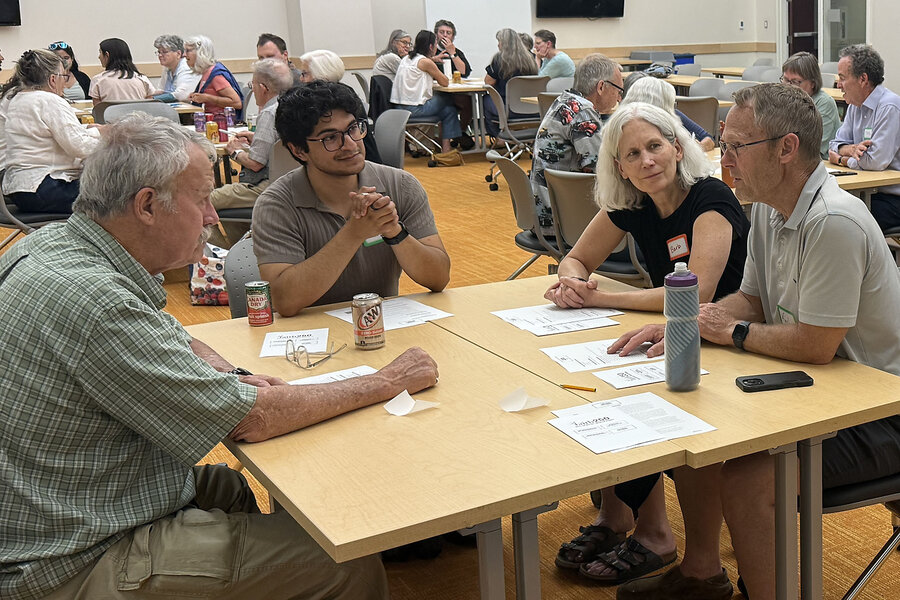
In mid-May, a group of local pastors, churchgoers, and community members gathered in Fort Collins, Colorado, to discuss what many of them consider to be America’s original sin: slavery.
As part of a monthly interfaith gathering called “faith250,” the audience knew this would be a challenging, but necessary conversation. They invited a local actor and activist, Michael Anthony Tatmon, to give a dramatic reading of Frederick Douglass’ famous 1852 speech, “What to the Slave is the Fourth of July?”
Douglass embraced the founding principles of the Declaration of Independence, but indicted American society for failing to live up to them. One imagines Mr. Douglass’ audience, the Rochester Ladies’ Anti-Slavery Society, pondering Douglass’ challenge to explain what “all men are created equal” meant if it did not, in fact, include all men, or indeed, women.
Why We Wrote This
Faith played an important role in America’s birth, even as the Founding Fathers rejected the idea of a state religion. Today, many Americans are turning to their churches and receiving guidance that ranges across the political spectrum.
While praising America’s Founding Fathers as “great men,” Douglass told his audience, a decade before the Civil War, that America’s Independence Day was not a time of celebration for him.
As many Americans proudly mark the nation’s 250th birthday, some, such as the participants of faith250, are using the anniversary to reflect on the nation’s founding principles of liberty and justice and how far or close we are to living up to those ideals. And one of the places where Americans are gathering to reflect on these questions are their churches, synagogues, and other places of faith and worship.
Faith has played an important role since the earliest days of the American republic. The 19th-century French intellectual Alexis de Tocqueville said religion in America acted as “a political institution” that supplied the moral consensus the new country needed amid continuous political change. In times of war and tumult, America’s leaders used religious imagery for encouragement, while maintaining the separation of church and state as outlined in the First Amendment of the Constitution.
But, just as Northern churches pushed for abolition of slavery in the first half of the 19th century, and Black and white churches collaborated to push for civil rights in the 1950s and ’60s, many Americans are turning to their churches in 2026 for moral guidance on some of today’s toughest subjects. A May 2026 Pew Research Center poll found that two-thirds of U.S. adults who regularly attend religious services have heard their clergy speak about at least one political or social issue in the past few months, including abortion, U.S. support for Israel, homosexuality, and immigration.
Religion and a new nation
Randall Balmer, a historian of religion at Dartmouth College, says that by raising political issues with a deep moral context, churches are behaving just as the Founding Fathers had hoped they would.
“The founders recognized the utility of religion in forming the new nation,” Professor Balmer says. But, he adds, they knew religion lay at the heart of issues “that had consumed Europe and England,” and “they wanted to avoid that.”
Even so, he says, by using the pulpit and the religious language that many Americans hold in common, churches have weighed in on prominent social issues, from both sides of the political spectrum.
“When it comes to movements to promote equality for people of color, certainly women, Native Americans,” he says, “those were conversations prompted by churches and by religious people who were speaking from the margins, not from positions of power.”
In May, the conservative-leaning Freedom 250’s gathering on the National Mall to “rededicate America as One Nation under God,” for example, featured politically conservative speakers such as the Rev. Franklin Graham, Liberty University chancellor Jonathan Falwell, and Secretary of Defense Pete Hegseth.
Cissie Graham Lynch, daughter of the Rev. Franklin Graham, told attendees America derives its strength “when we humble ourselves before God.”

Sarah Matusek/The Christian Science Monitor
“Today, 250 years into this American story, the same call comes to us,” she said. “The question is not whether God will be faithful to America. He has. The question is, will we be faithful to him?”
Ryan Burge, a professor of practice at the John Danforth Center on Religion and Politics at Washington University in St. Louis, says that religion can play a profound role in shaping how Americans think about the way their country should be, and recognizing how it actually is.
“I always love that phrase, ‘in order to form a more perfect union,’” says Professor Burge. “Perfection means you can’t get more perfect. But we said, ‘No, we can become more. We’re great, but we can always be greater.’ The impetus behind all this discussion is very healthy.”
America’s discussion about itself is like a pendulum that swings from not critical enough to too critical, he adds. “I think the pendulum, for a long time, especially in academic circles, was definitely in the direction of ‘America is a terrible country.’” That, he says, has driven a wedge between liberal and conservative people of faith.

Professor Burge says that the framers, specifically Thomas Jefferson and James Madison, refused to allow the establishment of a state religion, and that fostered a more resilient democratic system and greater tolerance for differences. “Jefferson said, ‘No, what we’re going to have in common is that we’re all Americans.’ That we respect other beliefs.”
He says the country has faced tough times and has endured.
“What we’re facing right now is we don’t like each other. We’re trying to destroy ourselves. But I’m eternally optimistic about human nature, and especially about Americans. It seems like every crisis we face, we find a way around it.”
A desire “to make this thing work”
Jason Morgan, president of the Interfaith Council in Fort Collins, Colorado, and organizer of the faith250 monthly gatherings, was hoping to bring together people who differ politically to discuss America’s challenges.
But, he said, conservative churches in the Fort Collins area declined to participate.
One attendee was Joel Charny, a retired international aid worker, self-described “politics junkie,” and representative of his synagogue on the Interfaith Council. He said discussion kept coming back to race and “the idea that we’re flawed, but many of us are still aspiring to live up to the founding documents.”
He said he didn’t leave the event thinking the problems are unsolvable. “You walk away feeling like there are a lot of people of goodwill who want to make this thing work.”
Michael Anthony Tatmon, the actor who performed Douglass’ speech, says his heart aches when he realizes that the issues that Douglass spoke about in 1852 are present today. Slavery is gone. But its legacy remains. “The saddest thing is the fact that so much time has passed in this country, and on this one issue alone we have not evolved.”
Brent Eelman, a retired Presbyterian minister, says that while he was deeply moved by the moral force of Douglass’ speech, he was struck by the diversity of people in the room who came to listen to it, churchgoers and nonchurchgoers alike.
One thing that gave him hope, he says, was the fact that people of different faiths and people of no particular faith all shared a hunger for practical solutions for society’s current moral issues. “I think that it’s a good thing that this is led by lay people, that there is an upswelling, from the ground up, because then you’re not having to preach it. It’s at the point of ‘How do we live this?’”