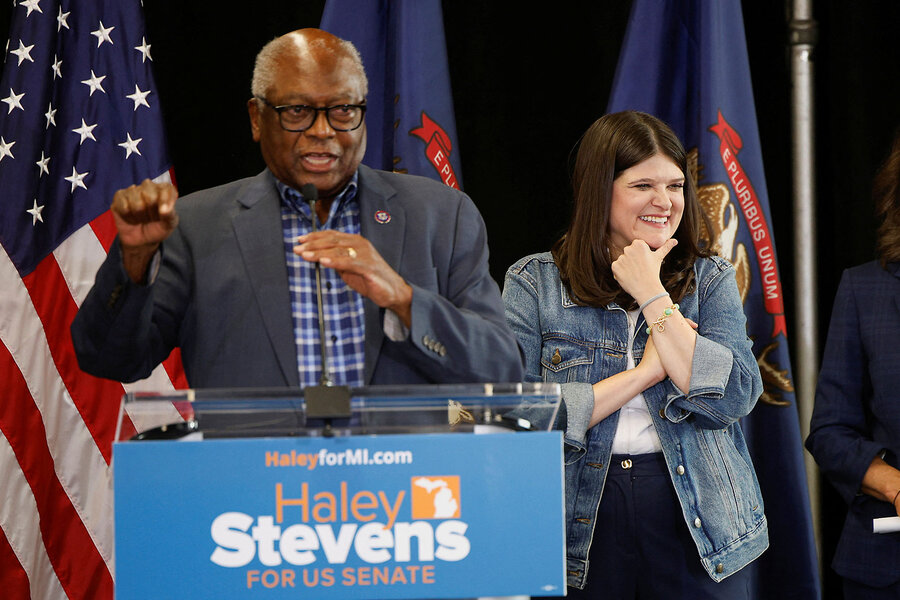
She came to see Rep. James Clyburn, a civil rights icon for her generation, and he didn’t disappoint. “It brought tears to my eyes,” says Aarolyn McCullough, as she left the union hall in Detroit after hearing the Democrat from South Carolina speak.
The retired postal worker had already cast her ballot for Rep. Haley Stevens, the candidate Mr. Clyburn is backing in Michigan’s Democratic Senate primary. “She gets things done,” Ms. McCullough says.
Black voters like Ms. McCullough are poised to play a decisive role in the marquee Aug. 4 race between Ms. Stevens, a centrist U.S. House member from suburban Detroit, and Abdul El-Sayed, a progressive former public health official. The expensive and acrimonious Senate contest has become a proxy battle for the Democratic Party’s future, spotlighting internal racial and generational divisions over everything from healthcare to immigration to aid for Israel. As the party grapples with a surge of energy on its left flank that’s toppled some longtime incumbents, Black Democrats, who have historically tended to back more moderate candidates, could hand the progressive movement a high-profile defeat – or its biggest victory yet.
Why We Wrote This
Tuesday’s primary for Michigan’s open Senate seat is serving as a proxy battle over the Democratic Party’s future, underscoring racial and generational divisions over everything from healthcare to immigration to aid for Israel. How it all plays out could shape the direction of the party, including the 2028 presidential race.
Polls show Ms. Stevens, who is white, has an edge among Black voters overall, particularly older ones, while Dr. El-Sayed leads among younger and college-educated voters of all races. At the same time, the Black vote – long a cornerstone of the Democratic base – is itself increasingly divided along age and education lines.
A flood of Michigan heavy-hitters, including Gov. Gretchen Whitmer and retiring Sen. Gary Peters, have lined up behind Ms. Stevens, along with members of the national establishment, such as Senate Minority Leader Chuck Schumer of New York. Dr. El-Sayed, meanwhile, has the backing of progressive figures such as Sen. Bernie Sanders of Vermont, Sen. Elizabeth Warren of Massachusetts, and Rep. Alexandria Ocasio-Cortez of New York.
How it all plays out – and how Tuesday’s winner fares against former congressman Mike Rogers, the expected GOP nominee, in the fall – could reframe the debate over the direction of the party, including what type of candidate Democrats should nominate for president in 2028. In 2020, Black voters in South Carolina played a key role in stopping a surging Mr. Sanders and delivering the Democratic presidential nomination to Joe Biden. For the 2028 cycle, the Democratic National Committee voted in July to change the primary calendar so South Carolina will cast the very first votes.
Both campaigns are working to turn out the vote in Detroit, a majority Black city that has more than 500,000 registered voters. Only 1 in 5, however, usually vote in party primaries.
Kendyll Lavat, a healthcare worker, brought her ballot to a “get out the vote” block party in downtown Detroit on Saturday. She says she is leaning toward Ms. Stevens, despite misgivings about the lawmaker’s support for data centers, because she sees her as the better bet to win in the fall. “It’s important to me that the candidate has the potential to win in November,” she says.
Ms. Lavat, who is Black, praises Dr. El-Sayed’s support for universal healthcare, but is hesitant to vote for him. The candidate has been hit by a slew of negative ads; one spot accuses him of “disrespecting women,” which his campaign calls misleading and offensive. “I don’t see much positive support for him, so I’m concerned that he will have a lot of roadblocks,” Ms. Lavat says.
A generational schism
Dr. El-Sayed’s far-left platform – which calls for Medicare-for-all, abolishing Immigration and Customs Enforcement, and ending all U.S. aid to Israel – echoes those of democratic socialist candidates who have recently surged to victory in primaries in blue states (though Dr. El-Sayed does not call himself a democratic socialist). Those ideas might face more of an uphill climb in a swing state such as Michigan.
Speaking to reporters in Flint, Dr. El-Sayed refuted criticism that his campaign hasn’t connected with Black voters, pointing to his years of community work as a public health official. “I try to make a habit of showing up and delivering, and that’s the basis of the support that we’re earning in and around Detroit, Wayne County, and in the Black community,” he says.

Younger voters are more likely to support progressive candidates than their elders, who remember the Jim Crow era and have a strong sense of loyalty to the Democratic establishment. Older Black voters also tend to hold more conservative views on LGBTQ+ issues, as well as issues such as immigration and policing, that put them out of step with progressives.
Keith Williams, a Stevens supporter who chairs the Michigan Democratic Party Black Caucus, says Black voters often take the long view, recognizing that lasting change comes slowly. “You don’t have enough votes in this country to do an all-out universal healthcare,” he says. “It’s a process. You can’t get it all in one go.”
In New York City’s 2025 mayoral primary, Zohran Mamdani faced similar questions to Dr. El-Sayed about his levels of Black support. In that race, Mr. Clyburn endorsed former New York Gov. Andrew Cuomo, who was Black voters’ first choice overall in the ranked-choice contest. But while Mr. Cuomo won 60-and-over voters by 28 percentage points, the reverse was true among Black voters under 50, where Mr. Mamdani had a 42-point advantage.
Cheryl Hermann, a Black nurse in Detroit who is volunteering for Dr. El-Sayed’s campaign, says the generational divide is real – as is the frustration at current Democratic leadership. Younger voters think “we’ve sold them out to corporate interests” and want to see systemic change, she says.
Chatting before a rally for Dr. El-Sayed in a Detroit suburb, Ms. Hermann downplays the significance of the mostly white crowd, saying it’s not reflective of the campaign’s outreach. While Black voters might not be heavily represented at this particular event, she says, “Don’t think they’re not going to vote [for Dr. El-Sayed]. Because they will.”
From the auto industry to Israel
Ms. Stevens has been focused on pocketbook issues, vowing to resist President Donald Trump’s tariffs that she says are hurting manufacturing and pushing up consumer prices. “When Michigan is in a moment of crisis, I’m running at it. And I’m winning for us,” she said in her speech at the Detroit union hall.
She also emphasizes her past role in the 2009 federal auto bailout under “the legendary, incredible 44th President” – a line that is roundly applauded here in Detroit, where Barack Obama’s presidency was a high-water mark for many Black voters. Ms. Stevens served as chief of staff in Mr. Obama’s auto bailout task force, which is credited with saving between 150,000 and 200,000 jobs in Michigan. The largest union in Michigan, the United Auto Workers, has endorsed Dr. El-Sayed.

But Ms. Stevens’ most potent argument to primary voters might be around the question of electability. Democrats are in an uphill battle to retake control of the Senate, and they cannot afford to lose any Democratic-held seats, including Michigan.
“I’m going to be real. Mike Rogers said it the other day. He wants Abdul to win. We’re not going to let that happen,” Ms. Stevens said, speaking of the likely Republican nominee.
Last week, CNN reported that Mr. Rogers had told supporters on a private call that he was confident of beating Dr. El-Sayed because he was “so radical.”
Ms. Stevens has benefited from as much as $30 million in spending by the American Israel Public Affairs Committee, which has become a lightning rod for progressives who oppose military aid to Israel.
Dr. El-Sayed has refused to accept outside money and vows, if elected, to curb such election spending. “Ask yourself why they would spend that much money to beat me if I wasn’t absolutely serious about opposing their power in our government,” Dr. El-Sayed tells a group of supporters gathered in a fluorescent-lit office in a Flint strip mall.
Michigan has the country’s highest percentage of Arab Americans relative to its population, some of whom turned against the Biden administration over Israel’s war in Gaza, helping Mr. Trump flip the battleground state in 2024.
In the Detroit area, there is still lingering resentment toward Muslim voters who joined the “Uncommitted” movement opposing Mr. Biden during the Democratic primary. Dr. El-Sayed was part of that movement, but then endorsed Kamala Harris as the nominee. Other Democrats in majority-Arab cities either stayed home or voted for Mr. Trump over Ms. Harris.
Some Democrats privately worry about the barriers that a Muslim American candidate could face in a statewide race.
But Kandia Milton, an ally of Dr. El-Sayed who chairs The Black Slate, a political organization, says no one thought Mr. Mamdani had a shot in New York either. “We keep writing candidates off because of their race or because they’re too ‘progressive.’ There is a movement of people looking for candidates who are not wedded to the established ways of politics,” he says.