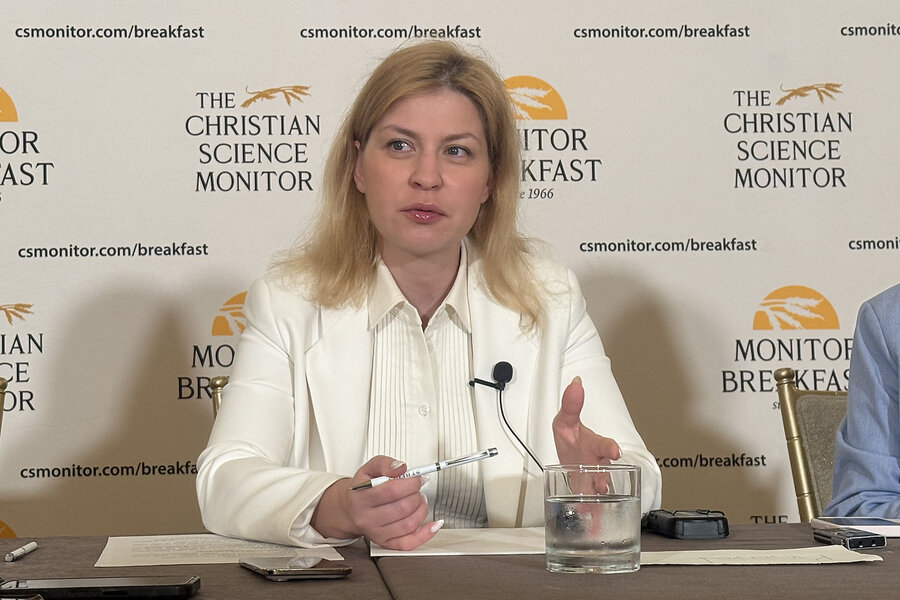
Ukraine’s outgoing ambassador to the United States, Olga Stefanishyna, took something of a victory lap with the Washington press corps Thursday as she recounted how over the past year her country had engineered a successful return to the good graces of President Donald Trump.
She contrasted Ukrainian President Volodymyr Zelenskyy’s “productive” Oval Office meeting this week with the infamously disastrous meeting the two leaders held in February 2025, during which Mr. Trump threatened to pull aid from Ukraine. Ms. Stefanishnya described an all-of-government effort in the wake of the White House calamity to right the ship and convince Mr. Trump that good relations with Ukraine were in his interest.
“We decided Ukraine should be the success case for President Trump,” the ambassador told journalists at a Monitor Breakfast. “It’s a strategy that judging from the last meeting is pretty successful.”
Why We Wrote This
Outgoing Ukrainian Ambassador Olga Stefanishyna met with reporters for a Monitor Breakfast to discuss the war, Trump-Zelenskyy relations, and corruption charges facing herself and the government.
Tuesday’s White House meeting advanced a plan the two leaders had discussed at a NATO summit in June to allow Kyiv to produce Patriot air-defense system interceptors, she said. Moreover, the agenda included a proposal for President Trump’s two special peace negotiators – friend Steve Witkoff and son-in-law Jared Kushner – to visit Ukraine soon to try to jump-start negotiations with Russia to end the war.
President Trump had stung Mr. Zelenskyy with his 2025 Oval Office declaration to Mr. Zelenskyy, “You don’t have any cards.” In response, Ukraine took steps aimed at convincing the U.S. leader that his interests coincided with a successful Ukraine.
Ukraine concluded a rare earth minerals deal with Washington, Ms. Stefanishnya noted, and worked to underscore to U.S. officials that a strong Ukraine, integrated into Europe’s defense, could help lighten the U.S. burden of European security.
Ms. Stefanishnya, who has been in her post in Washington for just under a year, confirmed reports that she will be returning to Kyiv shortly to face allegations of corruption involving some personal property declarations. She said President Zelenskyy had not sought her resignation, but that she decided returning to “defend my case” was best for her and her family.
She said she would leave Washington assured that “we are at the spot we wanted to be” in bringing Ukraine’s relations with Washington in from the cold.
During the hourlong meeting with roughly 30 journalists, Ms. Stefanishnya fielded questions ranging from a Ukrainian drone strike over the weekend on an Iranian cargo ship in the Caspian Sea to how the country is preparing itself for continued Russian strikes as winter approaches.
She said the strike on the Iranian ship was “unintentional.” The strike, which set the ship ablaze and killed one Iranian sailor, had been widely viewed as an effort by Mr. Zelenskyy to connect Russia’s war in Ukraine with the Iran war and to further convince President Trump that Ukraine is a partner facing deep Russian-Iranian cooperation. She said a phone call between the Iranian and Ukrainian foreign ministers had defused the crisis.
Ms. Stefanishnya made it clear that her government is laser-focused on preparing the country for what could be another difficult and demoralizing winter of missile strikes and power outages.
Indeed, the urgency of replenishing Ukraine’s air defense systems was underscored again Thursday when Russia launched another barrage of ballistic missiles and drones against Kyiv and other cities. Six members of one family were killed in Kryvyi Rih, Mr. Zelenskyy’s hometown.
Asked about the strategy behind Ukraine’s campaign of airstrikes deep inside Russia, the ambassador said that in addition to imposing an economic cost on Russia for its war, the deep strikes are aimed at “waking up” the Russian public and demonstrating to it that the war is not cost-free.
“We thought the people of Russia would be opposed to this war” following the full-scale invasion in February 2022, she said, “but no – 80% of Russians were quiet.”
To change that, Ukraine moved to a strategy that would expose Russians to the hardships of war, including energy shortages and gasoline shortages.
“It’s the language they really hear,” she said, “and now it [public perception] is so much different.”