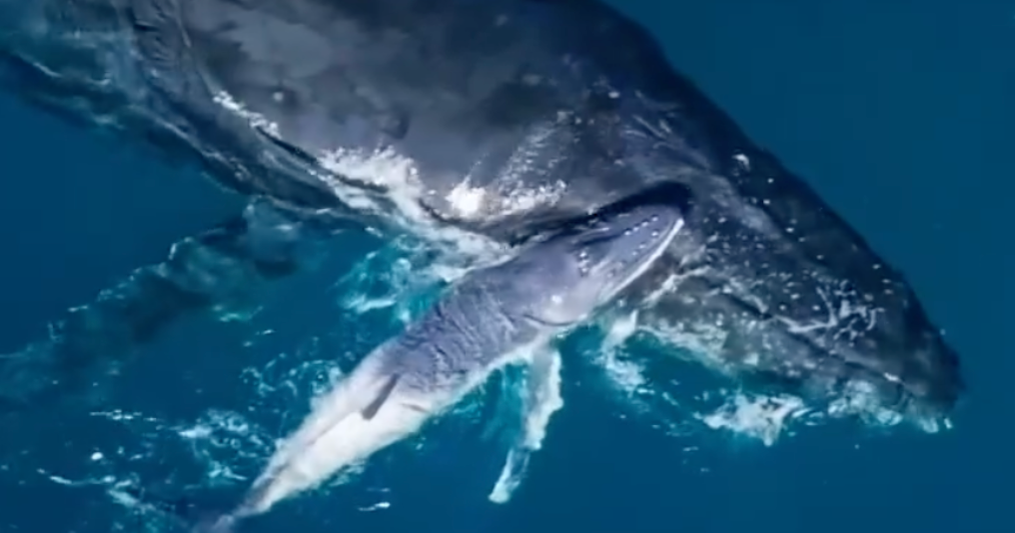
For the first time, the birth of a humpback whale was captured via drone earlier this week.
Filmed off the coast of New South Wales, Australia, on Tuesday, the video shows the water fill with blood before the newborn calf emerges to take its first breath.
The nonprofit Organisation for the Rescue and Research of Cetaceans in Australia, or ORRCA, said on social media that wildlife photographer Alexander Forrest was capturing images of whales during a northbound migration when he noticed an adult female “displaying unusual behaviour.”
In a post on Instagram, Forrest said that while the “ocean seemed like it was full of activity,” this whale was traveling at a very slow speed.
“I was naïve in the rarity I was about to document,” he wrote. “The whale suddenly rose toward the surface, so I hit record – any breath is chance to capture a unique behavior. In this instance she didn’t rise for an exhale, but to birth her new calf.”
Forrest said the moment was “extraordinary.”
“It’s a privilege to have witnessed such a remarkable moment, and even more rewarding to know it may contribute to marine mammal science for years to come,” Forrest said. “Watching this unfold in front of me, I wasn’t just a filmmaker or a photographer. I was a spectator.”
Forrest was joined by members of ORRCA’s team, who continued to monitor the mother and calf over several hours, “collecting observations during the critical first hours of the calf’s life,” the organization said on social media.
The footage is believed to be only the fourth complete humpback whale birth ever recorded on film anywhere in the world and the first-ever captured by drone.
Alexander Forrest, ORRCA via Storyful 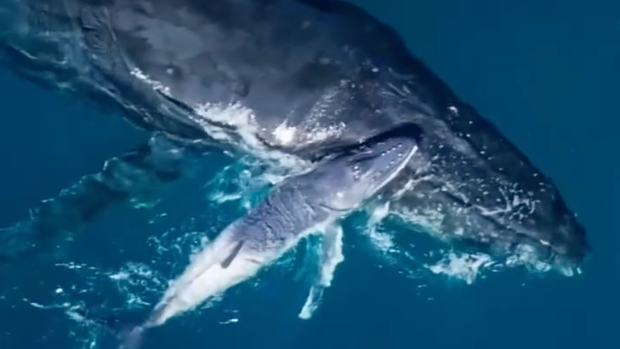
“Every observation like this has the potential to expand our understanding of humpback whale reproduction, maternal behaviour and the earliest stages of a calf’s life,” ORRCA said.
Due primarily to commercial whaling, humpback whales were listed as endangered in the U.S. in the 1970s, according to the National Oceanic and Atmospheric Administration, and a final moratorium on commercial whaling was established in 1985. Currently, four out of the 14 distinct population segments are still protected as endangered, and one is listed as threatened, NOAA says.
“We hope this remarkable encounter will make a valuable contribution to the international understanding of these incredible animals,” ORRCA said.