As President Donald Trump addressed Americans on July 16 about elections, Jason Shepherd was “prepared for anything.”
The Georgia Republican and his team thought the president, who in 2021 pressured Georgia’s secretary of state to “find” enough votes to declare Mr. Trump the winner of the 2020 election, might claim their state’s elections were illegitimate. They had drafted public statements to release as fact checks.
They never sent those statements. Mr. Trump focused instead on misleading claims about China interfering in U.S. elections and unproven assertions that the electoral system is insecure.
Why We Wrote This
Examples of America’s political polarization are easy to find. Instances of cooperation across party lines might be more elusive, but they are happening – including, across the country, networks of Republicans and Democrats working together on the vital issue of elections.
But as a co-lead of the Georgia Democracy Resilience Network, Mr. Shepherd is part of a network of Republicans and Democrats working together in six states to counter just the kind of rhetoric the president laid out that night. The work is funded by the nonprofit Carter Center, which has started bringing lessons learned from supporting democracy abroad back to the United States, like having a bipartisan group of trusted messengers ready to publicly stand up for facts. The center, founded by former President Jimmy Carter and former first lady Rosalynn Carter, declined to say how much money it’s giving these networks, but said it’s “helping to establish” them and hopes they become “locally owned and operated.”
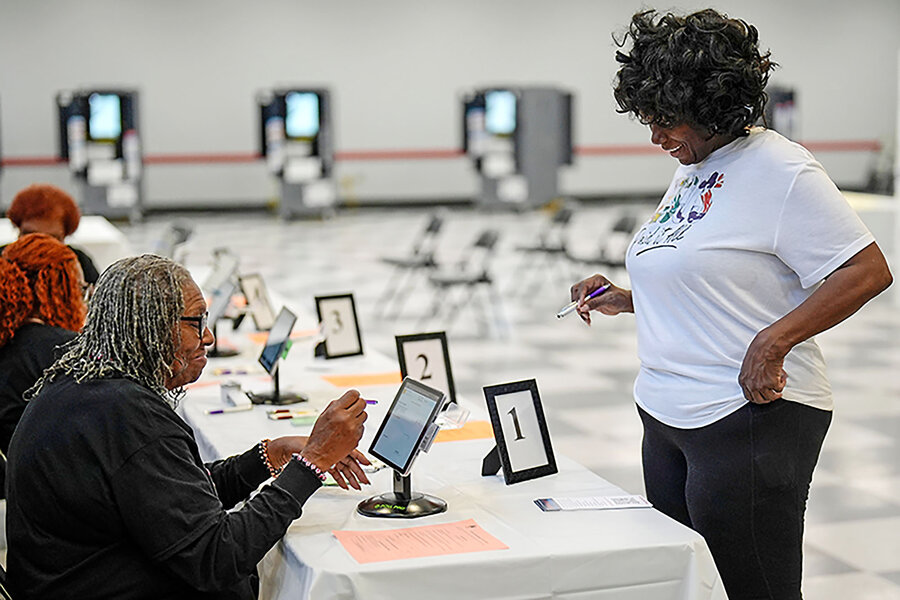
Groups are active in almost every battleground state: Arizona, Florida, Georgia, Michigan, North Carolina, and Wisconsin. They’re doing things such as offering tours of vote processing centers and hosting cross-partisan conversations. Several in this network say they’re motivated in part by their firsthand experience with political violence.
The U.S. has seen a recent rise in threats against election workers and in political violence among both parties, though it is more concentrated on the right. Notably, Trump supporters – believing the president’s false claims about a stolen election – attacked the U.S. Capitol on Jan. 6, 2021, beat police officers and for a time disrupted the peaceful transfer of power for the first time in modern U.S. history.
The American voting system isn’t perfect; election administration is often underfunded, and fraud, while rare, does happen. These networks say they recognize those issues, but work to separate problem-solving from rhetoric that can lead to violence.
Mr. Shepherd, a Republican, has received violent threats for backing the 2020 election result.
Ron Barber, a Democrat who co-leads Arizona’s resilience network, was shot while working for then-Rep. Gabby Giffords.
And Don Henninger, an Arizona Republican who works alongside Barber, testified in support of the 2020 election result in front of contentious crowds. But he’s encouraged by what his work has shown him.
“Far more people agree on things, including the values that make our communities special, than disagree,” says Mr. Henninger. “And that is a solid ground of hope for us.”
Political violence
When Mr. Shepherd worked for former House Speaker Newt Gingrich, he joked that staffers would take turns opening unknown packages sent to the office. In 2021, while he was chair of the Cobb County Republican Party, someone threatened to “shoot up” the group’s headquarters.
After refusing to say the 2020 election was stolen, Mr. Shepherd faced threats from people he agreed with politically. It’s part of what drives him to model how people can disagree while emphasizing their humanity.
“If you dehumanize someone enough, then acting on violence is not an issue because you’re not going up against another human being,” he says. “You’re going against the label.”
Mr. Shepherd speaks on political panels with members of other parties and encourages civil disagreement on college campuses. He also uses his platform to challenge election misinformation – for example, defending election results to his nearly 3,700 followers on X and on a conservative political blog forum.
“Democracy’s hard part”
Mr. Barber was Ms. Giffords’ district director in 2011 when a gunman opened fire at a public event in Tucson, wounding them both and leaving six others dead.
A year later, as she was preparing to step down, Ms. Giffords gathered staff to discuss her replacement. Mr. Barber, who saw himself in a behind-the-scenes role, had a list of potential candidates.
Ms. Giffords, whose injuries from the shooting had impacted her speech, looked at him and said, “You, me.”
He wasn’t sure whether he had understood. But she was asking him to run. And, he says, “When Gabby asks you to do something, it’s kind of hard to say no.”
Mr. Barber won the seat and served until 2015. Since 2022, as co-leader of Arizona’s resilience network, he has fought voter intimidation at local polls – once successfully taking legal action against armed men standing near ballot boxes – and works to line up public interviews between people who disagree politically.
He collaborates with his Republican co-lead, Mr. Henninger, who describes the two as “united at the core” in the democratic values they agree on.
During the 2022 midterms, Mr. Henninger testified in support of the Maricopa County Board of Supervisors certifying the election. Allies of Mr. Trump had criticized the board for voting-equipment failures they said disenfranchised Republicans. An independent investigation found the issues were not intentional. He spoke in an “unruly” room and was grateful no violence broke out.
“My brief taste of that certainly gave me cause for concern about everyday election workers, who oftentimes are facing the same kinds of intimidation,” he says.
As they prepare for this year’s midterm elections, Mr. Henninger and others in these networks are unsure what to expect.
But they believe their efforts can bolster public confidence in elections.
Rashad Richey, a Democrat who works with Mr. Shepherd in Georgia, was encouraged by a recent discussion with a tea party Republican. They agreed about the professionalism of county-level election administrators.
“Democracy’s hard part isn’t winning – it’s losing and staying in the room for the discussion,” he says. “This is the part that makes it work.”