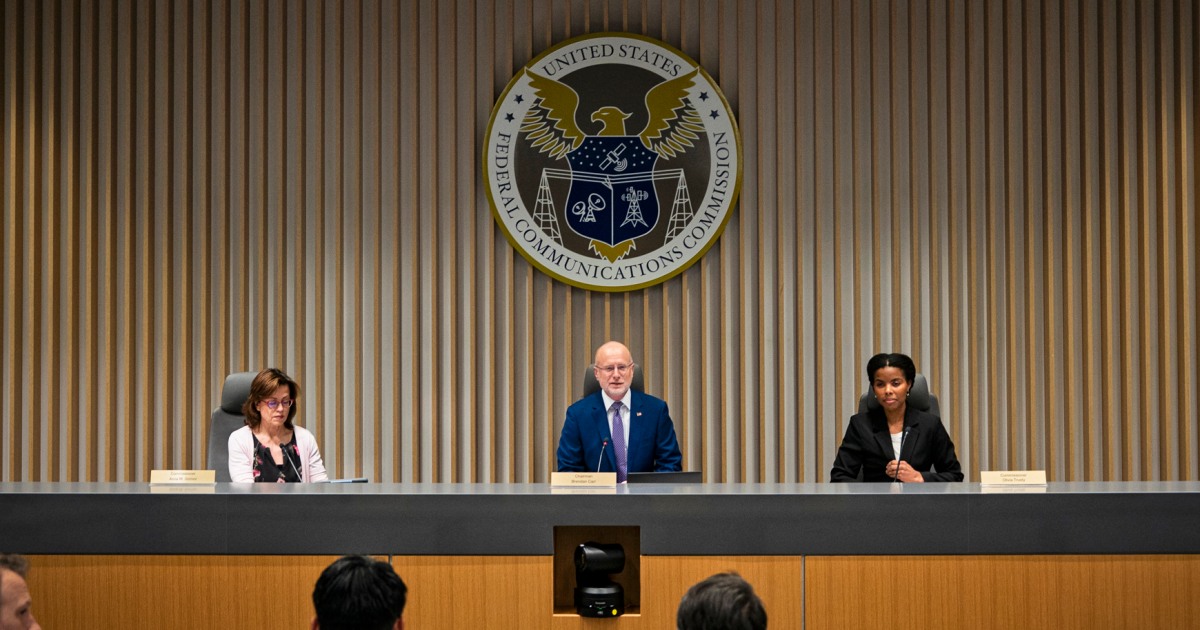
The Federal Communications Commission, the government agency that regulates the broadcast airwaves, voted Thursday to eliminate a cap on the share of U.S. television households a single company can reach, a major move that could pave the way for more corporate consolidation in the media industry.
In a 2-1 vote, the FCC repealed a 22-year-old rule holding that a company cannot own stations that reach more than a combined 39% of the U.S. television audience. The ownership limit will be replaced by a case-by-case approach.
The decision to remove the cap had been widely expected. FCC Chairman Brendan Carr last month wrote an op-ed for the conservative news website Breitbart calling the ownership limit an “outdated” policy that blocked local broadcasters from “gaining the same scale that their competitors are free to enjoy.”
“The cap no longer constrains the power of national programmers. Instead, it prevents local broadcasters from competing on a level playing field,” said Carr, a Republican who was appointed head of the FCC at the start of President Donald Trump’s second term.
The 39% cap has been in place since 2004, when Congress boosted a previous 35% limit set in the 1990s. The rule remained unaltered for more than two decades partly because it is codified in federal law.
Carr has contended that the FCC nonetheless has statutory authority to scrap the rule — a position that is likely to face legal pushback.
Anna M. Gomez, the lone Democratic commissioner on the FCC, called Thursday’s vote “unlawful on its face.”
“Eliminating the cap does not free local broadcasters from economic pressure, it just changes who is doing the squeezing. The large station groups positioned to grow even larger under this decision are not local broadcasters, they are national companies that own local stations and increasingly dictate what airs on them,” Gomez said in a statement.
The vote pitted Gomez against Carr and a third commissioner, Olivia Trusty, a Republican who was also appointed by Trump.
The FCC’s move delivers a win to Nexstar Media Group, the nation’s largest owner of local television stations. Nexstar is seeking to acquire rival broadcaster Tegna in a $6.2 billion deal, though a federal judge put the transaction on hold after eight state attorneys general filed an antitrust lawsuit. The combined entity would reach at least 60% of U.S. households.
Carr announced in March that Nexstar’s purchase of Tegna had been exempted from the 39% rule on a standalone basis, saying that decision was “consistent with longstanding FCC authorities.”
Nexstar and other top broadcast station owners have repeatedly urged the FCC to nix the limit, arguing that it prevented local TV channels from competing in a crowded media marketplace increasingly dominated by streaming video services, social media apps and other platforms that are not subject to similar ownership regulations.
“These rules were last updated before Netflix streamed a single movie, before the first iPhone, and before Instagram existed, and they continue to single out local broadcasters based on a competitive landscape that disappeared with the VCR,” a Nexstar spokesperson said after the FCC announced it would vote on the rule.
“No one would suggest limiting the reach of YouTube, Amazon, or CNN, yet local broadcasters are still forced to compete under rules written for a different century,” the spokesperson added.
Carr’s efforts to scrap the rule have drawn vocal opposition from some consumer advocates and lawmakers. The opponents of the rule change have argued that nixing the cap would accelerate media consolidation, trigger rounds of layoffs, shrink the pool of independent station owners and limit viewpoint diversity on the airwaves.
The FCC’s critics have also repeatedly questioned whether Carr has the legal authority to change a policy put in place by an act of Congress.
“Brendan Carr cannot undo the limit that Congress set just because he feels like it,” said Matt Wood, the vice president of policy and general counsel at Free Press, a progressive advocacy group.