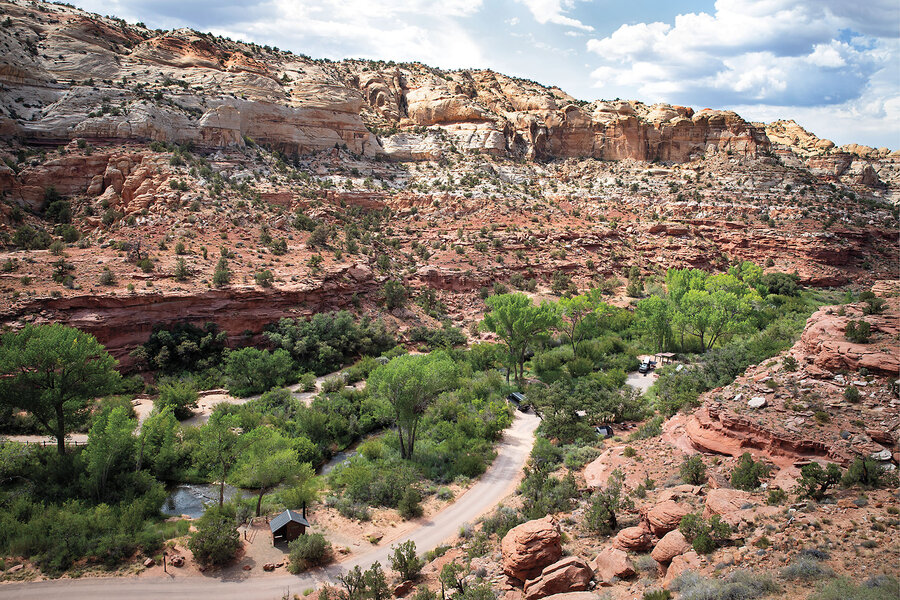
There is a 20-mile stretch of Utah’s Scenic Byway 12, from the small town of Boulder to the other small town of Escalante, where the whole world appears made of sand-colored plateaus dotted with desert brush. In the stillness, birds swoop over slot canyons. The occasional car stops on a crumbling roadside shoulder, its passengers staring into the expanse of green valleys and orange cliffs.
This area of southern Utah is as old as it is sweeping, with pottery shards and campsites still scattered about from when the Ancestral Pueblo people farmed this dry land through the 12th century. Tens of millions of years before that, dinosaurs roamed a landscape that looked utterly different: a lush hothouse whose muddy flood plains have held some of the best-preserved dinosaur fossils in the world, including at least 15 species that have been found only here. This place has taught scientists more about the end of the dinosaur era than anywhere else in the world. All of this richness, from then and now, led President Bill Clinton to sit at a wooden desk on the edge of the nearby Grand Canyon in 1996 and establish roughly 1.7 million acres of public land here as the Grand Staircase-Escalante National Monument.
But 75 million years after the dinosaurs, 900 years after the ancient farmers, and 30 years after Mr. Clinton’s designation, President Donald Trump has opened the door for possibly the greatest changes to this environment since rivers carved these canyons. In July, Mr. Trump signed orders cutting the size of Grand Staircase-Escalante and the neighboring Bears Ears National Monument by nearly 90%, removing nearly 3 million of the previously protected 3.5 million acres. While this swath of southern Utah remains public land under federal control, the loss of national-monument designation means this land will now be open to mining for coal, minerals, and uranium.
Why We Wrote This
The U.S. government is slashing two revered national monuments in Utah. What happens next could determine how vast public lands in the western U.S. are managed – or exploited.
“We’ve done something that was, I think, very desperately needed,” said Mr. Trump from behind the Resolute Desk in Washington, flanked by Utah’s smiling GOP congressional delegation and governor. “It was very unfair to the people of Utah. And now, fairness has been brought back.”
The question of “fairness” and public lands has animated the American West ever since its states were admitted to the Union, when swaths of federal land became, in many places, the price of acceptance. No state in the modern era has pushed back against this arrangement quite like Utah, whose Republican political leadership sees it as an affront to state autonomy, conservative ideals, and a vision of Wild West independence that endures today. And within Utah, no place has been more emblematic of the power of grassroots support of these places – or the power of dogged policymakers – than Grand Staircase-Escalante, which had been, until July 13, the largest national monument in the 48 contiguous United States. Now, this place – with its canyons and dinosaur bones, as well as its ATV trails and coal deposits – has become the face of not just the GOP’s fight against public lands, but also the future of how public lands could or should exist in the West.
Lands of “historic or scientific interest”
With a map several feet wide by several feet long unfolded atop the register’s counter in his outfitting shop on Escalante’s Main Street, Nate Waggoner uses his index finger to suggest a morning hike alongside the meandering Escalante River. But choose to drive down a dirt road several inches to the left on the map and, well, “You better pack some water and a sleeping bag,” he says. A few specks of rain could turn the red dirt to a hungry mud that will devour even the stoutest four-wheel drive pickup.
That’s what so many locals here, in the small towns dotting the edges of the monument, love about it: It’s unpredictable, difficult, and utterly wild. Compared with national parks, “which are a lot of groomed paths to an overlook” for an Instagram post, says Mr. Waggoner, national monuments such as Grand Staircase-Escalante take a certain kind of spirit. Visitors often check in with local outlets such as Mr. Waggoner’s Escalante Outfitters, which he opened two decades ago and has since expanded to include a popular pizza restaurant and cabin rentals.
“You turn off onto a dirt road, get out and walk for a couple of days, and then boom, you are in it,” he says. “It’s a different kind of wilderness experience.”
National parks might be what comes to mind for most Americans when they think of public land: Yosemite’s granite domes or Yellowstone’s roaming buffalo. But national parks managed by the National Park Service are only one slice of America’s roughly 640 million acres of federally owned land.

Melanie Stetson Freeman/Staff
Of the four major agencies that manage federal land – including almost half the land of the West – the Bureau of Land Management oversees the most acreage, including Grand Staircase-Escalante. The U.S. Forest Service, the Fish and Wildlife Service, and the National Park Service have their own allotments. National wildlife refuges, national forests, national monuments, and national parks all come with different rules about what’s allowed to happen within their boundaries and how they are supposed to be managed.
But of all the federal government’s land in the United States, which totals about 28% of the country’s land area, national monuments stand out to public-land opponents as the most problematic – and that’s largely because of how they are created.
In 1906, amid concerns that collectors were looting Native American artifacts, President Theodore Roosevelt signed a law that allowed presidents to unilaterally set aside public land as national monuments. The Antiquities Act, Roosevelt and other supporters said, would protect American landmarks or objects of “historic or scientific interest.” Since Roosevelt, every president (including Donald Trump) has used this power, except for three. Today, there are 168 national monuments, including marine areas.
From the beginning, opponents worried the Antiquities Act could lead to government overreach. That one person can determine the future of an area larger than the state of Delaware, with merely the stroke of a pen, feels like a personal affront to many conservatives. The national monuments in southern Utah, created or re-expanded by the three most recent Democratic presidents, stoked this debate as opponents argue these vast allotments go against the Antiquities Act’s instruction to reserve “the smallest area compatible” with protection.
“Large monuments are an abuse of the Antiquities Act, and these are two of the worst examples of that,” says Ben Burr, executive director of the BlueRibbon Coalition, a nonprofit that has challenged the legality of these monuments in court.

Melanie Stetson Freeman/Staff
That fight has been focused here in Utah for two big reasons.
For one, Grand Staircase-Escalante and Bears Ears are big. Proponents say their size allows for future and current scientific discoveries, such as the baby duck-billed dinosaur excavated at Grand Staircase-Escalante in June. Tribal nations have also long fought for the protection of these two areas of southern Utah. The entirety of Grand Staircase-Escalante is a cultural and spiritual landscape, says Autumn Gillard, coordinator for the Grand Staircase-Escalante Inter-Tribal Coalition.
The second reason is … Utah. The federal government owns almost half of the West, but it really owns Utah – about 63%, the greatest share of any state other than Nevada.
Like other Western states, Utah renounced claims to unappropriated land within its borders to join the Union in 1896, something Utah spelled out in its own state constitution. But constitution or not, Utah politicians have waged a “philosophical battle” over public lands almost ever since, says John Ruple, a law professor at the University of Utah and a former policy analyst in Gov. Jon Huntsman’s public-lands office. Experts have pointed to a number of overlapping reasons for this: the sheer amount of public land in Utah, the territoriality of longtime Utahns whose Mormon ancestors were outcast here, and the deep conservatism that controls all levels of government.
“In the West, in a place like Utah, an anti-government coalition looks at public lands because they are such a visible representation of federal power,” says James Skillen, a professor at Calvin University in Michigan who has authored several books on public land in the West. The fight against public land becomes about ideology, he says, rather than about economics or even about what local communities want.
During his first term, Mr. Trump instructed his Interior Department to review all national monuments larger than 100,000 acres. With the encouragement of Utah’s GOP leaders, he picked two to slash. He traveled to Utah in 2017 and signed orders shrinking Grand Staircase-Escalante and Bears Ears by about 50% and 85%, respectively. The Southern Utah Wilderness Alliance (SUWA) and other environmental nonprofits quickly sued. But before those cases could move forward, Joe Biden won the 2020 election, took office, and restored the monuments.

Melanie Stetson Freeman/Staff
Utah politicians, however, neither started nor ended there. In 2012, the state legislature passed the Utah Transfer of Public Lands Act to require the federal government to give the majority of federal land back to the state (it hasn’t), and in 2025, the U.S. Supreme Court declined to hear a lawsuit from Utah about the federal government’s “indefinite retention” of so much of the state’s land. Then-Rep. Jason Chaffetz proposed legislation in 2017 to sell 3.3 million acres of public land in the West but was forced to withdraw after backlash. Similarly, Sen. Mike Lee was forced last year to withdraw a federal land sell-off provision from Republicans’ tax-and-spending bill after bipartisan backlash from conservation groups and fellow Western lawmakers.
In another, quieter attempt this year, Mr. Lee and U.S. Rep. Celeste Maloy in June failed to overturn a Biden-era management plan of Grand Staircase-Escalante using a filibuster-proof move under the Congressional Review Act.
“The common denominator is Utah politicians. … They are clamoring for it,” says Steve Bloch, the SUWA’s legal director. “Utah envisions itself as the epicenter, as leading the charge against the system of federal lands.”
The economics of national monuments
When Grand Staircase-Escalante was established, it faced local pushback that mirrored elected officials’ complaints. Following Mr. Clinton’s proclamation, the southern Utah border city of Kanab flew flags at half-staff in protest, and schoolchildren released 50 black balloons as a warning to other states. Since then, however, sentiment on the ground has shifted.
Today, polls repeatedly show Utahns’ support for keeping Grand Staircase-Escalante’s and Bears Ears’ 1996 and 2016 boundaries intact. This transition from reviled to beloved is common for national monuments, many of which end up becoming national parks. Look no further than neighboring Arizona’s Grand Canyon, or the national parks near Grand Staircase-Escalante, such as Zion or Bryce Canyon.

Melanie Stetson Freeman/Staff
“The state government in Utah takes positions on these issues that are far outside the mainstream … that fly in the face of what the public wants,” says Chris Winter, executive director of the University of Colorado’s Getches-Wilkinson Center for Natural Resources, Energy, and the Environment. “Federal public lands, especially in the West, are widely popular.”
And for locals, they can be transformative. Before the monument was established, Garfield County had the state’s highest unemployment rate – around 10%, three times higher than the state average. Since 2001, the population in the Grand Staircase-Escalante region has risen by 26%, and jobs have grown by 51%.
Blake Spalding, who moved to Boulder, Utah, in 2000, now employs roughly 60 people in the town of about 230 at her Hell’s Backbone Grill & Farm. She moved here because of the monument, and over the past two-plus decades, acclaim for both it and the restaurant have grown in parallel. She has since expanded her business to include a food truck and a hotel.
“I put everything I have into this because I believe we have the ability to open hearts and minds, and to help people fall back in love with the natural world,” she says.

Melanie Stetson Freeman/Staff
When President Trump signed an order shrinking the monument during his first term, Ms. Spalding joined a lawsuit challenging the move. When she learned of the administration’s renewed effort in July, she asked her young business partner, Nina Brownell, who first started working at the restaurant in college, whether it would be better if they let this whole thing go. Ms. Brownell responded that it was more important than ever that they keep going.
“Those of us who live here live here for a reason,” says Ms. Brownell. “We care about the bees, and we care about the mountain lions, and we care about the wildflowers. There’s really this deep frustration and anger for people who live far away and know nothing about this.”
“Move-ins” versus longtime locals
Garfield County, home to Escalante, Boulder, and up until July, nearly one-third of the monument, is larger than the state of Connecticut. Neighbors live hours away from one another. This remoteness is beloved by residents and visitors – and also allows for a deep divide among those who call it home.
“What Clinton did in ’96 has steamrolled into a catastrophe,” says Leland Pollock, chair of the three-member Garfield County Commission who has lived in the area his entire life and praised Mr. Trump’s July proclamation. “Our goal is to not get into coal mines and drilling and all that nonsense,” he says. Rather, he hopes the Bureau of Land Management will now face fewer restrictions in caring for the land, and be able to take steps such as removing the juniper and pinyon pine trees that have sucked up soil moisture and made life more difficult for those with grazing permits, including himself.
And while the tourism sector has replaced the sawmill jobs that left decades ago, and which had employed a few hundred people (“Which is like 100,000 people anywhere else,” says Mr. Pollock), it doesn’t replace what was lost, he says. While the unemployment rate during the summer now hovers in the low single digits, it can reach up to 16% during the winter.

Melanie Stetson Freeman/Staff
“Move-ins love it, longtime locals hate it,” as one woman outside the Escalante Post Office summed up the monument divide. She counts herself in the “love it” camp, but declined to give her name for fear of local backlash.
Locals, however, appeared largely united in disbelief in the hours after the Oval Office signing ceremony, after listening to the reasons given by their elected officials for slashing the size of these monuments. By establishing these monuments, Presidents Clinton, Barack Obama, and Biden “locked those acres up,” said Kate McGregor, the deputy secretary of the Interior. “For nobody to use,” added President Trump. “You can’t do anything. You can’t go hunting. You can’t go fishing. You can’t do anything. You can virtually not even walk on it.”
None of that is true, as even a visitor can attest. Hiking, hunting, and fishing are all permitted. As are motorized vehicles. “You could drive on dirt roads in the national monument for the rest of your life,” says Mr. Waggoner, of Escalante Outfitters. (Mr. Burr, with the BlueRibbon Coalition, argues that the Biden administration’s management plan limited off-road vehicle use and even though “the process hadn’t completely unfolded yet,” it was coming.) And documents reviewed by the New York Times show that the Trump administration was briefed on recreational opportunities inside Bears Ears at least one month before the Oval Office event. Another regularly repeated falsehood is that the monument stripped local ranchers of their grazing rights. To the contrary, livestock grazing was grandfathered into the monument’s management by the Bureau of Land Management, which operates under a “multi-use mandate.” Grazing is permitted on more than 90% of the monument.
The fact that officials are denying the very uses that are now propping up local economies – which were struggling before the monument’s designation – worries local business owners. Morgan Sjogren, who just obtained her BLM permit to guide in Grand Staircase-Escalante, has received calls from her first clients booked for this fall, asking whether their trip is canceled.

Melanie Stetson Freeman/Staff
Ms. Brownell looks out to the foreign visitors perched at her restaurant’s picnic tables with cameras and burgers, and notes that the first thing they comment on is the accessibility of natural beauty in America.
“Please tell me who’s to benefit from this,” Ms. Brownell says of Mr. Trump’s order.
One answer to this might be the extractive industry. Documents from the first Trump administration, some made public by The New York Times, show that Utah politicians both encouraged the 2017 reductions and also structured the new monument boundaries to exclude potential energy and mineral deposits.
But many are skeptical of this explanation. There is already enough uranium mining in the West to meet America’s demand, says Professor Ruple of the University of Utah. He also points out that it doesn’t make financial sense for companies to mine for coal or drill for oil in such an unforgiving landscape, which lacks existing infrastructure such as pipelines, especially when it’s almost certain that companies will face constant litigation from monument advocates.
“If you were to find the mother lode of coal in the Grand Staircase, what are you going to do with it?” asks Professor Ruple.
Environmental advocacy groups have vowed to file lawsuits over the national monuments’ reductions, and both sides of the debate say the courts might have to finally answer whether the Antiquities Act is a one-way street, or decide that presidents are allowed to rescind (in addition to establishing) preserved land. They will have to rule if this landscape as a whole – its layered staircase of rocks and stones, its tourism, its sites that inspired Indigenous songs – is worth it.
“This one particular geologic formation that we have here, it’s amazing, and it’s the perfect example of why we have the Antiquities Act because nobody knew,” says Mr. Waggoner. “We just set it aside until somebody finds it. And that’s pretty amazing.”