Across the United States, financially strapped school districts are spending increasing amounts of money on artificial intelligence products, despite a growing body of research showing AI can harm children’s ability to think.
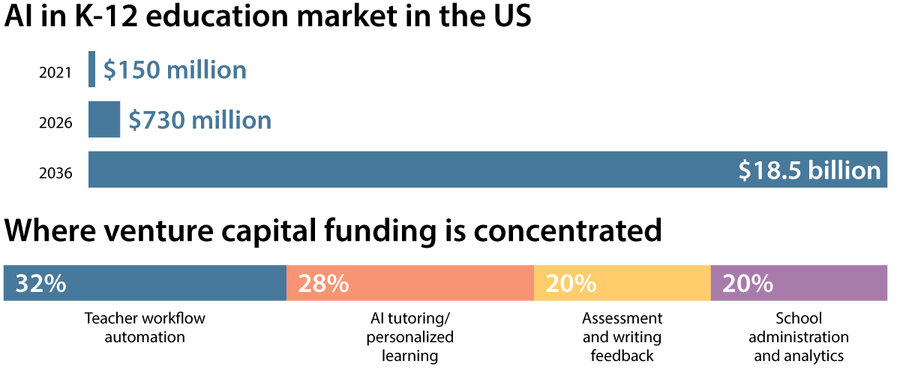
Education’s AI sector, virtually nonexistent before ChatGPT’s release in 2022, grew to $730 million in 2026, according to a report prepared for The Monitor by Future Market Insights. The research firm projects the market for AI in K-12 education will grow by 40% annually for the next decade, reaching $18.5 billion in 2036.
The beneficiaries, observers say, are a growing list of companies with names like MagicSchool, SchoolAI, and Buddy. They seek to profit from a quandary increasingly facing educators: Students and teachers are already using AI. But not always in a way that facilitates learning.
Why We Wrote This
As Silicon Valley titans and startups cash in, educators and parents struggle to decide which artificial intelligence tools help – or harm.
“My students can put a homework question into Google and the AI summary will give them the answer,” says Merek Chang, who teaches chemistry and biology at Los Altos High School in the San Gabriel Valley, outside Los Angeles.
The tech companies say their specialized AI products provide the solution. AI can help teachers write lesson plans and grade papers, saving them time, the companies say, while “personalized learning” bots cater to students’ individual needs and produce spectacular academic gains.
But without a significant body of research proving these tools’ efficacy – and some studies showing harm – a growing number of experts are worried that children have become the guinea pigs of the next Big Tech experiment.
“There has been an absolute gold rush,” says Kris Hagel, chief information officer at the Peninsula School District, outside Tacoma, Washington.
Meanwhile, frontier AI firms Anthropic and OpenAI have announced they are offering their Claude and ChatGPT products to educators for free – but only temporarily. Anthropic’s commitment to complimentary service for educators expires June 2027; OpenAI’s expires June 2028.
“They want to capture the market. We’ve seen this many times before,” says Chris Agnew, director of the Generative AI for Education Hub at Stanford University.
In an interview, OpenAI’s vice president of education, Leah Belsky, declined to speculate on whether ChatGPT would remain free for educators, but she said helping teachers is part of the company’s mission. Anthropic did not respond to multiple requests for comment.
Balancing promise with peril
According to the Center for Democracy and Technology, an estimated 85% of teachers and 86% of students already utilize generative AI in their schoolwork.
The Trump administration has pushed school districts to incorporate AI. In July 2025, the Department of Education, which Mr. Trump seeks to dismantle, issued guidance that encourages educators to “harness the potential of AI,” by utilizing “high-quality” AI instructional materials and deploying “AI-enhanced high-impact tutoring.” But the department has not set standards to help local officials vet these tools. In April 2025, Education Secretary Linda McMahon elicited cackles from the administration’s critics when she mistakenly referred to AI as “A1” in a speech at Arizona State University.
Without federal standards, more than 30 states have adopted their own guidelines. A few, including Wyoming and North Carolina, have provided districts with robust frameworks to balance the technology’s promise with its peril.
Future Market Insights analysis for the Christian Science Monitor
|
Jacob Turcotte/Staff
Part of Wyoming’s guidance is a video on the state’s Department of Education website titled “Threat Assessment.” It begins with a warning: AI is “already here,” it says, “inside the ed tech tools you’re probably already paying for,” before adding that without federal standards “this job just got harder,” because “all the responsibility for checking every single tool for safety, for privacy, for whether it even works, that now falls squarely on you.” The video then lays a laundry list of red flags – from apps that collect data on students to those that target them with advertisements to those that may harm their ability to learn.
Wyoming’s Department of Education also provides vetting tools to districts. One of them, developed by Project Unicorn, a consortium of nonprofit organizations and school associations, is a chatbot that evaluates other AI applications. Project Unicorn’s website includes its own disclaimer: “While every effort has been made to ensure accuracy and relevance, please treat all information as guidance and informational rather than final legal, technical or purchasing advice.”
The lack of clarity around the new technology has opened the door for corruption, some worry.
On June 21, Los Angeles Unified School District Superintendent Alberto Carvalho resigned after his home was raided by the FBI amid an investigation into a district contract for an AI chatbot. Two weeks later in New York, Schools Chancellor Kamar Samuels asked principals to pause purchases of AI software after New York City Council members demanded a moratorium on AI’s use in schools “until rigorous guardrails can be developed with public and expert input, to prevent serious damage to NYC children and their future.” A broader petition seeking a two-year moratorium on generative AI use in the city schools has generated thousands of signatures.
Industry’s sunny vision
In Silicon Valley, a rising cadre of founders offers a far sunnier vision of AI’s impact on education, exhibiting characteristically brash confidence while issuing bold statements about their technology’s power to uplift children and transform learning.
Among the competing startups is Bloomy, an AI learning bot developed by Alex Southmayd, a former McKinsey & Company consultant. Mr. Southmayd once recruited drivers for Lyft, the ride-hailing company. Now, he is building Bloomy at
Y Combinator, the San Francisco tech incubator that has helped launch a long list of Silicon Valley titans, including Airbnb and DoorDash.
“Why have a teacher lecture 30 students at once when each student can receive a customized lesson that’s perfect for them?” Mr. Southmayd asks. He imagines a world where students receive AI-enabled personalized instruction from his Bloomy app, gamified through the receipt of “Bloomy Bucks” for correct answers to be redeemed with a teacher.
Mr. Southmayd says he knows parents are worried about the damaging effect excessive screen time can have on their children, but he argues his app is good for kids’ development.
“Social media, as well as many ed tech platforms … erodes focus and mental resilience,” he says. “We structure the experience so that students …find satisfaction in effort, patience, and mastery rather than passive consumption.”
Mr. Southmayd says pilot results – mostly in charter schools – show his app improves student performance in both writing and math. But like most of its competitors, Bloomy’s performance has not been subject to randomized, controlled trials that compare it to regular school instruction.
According to Stanford’s Mr. Agnew, the effectiveness of “personalized learning” chatbots has yet to be independently established by researchers. Very few rigorous studies have even been conducted, he says.
“I have not seen anything that shows we can replace the human teacher, nor should we,” he adds.
Indeed, Mr. Agnew’s center at Stanford has documented a performance cliff borne of intellectual outsourcing to AI. While students using unrestricted AI show immediate performance improvement while using AI agents, their performance plummets once the tool is removed.
Education experts say this is in line with what we’re learning about the impact of AI use among adults. In February, a team of researchers from the University of Pennsylvania’s Wharton School of Business published a study that found use of artificial intelligence was “reshaping human reasoning” and leading to “cognitive surrender.” The study involved 1,300 participants and 10,000 trials.
Robbie Torney, head of Digital and AI Assessments for the nonprofit Common Sense Media, says school districts should remember the fundamentals of what’s known to work in education: “A sense of belonging, connection to a teacher, and connection to community, which motivate students to learn.”
Mr. Southmayd counters that his company does not seek to replace teachers but wants to free them up for more one-on-one instruction. “I don’t know any teacher who feels they have too much time,” he says.
No firm is better positioned to benefit from the growth of AI in education than Google, which has gifted millions of Chromebook laptops to children and whose software suite, Google Classroom, is already used by most school districts.
With minimal fanfare, Google has integrated its Gemini and NotebookLM AI tools into the Google Classroom suite. Consumer testing of Gemini by the nonprofit group Common Sense Media, however, found the version of Gemini being made available to schools has “the same safety problems as the consumer version.” The group rated Gemini for schools “high risk.”
Among other things, Common Sense Media found Gemini’s K-12 chatbot treats a sixth grader the same as a high school senior, “providing identical responses despite vast developmental differences” and “can surface inappropriate content.” Gemini also allows students to seamlessly switch back-and-forth between the school version, which is designed to teach, and the consumer version, which will simply give them the answer.
Google declined a request to comment on Common Sense Media findings and did not respond to the substance of eight questions posed by the Monitor. Instead, company spokesperson Maggie Shiels replied with a statement. “We know AI raises important questions,” it read. “That’s why we build with educators and experts to ensure our AI is helpful, safe by design, and grounded in pedagogy and how people actually learn. We believe technology, when used effectively with educators in the lead, unlocks student potential.”
The company added that school administrators have the power to turn Gemini off.
Uncertainty in the classroom
Mr. Agnew said early research findings have been more positive when it comes to AI’s deployment as a resource for teachers, such as assisting in the drafting of lesson plans or analyzing individual students’ needs.
“AI can reduce teacher time spent on routine tasks,” with no evidence of quality loss, according to a report his center published. AI can also be effective in streamlining administrative tasks, such as scheduling school buses, Mr. Agnew says.
At the Peninsula School District outside Tacoma, Mr. Hagel says he has developed AI assistants that help teachers take attendance, write up summaries of playground fights, and hone financial analyses.
Common Sense Media ranks these tasks as lower risk than the deployment of AI for classroom instruction, but there are concerns nonetheless. “AI can be biased,” Mr. Torney says. “They have been found to give women different salary negotiation advice than men and produce different evaluations of the same resume when only the name at the top has changed.”
Mr. Torney says his organization has found similar discrepancies when using AI to grade school assignments. When the AI chatbot grades the same paper hundreds of times, it does not always provide the same grade. The result can also be different depending on the race and gender most commonly associated with the name at the top.
Classroom teachers are often left to navigate this themselves. Mr. Chang told the Monitor there has been no mandatory professional development AI training for teachers in his district.
He says his focus has been on building “AI literacy” to help his students better understand how the technology works.
In a recent chemistry class, he asked his students – 90 % of whom are Latino and 80% of whom qualify for free or reduced-price lunch – to pick a substance of their choice and investigate its molecular structure. One picked the styling product pomade: “What is the molecular structure of pomade that it allows you to keep your hair up?” he asked a bot.
Together, they work through questions about double bonds and single bonds – chemistry concepts they were learning in class – and how that might work in the real world.
“Typically the way they use AI, it’s like a Google search, you type in your question and you get some kind of output,” Mr. Chang says. “This way you have to define what your input is and get information from a verified source. So we have to understand what a trustworthy source is and get in that mindset.”
“I can’t imagine the future of AI and what it might look like,” Mr. Chang says, “but as a teacher I can’t ignore it.”